
|
Sitka National Historical Park has the distinction of being the oldest federally designated park in Alaska. It was designated as a park by President Benjamin Harrison on June 21, 1890. The park has been known officially by several different names, including Sitka Park, Government Park, Indian River Park, Sitka National Monument, and Sitka National Historical Park. It is just as often referred to by its unofficial names, Lovers' Lane or Totem Park. The park followed a somewhat unusual path to its designation as a national park unit. By the late 1800s, the mouth of the Indian River already had a long history as a cherished but informally maintained community park. The importance of the park to the community was not overlooked by a panel of three local commissioners appointed to identify lands that should be set aside for public use. In 1890, along with more utilitarian lands reserved for military, transportation, school, and government use, the commissioners recommended that Sitka's favorite recreation spot be set aside as a federal public park. President Benjamin Harrison approved the recommendation by proclamation later that year. Shortly after 1900, a group of influential Sitkans concerned about vandalism and the overall lack of care for the park started a movement to have it declared a national monument. The campaign was successful, and the designation was approved on March 23, 1910. The map on the right accompanied the 1910 Presidential proclamation setting aside Indian River Park as a national monument. Along with its new status, the monument acquired a formal statement recognizing the park's historical past. The proclamation cited the need to commemorate and preserve the site of the Russian-Tlingit battle of 1804, along with a newly installed collection of historic totem poles. With the creation of the National Park Service in 1916, the monument was brought under the new agency's care, but no significant appropriation was made until 1921. 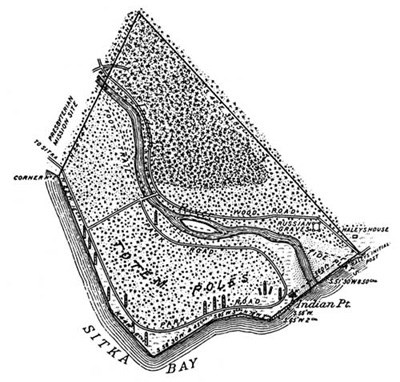
The 1930s brought an increase in planning efforts, but the park was still managed from a distance and functioned more like a community park than a unit of the National Park Service. Through the 1960s, administration of the monument was either combined with Glacier Bay National Monument or was under the purview of the Superintendent of MT. McKinley National Park. The 1940s began with the arrival of Ben Miller, the park's first full time resident custodian. The park, like the rest of Sitka, felt the effects of the World War II buildup. Evacuation of nonmilitary personnel and disruptions to civilian travel greatly limited visitation. The park was transferred into military hands during 1942 and was briefly occupied for defense purposes. It was formally returned to the Department of Interior in 1947. More significantly, a series of massive military construction projects triggered the removal of massive amounts of gravel from the park's river, shoreline, and estuary. Environmental impacts from the gravel removal proved to be a major resource issue for decades to come. 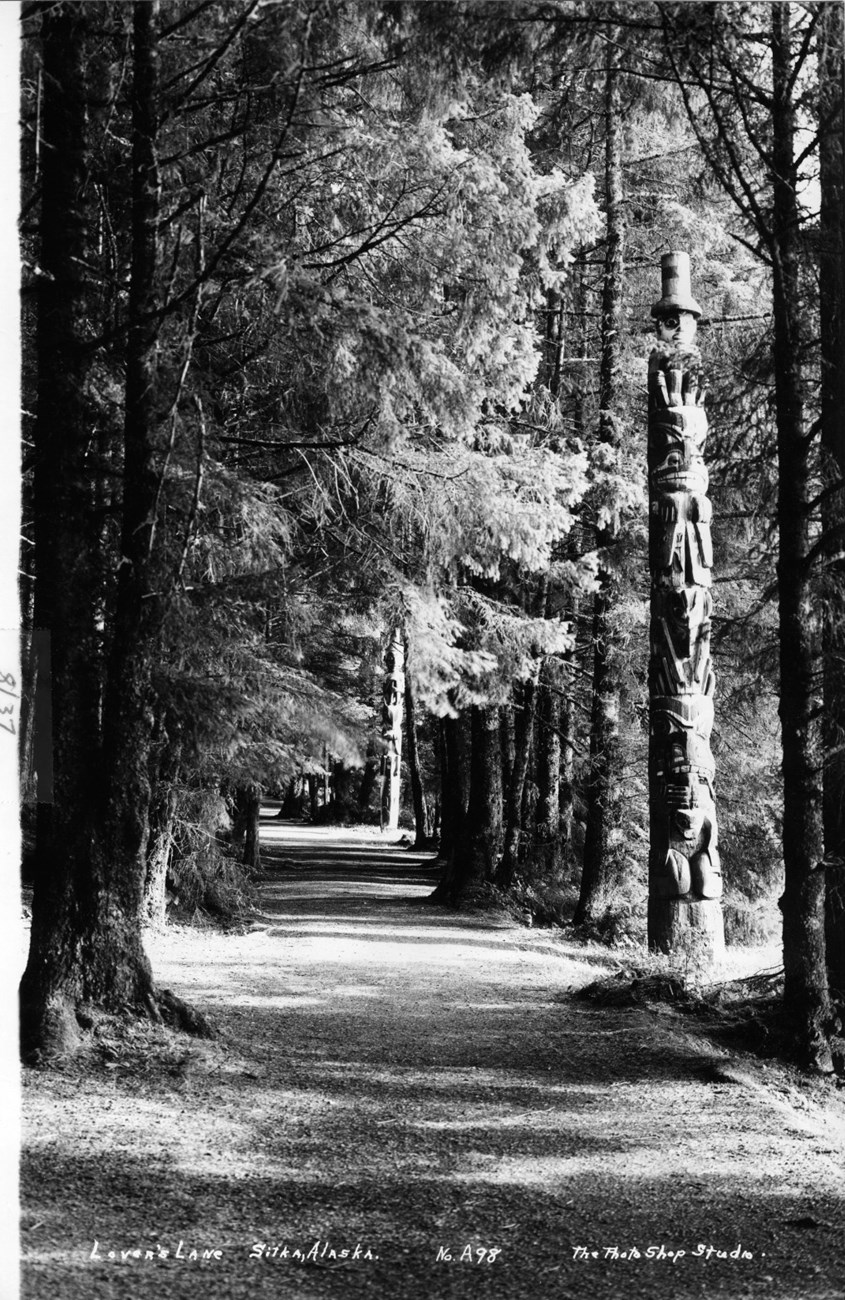
In 1965, a new visitor center, the park's first real visitor facility, was completed. It provided room for exhibits and demonstrations of Alaska Native arts and crafts. In 1969, in an agreement that was groundbreaking at the time, the Alaska Native Brotherhood assumed control of the demonstration program and established its focus on Southeast Alaska Native cultural arts. Known today as the Southeast Alaska Indian Cultural Center, this successful program celebrated its 30th anniversary in January 2000. Another aspect of the park facility that was clearly ahead of its time was its display of remarkable Tlingit artifacts. Many of the objects in the collection were loaned or donated by local clans under agreements designed to insure ongoing traditional use. In 1972, the monument's name was changed to Sitka National Historical Park, and its boundaries expanded to include the Russian Bishop's House, a national historic landmark. Acquisition of the house brought more emphasis to the Russian American focus of the park and involved the park in a lengthy restoration project. |
 |
|
Last updated: December 9, 2017