
• Giant Sequoia Trees

    Sequoia & Kings Canyon

    National Parks California

There are park alerts in effect.
show Alerts »
  • Changes to Some Opening/Closing Dates for Services and Facilities – Check Back for Updates

    Some of the opening/closing dates for facilities and visitor services in the parks have changed due to weather and/or other circumstances. See link for details and match to locations on the park map (under "Park Tools," bottom left, this page). More »

  • Road Construction Delays (if Entering/Exiting Hwy. 198)

    Expect minimal construction delays on main road through parks (Generals Hwy) through June 2013 on weekdays generally from 7 a.m.-6 p.m. See link for schedule. Call for 24-hour road conditions info: 559-565-3341 (press 1, 1, 1). More »

  • Vehicle Length Limits Have Changed in Sequoia NP (if Entering/Exiting Hwy 198)

    Planning to see the "Big Trees" in Sequoia National Park? If you enter/exit via Hwy. 198, please pay close attention to new vehicle length advisories for your safety and the safety of others. More »

  • You May Have Trouble Calling Us. Use the "Contact Us" Link (Bottom Left) to Send an E-mail.

    We are experiencing technical problems receiving some incoming phone calls at the parks. We apologize for the inconvenience. Please keep trying to reach us or check this website for frequently-asked questions. The search box (top, right) may be helpful.

  • Prescribed Fires Planned at Ash Mountain/Sequoia National Park (Parks' South Entrance)

    Fire crews will be working on hazard fuel reduction project at Ash Mountain (south entrance) starting May 23. There are nine small burn segments near the south entrance. The fire may be visible from the road and will produce smoke for very short periods.

Birds

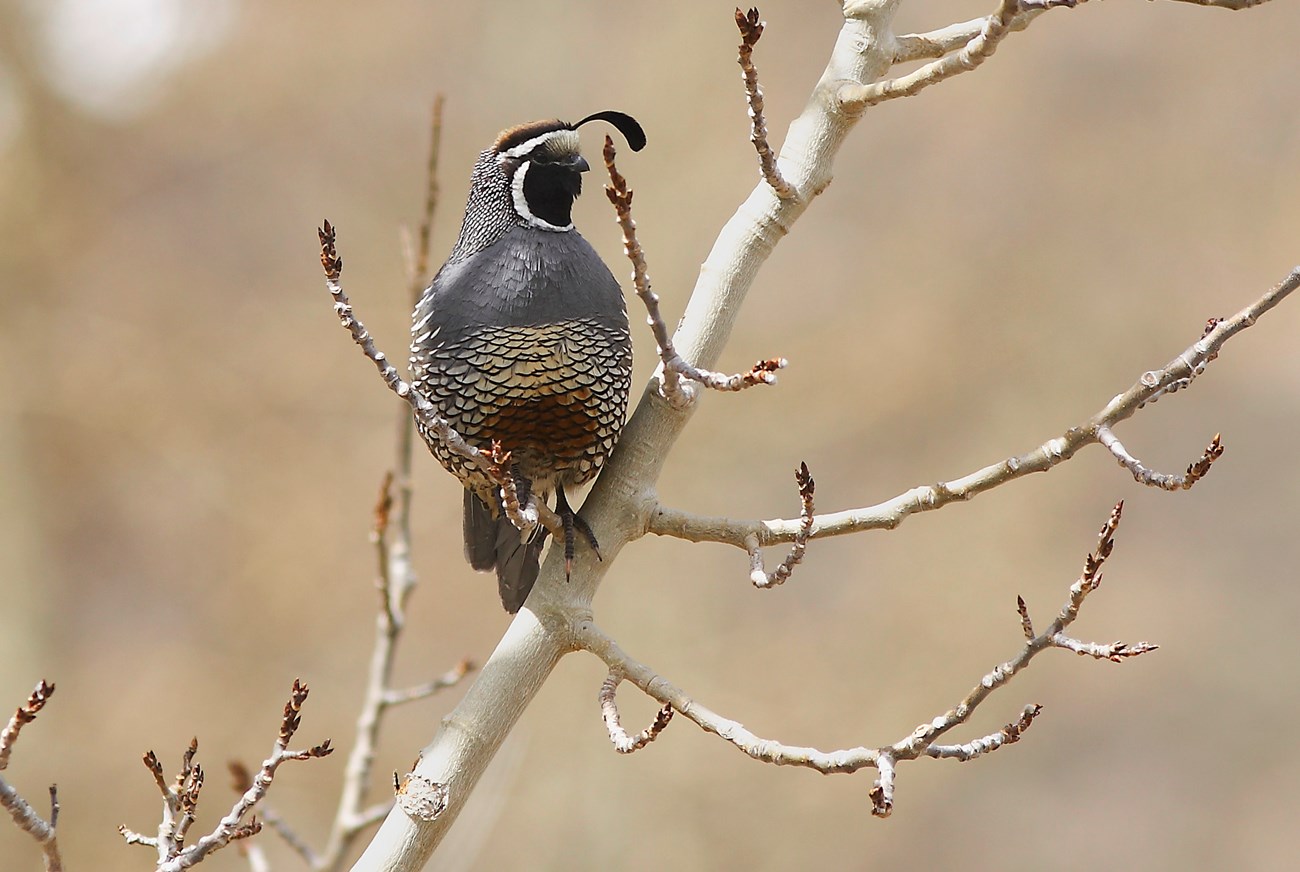
Sequoia and Kings Canyon National Parks' 863,741 acres provide habitat for over 200 species of birds, including many neotropical migrants. Park biologists monitor birds to obtain more information about individual species and also because they are indicator species of local and regional change for the larger ecosystem. Documented effects of DDT on peregrine falcons and brown-headed cowbird nest parasitism on songbirds have alerted us to the dangers of pesticides and over-development. In the Sierra Nevada, these factors are implicated in the precipitous decline of the willow flycatcher.
 
Oriole perches on a twig

Male Bullock’s Orioles stand out like living embers in the green foliage of Sierran trees. These birds are fairly common in the foothill woodlands throughout the spring and summer.

NPS Photo

Several monitoring programs are currently underway. Park staff record peregrine falcon activity on an annual basis, the Sequoia National Forest conducts annual California spotted owl surveys both adjacent to and within park boundaries, and in 2000, wildlife biologists coordinated the first annual SEKI Christmas Bird Count. In 1991 and 1992, the Institute for Bird Populations (IBP) operated two MAPS (Monitoring Avian Productivity and Survivorship) bird-banding stations in Kings Canyon. The parks have recently received funding to reestablish these stations. Park staff are seeking funds for a needed park-wide bird distribution and abundance survey. In 2000, the IBP completed an assessment of backcountry meadows in the parks to recommend which ones should be designated Important Bird Areas. In 1995 and 1996, baseline data were collected on brown-headed cowbirds - an obligatory nest parasite which drastically reduced the nesting success of host species and their numbers will be monitored in the future.

Sightings

In 2000, we recorded two rare sightings, a gyrfalcon and a great gray owl.

Did You Know?

Mineral King.

The Mineral King area of Sequoia National Park contains one of the finest examples of alpine karst topography in the United States. More than 30 caves, 15 springs, dozens of sinkholes, blind valleys, and sinking streams occur in this area.