National Park Service
2035 E. Paul Dirac Drive
Johnson Building, Suite 120
Tallahassee, Florida 32310 phone (850) 580-3011
fax (850) 580-2884 Webmaster: John Jameson
john_jameson@nps.gov

Winner of the National Park Service Keeper of
the Light Award
Technical Assistance Program
[ Partnerships, Education, and Outreach Activities link]
Many Federal agencies have developed their own
cultural resources programs with staffs of one or more archeologists
and historians. Under normal circumstances, these agencies are able
to fulfill their Public Law 93-291 responsibilities with this in-house
capability. Other agencies, such as the U.S. General Services Administration
(GSA), have no cultural resources staffs and are thus unable to adequately
undertake and administer cultural resource projects in-house. In such
situations, these agencies may obtain assistance from the Secretary
of the Interior through an agreement providing for the funding of the
actual data recovery program and the technical and administrative costs
required to develop and administer the program.
The Secretary of the Interior also has responsibilities
to assist other Federal agencies in compliance with Executive Order 11593
(Protection and Enhancement of the Cultural Environment). Such assistance
ranges from consultation via a telephone call through the conducting of
cultural resources surveys and evaluations to direct assistance in fulfilling
an agency's compliance responsibilities with the Advisory Council on Historic
Preservation's Procedures for the Protection of Historic and Cultural Properties
(36 CFR Part 800). Technical and administrative costs are reimbursed by
the agency requesting assistance.
T he Secretary of the Interior's cultural resources
responsibilities are fulfilled through professional staffs in the regional
offices of the National Park Service. TAP is responsible for programs
in Alabama, Arkansas, Florida, Georgia, Kentucky, Louisiana, Mississippi,
North Carolina, Puerto Rico, South Carolina, Tennessee, and the U.S.
Virgin Islands. In coordination with other Regional offices, TAP has
also supervised projects in California, Washington, Arizona, Texas,
Wyoming, Pennsylvania, and New York. Cultural resources investigations
are conducted via contracts with qualified firms and institutions. Procurement
is competitive in compliance with the Federal Acquisition Regulation,
and contract awards are made on the basis of the best technical proposal
obtained through negotiation. Contracts are firm fixed price.
When an agency requests cultural resources assistance, a memorandum of agreement is usually developed between the agency and the Southeast Archeological Center. This agreement defines the roles of the two parties and the terms of TAP's participation. This participation is on a cost reimbursable basis. Reimbursement for noncontractual services is on an actual cost basis plus a maximum of 20 percent of the total actual costs as administrative overhead. These technical services include the preparation of scopes of work for cultural resources investigations, compliance documents and mitigation plans, monitoring of field projects contracted by other agencies, and procurement costs prior to the award of a contract. Actual costs for these services includes salaries, travel, supplies, etc. Reimbursement for contractual services include the cost of the contract plus a maximum of 20 percent of that cost for administrative overhead. Salaries, travel and other costs involved in the administration of the contract are drawn from the administrative overhead. Assistance is provided as staffing and workload permit.
Partnerships, Education, and Outreach
National and Regional Cooperative Agreements
TAP maintains a wide variety of cooperative relationships,
with federal and state agencies, ranging in scope from regulatory
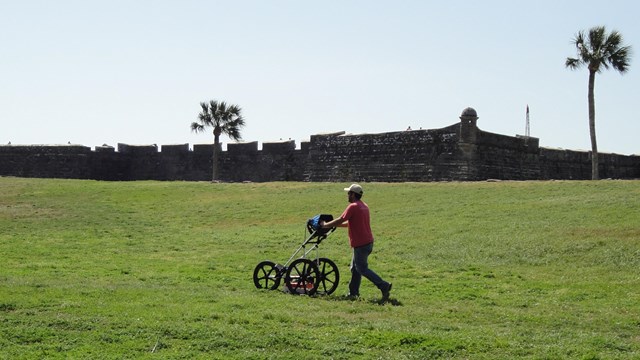
compliance assistance, archeological site stabilization,
CRM planning, and public education and outreach.
The Division has been designated by the Washington office of NPS as
the nationwide point of contact for cooperative agreements with bureaus
and installations in the Department of Defense, the General Services
Administration, and other federal and state agencies. A cooperative
agreement with the University of Mississippi has established the National
Clearinghouse on Archeological Stabilization, with numerous protection/stabilization
projects carried out in national parks and military installations throughout
the United States. A cooperative agreement with the University of South
Carolina has helped TAP to carry out archeological studies, planning
overviews, and public outreach projects in the Southeast.
Education and Outreach
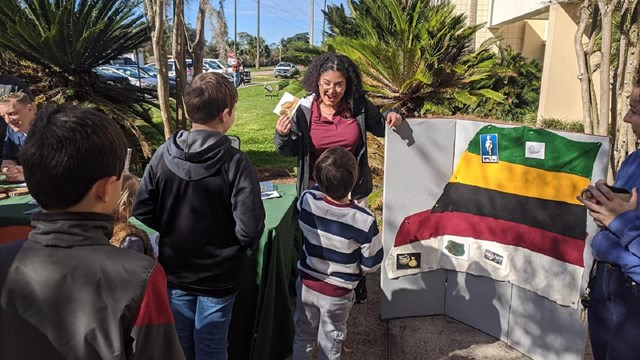
Another major area of interagency technical assistance
has involved public interpretation, education,
and outreach, where Center personnel provide unique expertise within
NPS. TAP is an active participant in an interagency effort to conduct
historic overviews, write popular histories,
and develop regionally specific teacher lesson plans in South Carolina
and Georgia. The Division currently administers indefinite quantity
contracts for the writing and editing of popular
histories, posters, public
education plans, brochures, and producung
original interpretive art work. Working with state agencies, TAP has
assisted and produced public
education posters in Louisiana, Tennessee, South Carolina, North
Carolina, Georgia, Florida, and the Lower Mississippi
Delta. Examples of other assistance projects include contracting
to build a public interpretation/ stabilization exhibit at Warren AFB,
Wyoming, and, working with GSA, U.S. Geological Survey, and the U.S.
Court of Appeals, Ninth Circuit, the design of permanent museum displays
in the San Francisco Bay area, California.
TAP's Public Interpretation Initiative is a long-term interagency program of coordinated training opportunites, workshops, publications, organization of professional symposia, interpretive arts projects, and national and international standards development that helps to accomplish federal mandates for the preservation of archeological sites and historic sites, emphasizing public education and participation as well as interagency information exchange. The Initiative also helps to accomplish Section 110 of the Archeological Resources Protection Act (ARPA) that requires each Federal land manager to "establish a program to increase public awareness of the significance of the archeological resources located on public lands and Indian lands and the need to protect such resources." With the NPS' Mather and Albright training centers, TAP coordinates interdisciplinary training courses and workshops designed to provide the "basic tools" necessary for program managers, interpreters, educators, and archeologists in developing effective presentations at the park or site level that meet federal standards and agency missions.
Other Cooperative Efforts
TAP and the Southeast Archeological Center carry out
internally or administer contracts for various archeological
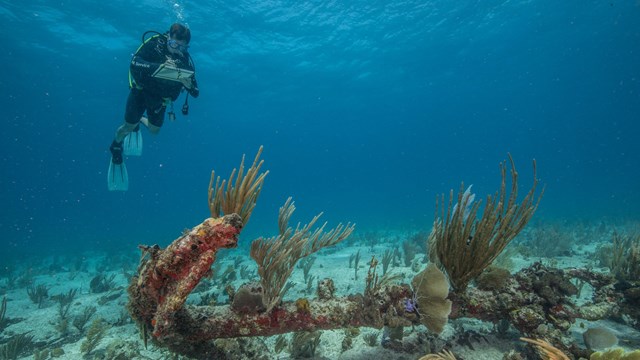
and historical studies, site stabilization
projects, and public education projects.
Funding for these efforts has been supplied through reimbursable accounts
established with GSA (California, Arizona, and Texas); the U.S. Army
(Fort Bragg, NC; Fort Benning, GA; Fort Polk, LA; Fort Stewart, GA;
and elsewhere); and the U.S. Air Force (Warren AFB, WY; Eglin AFB, FL;
and elsewhere).
Legislative Authority
The Technical Assistance and Partnerships (TAP)
interagency assistance program was established in 1975 to better meet the
Secretary of the Interior's increased responsibilities under the Archeological
and Historical Preservation act of 1974 (Public Law 93-291) which amended
the Reservoir Salvage Act of 1960. The latter act provided for the recovery
of archeological data to be damaged or destroyed by the construction of
dams and other water control structures. The 1974 amendment provides for
the recovery, protection, and preservation of cultural resources data to
be adversely affected not only by dam construction but by all federally
financed or licensed activities that will affect significant cultural resources.
Funding Sources Two sources of funding are provided by Public Law 93-291. In federally financed undertakings, the law permits the use of up to one percent of the total amount authorized for the project to be used for the recovery, protection, and preservation, of significant data. In those instances where a Federal license or permit but no funding is involved, funds are appropriated to the Secretary of the Interior for data recovery. The law further provides that in federally financed projects that will adversely affect significant cultural resources, the funding agency may conduct the data recovery program or it may request that the Secretary of the Interior undertake the program. In the latter instance, the agency must transfer to the Secretary funds sufficient to complete the program or the one percent maximum, whichever is lower.
For more information about TAP, contact John Jameson at john_jameson@nps.gov or (850) 580-3011 x243.