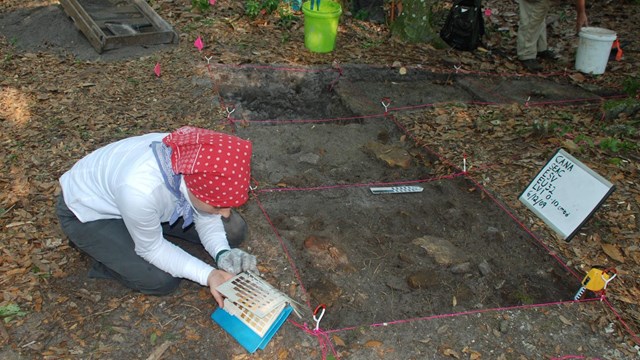
Archeology of the Post
Civil War Era
Following the Civil War, Union General Gillmore returned
to Fort Pulaski to modernize it for protection against the rifled cannons
he had once used to bring it down. Most of the
changes
occurred in the demilune outside the main fort, with planned changes
for the main fort being abandoned. Investigations in the demilune, which
was overgrown with vegetation until recently, could provide further
insight into modern fortification theory and construction method. The
fort ceased being a military installation in 1880, and the only inhabitants
of the island were the lighthouse keepers and their families. Following
the major hurricanes of 1881 and 1893, the lighthouse keeper's house
was
moved
to an area on top of the terreplein of Fort Pulaski. The daily lives
of those individuals who worked on these modifications could also be
better understood through thorough archeological investigation. The
terreplein was rebuilt during the 1930's restoration and reconstruction
efforts by the Civilian Conservation Corps, so would yield little information
about the two-story lighthouse keeper's house built upon it.
In the southern part of what is now Fort Pulaski National
Monument there was more activity. This was due to the construction of
the Savannah and Atlantic Railroad in 1887, which connected Savannah
to the booming resort area of Tybee Island. The railroad passed through
monument property, and extended east across Lazaretto Creek. The path
of the railway was turned into a historic and scenic trail extending
through McQueen's Island in 1991 (Click here for a Map
showing the path of the trail across McQueen's Island - 40 KB).
Investigations in and around this historic trail could yield further
information on rail line construction methods, although the area may
be so disturbed by modern activity that research possibilities may be
somewhat limited.
The
study of other sites such as Battery Horace Hambright, which was constructed
in 1895, is also important in gaining a complete understanding of Fort
Pulaski National Monument. The battery is a good example of defense
emplacements built during the end of the 19th century. It sits in stark
contrast to earlier batteries, such as those built by Union General
Gillmore in his attack on Fort Pulaski. The concrete and steel construction
added a new level of durability, especially against weapons that could
shoot farther with more accuracy than ever before. Archeological work
done around this battery could possibly yield more information about
the lives of the military personnel that manned it.
While the potential for archeological research concerning
post-Civil War occupations of the Fort Pulaski area are not as great
as previous periods, there is still a significant amount of knowledge
to be gained. Investigations at the cemetery relate to both Civil War
and post-Civil War research questions. This is due to the fact that
many of the remaining burials in the cemetery were added after the end
of the civil war, and therefore they reflect both the post-war military
and civilian occupation of Cockspur Island.
All known archeological sites that postdate the Civil
War at Fort Pulaski National Monument are related to government agencies.
As such, documentation regarding the location of sites and the dates
that sites were occupied, is a matter of public record. Archeological
investigations of the sites are appropriate, however, to determine land
use changes and provide information regarding the human experience relating
to the occupation of these sites. Proposed areas of interest should
have historic and ethnographic studies completed prior to excavations
to ensure maximum data recovery. In particular, the Hunter/Pulaski Crash
Boat Dock Annex and U.S. Navy refuse area have the potential to yield
significant archeological data to help interpret the lifeways of military
personnel prior to and during World War II (Click for a map of the US
Naval Base in 1945 - 71 KB). There is also a distinct possibility
that the area was used prior to World War II by the US Quarantine Station
(Click for a map of the Quarantine Station
in 1939 - 44 KB). The potential to gain insight into the types of
diseases treated at the US Quarantine Station, the medical procedures
used during treatment, and the evolution of medical technology are worthy
of consideration. Similarly, biocultural questions regarding health
and disease may also be answered through archeological evidence obtained
from the Navy refuse area.*
*Paragraph excerpted from Lou Groh's
2000 report, Fort Pulaski National Monument: Archeological Overview
and Assessment, from "Chapter 7: Recommendations for Future
Archeological Research", pages 96-97. Published by the Southeast
Archeological Center of the National Park Service, Tallahassee, Florida.
Creation
of a New National Monument
Table
of Contents