JOHN H. JAMESON. JR.
What This Book Is About
It is likely that the waning years of the 20th century will be identified
in the history of archaeology as a time when the profession, as a whole,
came to the realization that it could no longer afford to be detached from
the mechanisms and programs that attempt to communicate archaeological
information to the lay public. In the face of an increasing public interest
and demand for information, archaeologists are collaborating with historians,
museum curators, exhibit designers, and other cultural resource specialists
to devise the best strategies for translating an explosion of archaeological
information for the public. The 1980s and 1990s have seen a great proliferation
of efforts to meet this demand, with varying degrees of success. While
many innovative interpretive programs have been created, little has been
written about them.
This book is part of the
Public Interpretation Initiative (Jameson 1994a), a public outreach program
initiated and coordinated since 1990 by the Southeast Archaeological Center's
Technical Assistance and Partnerships Division (formerly the Interagency
Archaeological Services Division). The Initiative programs are designed
to foster an exchange of ideas between archaeologists and education professionals
who are striving for a more holistic approach to the public interpretation
of archaeological information. The program's activities have included the
organization and coordination of academic symposia, workshops, and training
sessions presented in a variety of national and international forums. The
articles in this volume were generated by these sessions or from follow-up
discussions. With the exception of some notable contributions from Stone
and Molyneaux's
The Presented Past, published in 1994 (Stone, this
volume), comparatively little has been published on the subject of public
interpretation.
The purpose of putting together
this volume was to begin to fill this void in the literature by providing
some philosophical background and examples of approaches and programs that
have worked. Although the case studies described here are examples of successful
strategies, some include warnings of pitfalls to avoid. While the models
presented in this volume are worthy of replication, they also provide some
useful guidelines against reinventing the wheel.
What Is Public Interpretation?
The articles in this book can be grouped under a developing specialty
in archaeology that can be termed the "public interpretation" of archaeological
information (Jameson 1994a). As used here, public interpretation includes
a broad scope of endeavors ranging from formal education and curriculum
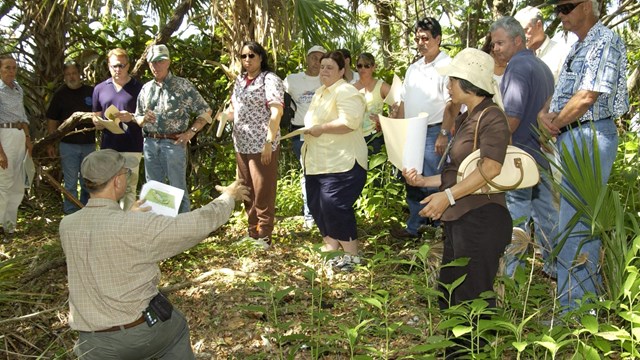
development to less structured programs such as site tours and museum displays.
The term also encompasses singular communicative devices such as the publication
of popular histories, public awareness posters and brochures, and development
of multimedia presentations including the fast emerging Internet sources
and World Wide Web sites of modern cyberspace. It embraces outreach programs
and other systematic attempts to provide educational and awareness services
beyond conventional boundaries.
Public interpretation involves
the development of communication strategies between the technical scientist-archaeologist
and nonspecialists such as park interpreters, whose job is to deliver the
"message" of archaeology to a variety of public audiences. The specialists
and professionals who carry out these programs include archaeologists,
historians, on-site interpreters, teachers, writers, artists, curators,
exhibit designers, and other cultural resource specialists. They are often
assisted by trained volunteers who help alleviate the inescapable shortages
of staff power and resources needed to carry out successful programs. When
resources allow, programs are most effective when these specialists form
interdisciplinary teams for design and implementation (Honerkamp and Zierden,
this volume).
Although closely tied philosophically,
public interpretation differs in its scope from more technical discussions
of interpretation of academics in that it has as its focus the translation
and simultaneous communication of archaeological information and concepts
to a wide array of audiences that comprise the general public. This is
not to say that many research-oriented archaeologists do not engage in
public interpretation of their data, as Stanley South and others aptly
demonstrate in this volume. The differences between technical or academic
versus public interpretation can be explained in terms of intended audience.
When scholars such as Ian Hodder (1991c; Hodder et al. 1994) discuss the
current approaches to archaeological interpretation, their primary intended
audience is other archaeologists and social scientists. While their observations
and conclusions are useful in debating the intellectual issues of the interpretation
of observed phenomena in archaeology, rarely do they encompass the issues
of effectively conveying archaeological information to public audiences.
Nor do they include concerns about engaging, entertaining, and informing
in an ethically sensitive manner-issues that are among the central themes
of public interpretation (Jameson 1994a; 1995).
In today's increasingly
multicultural and technological world, archaeologists working in tandem
with professional interpreters and exhibit designers are challenged to
make archaeologically generated insights more accessible to the public.
They do this by empowering members of the public to participate in the
critical evaluations of historical and archaeological interpretations that
are presented to them and helping them to understand how and why the past
is relevant to the present (Jameson 1994b; Davis and Hoffman, both in this
volume).
The Importance of Educating the Public
It has been 30 years since the passage of the National Historic Preservation
Act of 1966, the key legislation that began a surge of federally mandated
archaeological and historical studies in the United States. Since passage
of the Act, hundreds of thousands of professional reports have recorded
millions of archaeological and historical sites containing hundreds of
millions of cultural objects. Yet, in most areas, we are just beginning
to sample and record the evidences of the rich archaeological and historical
heritage left behind by our cultural forebears. The continuing flow of
information and the evolution of field methodologies and standards have
sharpened our ability to focus on the important aspects of this heritage.
In fact, we often cite these success stories as the principal arguments
and justification for continually building and adding to this already vast
database. But, despite the promises and predictions of 30 years ago, what
has the public, who has footed most of the bill in terms of tax dollars
spent on these studies, appreciably gained?
In our enthusiasm to enforce
the 1966 Act and a bevy of other protection laws, have we lost sight of
the ultimate purpose and raison d'être of the compliance process,
which is to provide public enjoyment and appreciation for the rich diversity
of past human experiences? I believe that we need to reevaluate how we
carry out the letter and spirit of these laws that recognize the reality,
as expressed in the 1966 Act, that: "the spirit and direction of the nation
are founded upon and reflected in its historic heritage"; that this heritage
should be "preserved as a living part of our community life.in order to
give a sense of orientation to the American people"; and that federal agencies
are required to take the lead in establishing programs for the protection
of significant historic resources "for the inspiration and benefit of the
people.." (Jameson 1994b).
The spirit of these legal
mandates requires us to ensure that archaeological information is provided
to the public in an informative manner. While most people do not have the
necessary knowledge or training to evaluate the results of archaeological
research directly, they can and should be given this information in an
accurate, "de-jargonized," and entertaining manner. When research is not
adequately made meaningful to the nonspecialist, it is ultimately an empty
endeavor.
As pointed out by Karen
Lee Davis and others in this volume, we also need to foster a dialogue
with the public that distinguishes between the goals and objectives of
public interpretation and those of pure research. Just as archaeological
methodology is guided by well-defined research goals, public interpretation
must be guided by an understanding of what it focuses on, and to whom it
is directed. The ultimate relevance of public interpretation and outreach
programs lies in the ethical responsibility among professional archaeologists
to make the past accessible and to empower people to participate in a critical
evaluation of the pasts that are presented to them (see Davis, this volume).
We achieve success when we recognize and practice this ethical imperative.
Public interpretation of
archaeological research is essential if we are to provide increased access
to and input about the past. While only a relatively small percentage of
practicing archaeologists are involved in researching the past, there is
no reason why the public cannot participate in this process through a critical
evaluation of the interpretations that are presented to them. To do this
we must provide the public with opportunities to participate as well as
to develop evaluation skills. As we prepare for the 21st century, we must
summon ourselves to reach out to the people and involve them in the rich
diversity of their national and ethnic experience. The challenge is to
bring the fascinating subject of archaeology into focus. To do that, we
must learn and instruct ourselves in the most effective public interpretation
and outreach methods (Jameson 1994a, 1994b; and in this volume, Davis,
Hoffman, Yamin, and Honerkamp and Zierden).
Organization and Topical Focus of This Volume
We have organized this volume into four parts, ranging from more broad,
philosophical discussions, to more specific case studies. Part I contains
general concepts that should be relevant to all settings in the public
interpretation of archaeology. While contributing additional philosophical
backdrop, the subject matter in Part II is more focused and contains descriptions
of proven strategies of broad application. The articles in Part III concentrate
on programs and strategies applied to urban settings, and Part IV includes
detailed descriptions of successful programs and how they were carried
out.
In "Part I: Background,"
four authors discuss broad philosophies of how information about the past,
generated through archaeology, can be presented to enable the public to
enhance its knowledge of the past, and, consequentially, its quality of
life.
Background: Archaeology and Education
In "Presenting the Past: A Framework for Discussion," Peter Stone of English Heritage introduces us to basic concepts in framing a discussion of effective public interpretation within formal and informal education venues. This article describes what he calls "the educational role of archaeology" as it has been applied around the world. One key conclusion is that archaeology is an excellent tool in training students to work more carefully and critically rather than memorizing information about a particular time period or culture, as is often the case in the formal curriculum of schools. Students learn the value of unrecorded information not found in the traditional curriculum or textbooks, and discover how archaeology can fill important gaps and even provide corrections to historical records and accounts. By seeing history as nonstatic and constructed, and therefore open to reinterpretation and coexisting divergent interpretations, students learn that "true history" is redefined and rewritten as new information becomes available. Since archaeology nearly always produces new information, conclusions about "truths" in history are only temporary, subject to reinterpretation, and never complete. Stone also cites research showing that students who study the past through archaeology rather than the traditional document-based approach retain more and enjoy their studies more.
Background: Empowering the Public to Appreciate the Past
In the second and third articles in Part I, Parker Potter and Nancy
Jo Chabot expand on another important concept mentioned by Peter Stone:
that, in the realm of public interpretation, the interests and the prejudices
of the messenger/interpreter have as much to do with the message as do
the inherent qualities of the information. Archaeologists should strive
to empower the public to be more in control of its own learning by giving
it the intellectual tools that archaeologists and historians use to interpret
sites. With these tools, people can participate in the creation of historical
knowledge and in the definition of the historical context of both themselves
and their culture. This knowledge produces a greater sense of well-being.
Potter and Chabot concentrate their discussion on the makeup of an effective
site tour, citing examples from Annapolis, Maryland, and Lochmere, New
Hampshire, respectively. They frame their discussion around varying approaches
to interpreting the "truths" about the past that exist among the visiting
public. Each tour or presentation is seen as a unique event (an artifact,
if you will) that depends on the identity and approach of the interpreter
as well as the makeup of the audience. With this approach, each presentation
can reveal multiple truths about the site that transcend mere description
of what was found in the ground.
As are several other authors
in this volume (for example, Davis, Honerkamp and Zierden, Hoffman, and
Yamin; also the reactive comments by South), Potter and Chabot are influenced
in their thinking by the philosophy of critical theory in archaeology,
which argues that when the past is interpreted and becomes history it tends
to become ideology (Leone et al. 1987). The consciousness or awareness
of that process helps those who write about or explain (interpret) the
past to realize the ideological notions that generate modern everyday life.
Interpreters realize that the meanings they impose on the past are particular
to their own cultural and social background. With this awareness, site
interpreters can help their audiences appreciate that many, if not all,
of their preconceived notions about time and space are actually part of
their own, modern, historically based ideology (Hodder 1991c:174-180; 1994:164-168).
Thus, audiences can appreciate that knowledge about the archaeologically
revealed past is useful in giving meaning to the present (Potter, this
volume).
Reacting to what he calls
"the current antiscience fad of critical theory," Stanley South provides
the last contribution to the background section of this book by discussing
the value of generalized interpretations that are "sensitively done and
based on empirical data." He warns archaeologists against going too far
in accepting the conclusions of critical theorists, posits that there are
no facts or truths in archaeology, and asserts that the past is not knowable
with any integrity (Hodder 1991c:178). If the past has no integrity, then
anyone's interpretation is as good as anyone else's. Thus, the interpretation
would be open to anyone's political or ideological whims. South offers
an analogy to some museum displays that pour too much on the visitor and
leave them bored: "You can never literally re-create a complete account
of past lifeways, but a generalized display based on empirical data, if
done properly, can fire the imagination at every turn." In pointing out
the achievements in archaeological interpretation of historical archaeologists
in America, he shows how a generalized approach to interpretation provides
a visual image that allows the visiting audience to imagine the past. It
is interesting to note that all case studies and strategies described in
this book by necessity employ elements of generalized interpretation as
South defines it, but also, when available, supply details of the site
and material culture that are corroborated by the archaeological evidence.
Strategies That Work
In "Part II: Strategies That Work," three authors describe proven strategies
of broad application in the public interpretation and teaching of archaeology.
These programs are exemplary and provide basic guidelines for success relevant
to archaeological research facilities, government agencies, managed sites,
and parks.
In explaining the successes
of the Crow Canyon Archaeological Center in Colorado, Megg Heath emphasizes
the importance of integrating the public into actual research. The maintenance
of high-quality research allows the Center's staff archaeologists to emphasize
the importance of systematic methods in research design, analysis, and
record keeping. This also allows the staff to follow and transmit ethical
standards.
Expanding on the theme of
public participation, Teresa Hoffman describes the Arizona state government's
efforts to make archaeology come alive for people. In a state where archaeology
enjoys a high public profile, pioneering programs such as Arizona Archaeology
Week and the more recently developed Archaeology Month have helped to raise
public awareness and at the same time combat vandalism.
As background to her discussion
of the special challenges at sites where fieldwork is no longer ongoing,
Karen Davis articulates many of the key concepts of public interpretation
in archaeology. With so much research funded by tax dollars or through
the Cultural Resource Management (CRM) compliance process, archaeologists
have a professional obligation to ensure that public interpretation of
newly generated archaeological information is carried out; people support
things they understand. Archaeologists should engage the general public
in dialogues about why we should care about and preserve the past; this
is essential, says Davis, to developing a supportive constituency. Archaeologists
are socially responsible not only for preserving the past but also for
making that past accessible. When active archaeological sites are not available,
indirect approaches, such as exhibitions, tours of the property, and signing,
are utilized.
Public Interpretation in Cities
Unique problems exist when public interpretation is practiced in large
metropolitan areas. In "Part III: Interpreting Archaeology in Cities,"
the authors provide three examples of perseverance in the face of formidable
political and logistical problems.
Karolyn Smardz describes
the creation and development of her unprecedented and inspirational program
that established archaeology as a formal element of the school curriculum
in Toronto. In working with young students, the goal of Smardz and staff
was to make archaeology accessible but also fun. The challenge was
to foster successful, popular, and sustainable programs with a substantially
international and multicultural audience.
In the second article of
this section, Sherene Baugher and Diana Wall describe the evolution of
three exhibits in New York City that, despite substantial legal and political
issues as well as chronic problems of maintenance and design defects, were
precedent -setting in the use of urban spaces for public interpretation.
Building on their experiences with earlier projects, they were able to
avoid certain political and logistical pitfalls that plagued previous efforts.
In an excellent example
of public interpretation resulting from CRM-driven research, Nick Honerkamp
and Martha Zierden recount the development of the Charleston Place project
in South Carolina. Their conclusions emphasize the value of interdisciplinary
cooperation in accomplishing both research and public interpretation goals.
This project offers an excellent illustration of methods in presentation
that allow the public to appreciate the value of archaeology in correcting
and revising history.
Detailed Case Studies
The last section of this book, "Part IV: Interpreting Archaeology at
Museums, Parks, and Sites," contains descriptions of on-site programs that
have achieved success and, in some instances, that have even been the victims
of this success (Whittlesey and Farrell), or that may have fallen short
of their potential (Bograd and Singleton).
Describing the world-class
interpretive center at Cahokia Mounds State Historic Site, Bill
Iseminger recounts the history of public interpretation at the prehistoric
Illinois site from 1925 to the present. The scheme of interpretation at
Cahokia has changed as public awareness and site visitation increased.
Cahokia has developed a program that attempts to engage and educate by
targeting several categories of visitors that Iseminger terms "levels of
public interest." These levels range from the professional interests of
archaeologists and anthropologists to the personal and educational interests
of tourists, students, and teachers. To avoid serving as "baby-sitters"
for school groups, Cahokia adopted an educational program that makes efficient
use of staff and well-orchestrated volunteer program. Before scheduling
school group visits, teachers must attend an orientation workshop and receive
a packet that includes pre- and post-visit activities. Native Americans
participate in the Heritage America program and several other activities
throughout the calendar year.
An exemplary case of collaboration
between scientific and native communities is the program established at
the Hatzic Rock Site, British Columbia. As authors David Pokotylo
and Gregory Brass point out, the archeologists and indigenous peoples could
have competed with each other for the authority to interpret the site,
but instead they have come together in the spirit of compromise and collaboration
in respecting each others' perspectives and philosophies. This cooperation
and the resulting alternative perspectives for the interpretation of "truth
history" at the Hatzic Rock Site show how the archaeological record can
contribute to a diversity of uses and interpretations in contemporary society.
At Sabino Canyon,
near metropolitan Tucson, Arizona, Stephanie Whittlesey and Mary Farrell
confront a problem for public interpretation common to so-called "natural
parks," where the significance of archaeology and cultural resources is
overshadowed by the splendor of the park's natural environment. To combat
this handicap, the approach at Sabino Canyon has been to "put people back
into the landscape." They do this by showing that, for the prehistoric
and indigenous peoples, the canyon was primarily a seasonal resource for
food and water. Since prehistoric groups and the historic Hohokam spent
only part of their time in the canyon, the interpretations have focused
on providing a wider perspective by placing Sabino within the context of
the local area and larger region. Thus, visitors can learn how people have
adapted in various ways to the unique conditions of the Sonoran Desert.
Barbara Heath supplies another
superior example of archaeology's filling important information gaps in
the historical record. In this case, it is the life and environment of
one of the most important "founding fathers" of the United States, Thomas
Jefferson. At Poplar Forest, Jefferson's Bedford County plantation
and retreat, archaeological information is being gathered that will shed
new light on the material world and standards of living of Jefferson, his
slaves, and his free workers. Public interpretation of this information
is carried out through a variety of media ranging from temporary exhibits,
guided tours, and lectures to written communications, including brochures
and articles. At Monticello, the Thomas Jefferson Memorial Foundation
uses all of these interpretive media, plus permanent exhibits, restored
buildings, gardens, and modern reproductions of archaeologically recovered
objects that are produced for sale in the museum shops.
An alternative perspective
is offered in the article by Mark Bograd and Theresa Singleton, who see
archaeology as a tool to help fill the information and interpretation voids
of social history: "The mission of social history," they write, "is to
render significant what has been thought incidental; to make central the
important contribution that the common person has made to America's past..The
ultimate goal of social history and good interpretation, is not simply
to add voices to mainstream history, but rather mainstream those voices
into history." If history museums espouse to be representations of America,
they "have an obligation to present a history that includes all of us."
Sites such as Monticello and Mount Vernon are seen as "interpretive
islands of black history surrounded by a sea of interpretation that neglects
the contributions of women, minorities, and the poor." At
Colonial Williamsburg,
where the line between the interpretation of history and the commercialization
of history can be blurred, the interpretation of slavery is obscured. "There
is always the fear," the authors write, "that, if we depict and discuss
slavery or present a mussed-up version of history, we may offend visitors,
who may then not want to return to visit. Underlying this fear is a presumption
that the public does not want to be challenged.they come simply for entertainment
or to have their preconceived beliefs affirmed." The reader will note that
this discussion has direct parallels to the points made by Peter Stone
(this volume) that the archaeological approach can provide a "reinterpreted"
and more complete historical record of society's disenfranchised that allows
individuals to better understand and appreciate their historical role.
Rebecca Yamin gives us a
case in point to discussions by Potter and Chabot (this volume) and others,
following the example of Mark Leone and colleagues, that "people do make
their own history and can change it by their actions in the present" (Tilley
1989:114). The experience of visitors to the Morven House excavations,
through the public interpretation programs, was that they were able to
momentarily drop their romantic vision of how things should have
been and begin to appreciate and accept the changes that had taken place
through time. Politics and public symbolism intervened, however, when orders
came that the site was to be restored to a single idealized moment in time:
the late 18th century setting of the home of Richard Stockton, signer of
the Declaration of Independence. In this case, despite the generally positive
reaction of the visiting public, the local media, reacting to political
hype, venomously attacked the project for its destruction of the pristine
18th century setting and for its attention to other historic periods. One
question can be asked from this experience: "Is the dismantling of public
symbols an appropriate role for archaeology?"
Meggett Lavin describes
the transformation of public interpretation at Drayton Hall plantation
in the aftermath of Hurricane Hugo in 1989. Prior to that year, site tours
focused on the architectural significance of the 1790s main house, the
state of preservation, and the unprecedented decision to leave the house
unrestored and unfurnished. Interpreters were often tempted by the abundance
of undocumented stories and local legends to expand on the "great planter,
great wealth" story line, inspired by the dramatic and aesthetic surroundings.
Eventually, however, the documentary, oral history, and archaeological
research projects focused on the "truth" of everyday living, information
that has created a new and much more interesting story line rooted in reality.
Archaeology's most critical contribution to Drayton Hall has been to provide
a model for examining the site as a whole and broadening interpretive thinking
beyond the "great family, great wealth" approach. The focus of present-day
interpretive programs is to help visitors understand how the architecture
of the building, in combination with archaeology and history, documents
changes in everyday life over the past three centuries. An education program
for school children is framed by the question, "How do we know what we
know?" Elements of this program include: Diaries in the Dirt, a
program that puts students in the role of archaeologists trying to piece
together the time line of events using oral history accounts, architectural
clues, documents, artifacts, and photographs of actual excavations; and
Plantation Excavation, where the students participate in a three-hour
model excavation.
Doug Scott of the National Park
Service describes another example of "a blessing in disguise" in relation
to a natural disaster that has prompted new opportunities for archaeological
research and public interpretation. Following a grasslands wildfire in
1983, the superintendent of Little Bighorn Battlefield National Monument
recognized the opportunity to investigate the newly exposed battlefield
for archaeological evidence. Since the site of the Battle of Little Bighorn
is one of the most notorious and debated battlegrounds in America, and
a popular unit of the National Park System, there was certain to be widespread
public and press attention focused on the project. As Scott points out,
with the strong public interest, the on-site interpretive program quickly
evolved from a one-person operation to a highly coordinated team effort
involving daily briefings by the archaeologists, press releases, daily
updates furnished to staff interpreters, and small group tours. These presentations
served to inform the public about the process of archaeology. The approach
taken, which met with great success, involved comparing the archaeological
investigation to a crime scene investigation.
In the final article, David
Kirkpatrick describes another example of a project that had to cope with
a subject where the "truth" is often lost in legend and myth. For over
one hundred years, Billy the Kid and the Lincoln County War (1876-79),
New Mexico Territory, have fascinated historians and the public and have
provided material for western novels and movies. Archaeological excavations
at the McSween House, site both of a famous five-day battle between
rival factions and of Billy the Kid's daring escape amid gunfire, provided
an opportunity to develop a unique public education and interpretation
program. The program focused on revising the public's perception of archaeology
and archaeologists, the reality versus the myth of Billy the Kid and the
Lincoln County War. Site tours, museum displays, active excavations, and
a well-organized volunteer program all provided opportunities for better
interpretation that resulted in increased public awareness about the role
of archaeology in enhancing everyday life.