Chapter 5
METAL-DETECTED ARTIFACTS:
DESCRIPTION AND ANALYSIS

The metal detector investigations at Monroe's Crossroads yielded a wide variety of artifacts Some specimens can definitely be attributed to the battle, while many are related to the post-battle era and some to structures that occupied the site (Figure 33). These latter artifacts represent items lost or discarded by occupants of the site or by visitors to the field, as well as many items relating to the U.S. Army use of the site for training. Post-battle artifacts that were definitively identified as such during metal-detecting efforts were not collected.

THE ARTIFACTS

This chapter primarily consists of a description and analysis of the artifacts from the metal detector inventory. There is also discussion of artifacts found in the excavations. The emphasis of these descriptions focuses on the battle-related artifacts, but the artifacts from the post-battle era are also described. General artifact locations are noted in the individual descriptive sections. Interpretation of the relationship of these artifacts will be found in the following chapter.

The majority of artifacts recovered are bullets, and the majority of these are battle-related. Because of the large quantity of firearms-related artifacts, the description and analysis emphasize that artifact type. See the section on Firearms Identification procedures for the analytical process.

Percussion Caps

Figure 39 - Cartridge case types found at Monroe's Crossroads. (42 KB)Thirty-six percussion caps were recovered during the field work (Figure 34). They can be divided into three sizes-a large (Figure 39 a, b at right) musket cap, small musket cap, and a smaller cap with no skirt flare. The large cap is approximately .247 inches in diameter at the top and .248 inches long. The cap skirt has a long flare at the base. There are 16 such caps in the collection (FS1454, 1455, 1456, 1596, 1662, 2013, 2014, 2015, 2016, 2017, 2020, 2021, 2022, 2023, 2024, and 2036). All but FS2036 were recovered in presumed Union positions (Figure 34). FS2036 was recovered northwest of the current Morganton Road and near the Longstreet Road along the presumed line of the Confederate withdrawal.

The smaller, flared rim musket cap is .2455 inches in diameter and .239 inches long with a short flare at the skirt base. Nine caps were found (FS1458, 1459, 1466, 1468, 1469, 1471, 1473, 1478, 1479, 1480, 1481, 1485, 1586, 1587, 1615, 1648, and 1652). With the exception of FS1615, 1648, and 1652, all were found in presumed Union positions. FS1615 was found north of the firebreak road and west of Nicholson Creek, and FS1648 and 1652 were found in the presumed Confederate position west of Nicholson Creek.

Only three caps fall in the smallest size category. Both FS1457, 1459 and 94 (found in one of the grave test units) are .217 inches in diameter and have a skirt .242 inches long.

All cap diameters and lengths fall within the range of musket caps (Hunt 1989:334-349), including the smallest cap, although the smallest cap is at the upper diameter and length limit for pistol caps. It seems likely that the flared rim caps were used for muskets, carbines, and shoulder-fired weapons, and the smaller caps for pistols and revolvers.

.44-Caliber Bullets

Figure 35 - Bullet types found at Monroe's Crossroads. (42 KB)Nine .44-caliber bullets were found during the investigations. Four bullets (FS1647, 1517, 1590, and 1701) carry the distinctive, five groove, left-hand twist marks of being fired in a Model 1858 Remington Army revolver. Two others (FS1530 and 1601) appear to be Colt-type bullets (Figure 35a at right). One (FS1590) has a right-hand twist, seven land and groove mark. The final three (FS1325, 1632, and 1666) are Bartholow-type bullets ( Figure 35b at right). This type was patented by Robert Bartholow as a purportedly waterproof powder cartridge (Thomas 1981:26). One (FS1325) bears no evidence of being fired and is probably a dropped bullet. The others bear the seven land and groove and right-hand twist marks. These four bullets' land groove marks are identical to the Colt revolver, except for the righthand twist to the rifling. The weapon type is unidentified at this time. However, the bullets may represent the Confederate copy of the Colt revolver.

Colt revolvers were the most widely known and used revolvers during the Civil War. Colt held a well-recognized prominence prior to the war that carried through well past the end of the war. The U.S. Army continued to use the Model 1860 Army revolver predominantly until the advent of the Colt Army Model 1873 (Coates and Thomas 1990:54).

The Remington revolver was less well known, but accounted for 35 percent of all revolvers purchased by the Union during the war (Coates and Thomas 1990:61). The Remingtons were generally well liked by the soldiers who carried them and were technically stronger guns due to the enclosed frame design.

The .44-caliber bullets were found scattered over all parts of the battlefield (Figure 36). Another .44-caliber bullet, not discussed here, was found in the excavation of the presumed Confederate grave. The bullets fired from Colt and Remington weapons exhibit no distinctive pattern in their distribution. They are intermingled in Union and Confederate positions, befitting weapons common and popular with both combatants.

.51-Caliber Bullets

Two .51-caliber bullets (FS1655 and 1682) were found (Figure 37). FS1655 is a hollow-base, conical bullet that appears to be a dropped bullet. It was found in the presumed Confederate position west of Nicholson Creek. FS1682 is a solid-base, conical bullet which was fired and found on the east side of the old Blue's Road alignment and east of the house site. It is possible, although positive identification is uncertain, that the bullet was fired in a Hall carbine which was a .52-caliber weapon. The Hall predated the Mexican War, but continued in use throughout the Civil War in both Union and Confederate cavalry units (Coates and Thomas 1990:42).

Smith .50-Caliber Bullets

Five Smith .50-caliber bullets (FS1617, 1627 [unfired], 1679 [unfired], 2002, and 2028) were recovered. The Smith carbine employed a breechloading system with external priming via a percussion cap. The cartridge case was originally hard rubber, although this type was generally later replaced by a wrapped cartridge. The Smith was purchased by the U.S. Army in early 1862, and many of the 31,000 carbines fell into Confederate hands during the course of the war (Coates and Thomas 1990:47).

One dropped or unfired bullet and two fired bullets were found in the presumed Confederate position west of Nicholson Creek (Figure 37). The unfired bullet (FS1627) was cast oversized (.5365 inches) and may have been too large to fit the chamber or bore of the Smith carbine. It may have been intentionally discarded because it did not chamber properly. FS2002 was found embedded in a fragment of pine wood along Nicholson Creek immediately south of the firebreak road. An unfired or dropped bullet was found north of the house site and east of Blue's Road. The final Smith bullet (FS2028) was found immediately north of the current Morganton Road and about 200 meters west of the current Blue's Road along the line of the presumed Confederate retreat.

Sharps .52-Caliber Bullets

The Sharps firearm was patented in 1852 and was a very popular military and commercial firearm for the next 50 years. It was produced in percussion, and, after the Civil War, in cartridge styles. Its popularity was due to its accuracy and reputation for effective stopping power. Particularly in the larger calibers, it was the favored gun of big-game hunters on the plains and in the West in the years after the Civil War (Gluckman 1965:230-268; Barnes 1989:139).

The Sharps was favored by both Union and Confederate cavalry. In fact, the Confederates made a rather poor copy of the Sharps for issue to some of their cavalry. The weapon used a paper or linen cartridge, firing a .52-caliber bullet (Coates and Thomas 1990:45-46).

Thirteen Sharps .52-caliber bullets were found at Monroe's Crossroads (Figure 35c [42 KB] and Figure 38 ). Two bullet configurations were noted, and all but two are impressed with Sharps land and groove marks. The first bullet type has a hole in the base (FS1432 [unfired], 1553, 1675, and 1728 [unfired]), and the second is a solid-base type (FS1514, 1678, 1681, 1704, 1722, 1707, 1717, 2034, and 2039).

The two unfired or dropped bullets were found in the vicinity of the cannon-related artifacts, one on either side of Blue's Road. One fired bullet was also discovered in this area. A single bullet was also found north of the current Morganton Road along the line of the presumed Confederate withdrawal. The remaining Sharps bullets were found north of the house site primarily on the east side of Blue's Road.

.54-Caliber Bullets

Three .54-caliber conical bullets (FS1593, 1620, and 1628) were recovered in the positions along Nicholson Creek (Figure 37). All are hollow-based, conical bullets, and all are fired. One was found in the Union position on the east bank of Nicholson Creek. The other two were recovered in the presumed Confederate position on the west bank.

The lands and groove marks on the bullets are indistinct, but appear to be right-hand twist, three wide, land and groove rifling. There are several possible weapons for these bullets. The most common would be the Model 1841 "Mississippi" Rifle or the Model 1841 South Carolina "Palmetto" Rifle. Also to be considered is the Merrill carbine, used primarily in the western theater of the war. However, Merrill carbines were captured and used by the Confederate Army of Northern Virginia (Coates and Thomas 1990:44).

Burnside .54-Caliber Bullets

Burnside cartridge cases (Figure 39d, e [42 KB] and Figure 40) and bullets (Figure 35 [42 KB] and Figure 41) were found in the presumed Union positions. The Burnside was an externally primed, brass cartridge in .54-caliber. There were 50,000 carbines purchased and issued by the Union during the war (Coates and Thomas 1990:38).

The Burnside carbine was a lever action, single-shot carbine that used a tapered brass cartridge ignited by a percussion cap. When loaded, the cartridge was placed in the breechblock and the hand lever thrown up to lock the block with its cartridge in the chamber. A percussion cap was placed on the nipple and fired by the hammer falling on the cap. The cap's fulminate of mercury compound fire was transmitted to the cartridge's powder charge by a small hole in the cartridge base.

The archeological investigations recovered four cartridge fragments (FS1584, 1669, 1671, and 2025 [with bullet]), 10 cartridge cases (1463,1452, 1509, 1513, 1588, 1594, 1657, 1658, 1670, and 1730), and 28 bullets (1317, 1340, 1522, 1524, 1533, 1539, 1550, 1589, 1597, 1603, 1610, 1616, 1618, 1621, 1626, 1635, 1636, 1638, 1640, 1641, 1711, 2001, 2003 [in wood], 2005, 2006, 2008, 2027, and 2031). Firearms' identification determined that the bullets (Figure 35d [42 KB]and Figure 41) were fired in weapons consistent with the Burnside carbine. Unfortunately, the externally primed cases preclude identification of individual characteristics.

The cases and cartridges are in two general clusters. The first is centered around the cannon-related parts and the presumed cannon battery position. Five cases were found down slope and to the west of the battery position. Numerous percussion caps were also found in these positions. The second cluster is north and east of the house site.

The bullets were found primarily in the presumed Confederate position west of Nicholson Creek. The others are down slope and below the battery position, north of the battery position, and north of the house site.

Spencer .56-56-Caiiber Bullets

The Spencer was a military firearm used during the Civil War and the early Indian Wars. Also produced in civilian models, the Spencer was a popular weapon and widely available. There were several calibers made for both the military and the commercial market during its production years (Barnes 1989:281; Gluckman 1965:388). The Spencer carbine was introduced in 1863 for use in the Union cavalry. The earlier rifled musket had proven very popular with Michigan cavalry units, although the length was unwieldy for cavalrymen. Nearly 95,000 Spencer carbines were purchased by the U.S. government prior to the end of the war, and they proved very popular and reliable with mounted troops (Coates and Thomas 1990:48). Several other Civil War firearms were also chambered for the reliable Spencer .56-56-caliber, rimfire cartridge.

Figure 43 - Detail of firing pin imprints on Spencer cartridge cases.Twenty-two cartridges or cartridge cases (Figure 39c [42 KB], Figure 42, and Figure 43a at left) were recovered, as well as ten bullets (Figure 35e [42 KB] and Figure 44). Six of the group are unfired cartridges (FS1649, 1712, 1713, 1714, 1715, and 2038). The fired cases include 15 fired in Spencers (1178, 1370, 1444, 1503, 1506, 1688, 1698, 2041, 2042, 2043, 2045, 2046, 2047, 2049, and 2050), and one fired in a Joslyn carbine (FS1677). This case has the typical Joslyn block firing pin imprint on the head (Figure 43b at left).

The fired cases are distributed along the ridge containing the Monroe House site and east of the junction of the current Morganton Road and Blue's Road. They were found near the presumed cannon position and north along Blue's Road, to well north of the house site, and to the east into the current artillery impact area buffer zone.

Those in the impact area overlook the probable alignment of the old Morganton Road that may have been used during the Confederate withdrawal. Among the most northerly group are four unfired cartridges. A single unfired case head was found in the presumed Confederate position west of Nicholson Creek. The bullets (FS1089, 1348, 1496, 1531, 1566, 1606, 1624, 1650, 2044, and 2048) are scattered along the ridge and north of the house Site. Three were also found imbedded in the presumed Confederate position west of Nicholson Creek.

All the bullets bear evidence of rifling marks on the bullet bodies. All appear to have standard U.S. government, right-hand twist wide, three land and groove marks. Differentiation between carbine types is not possible based on the bullet data.

The firearms' identification indicates that at least two firearm types are represented by the cases. One is the Joslyn, and the other is the Spencer. At least one Joslyn carbine and at least seven Spencers were used in the battle.

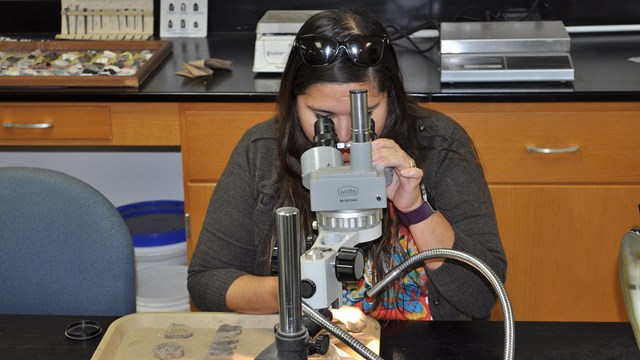
Two Spencer cases were too corroded to identify individual characteristics, but the remainder were suitable for microscopic examination. Although corrosion did obscure some details, probable matches were noted with ten cases (Figure 45). One Spencer is represented by cartridge cases FS1506, FS1688 and FS2042, a second by FS1178, FS1698 and FS2047, a third by FS1503, a fourth by FS2041 and FS2045, a fifth by FS2043 and FS2046, and the sixth and seventh by one case each, FS2049 and FS52050 respectively. The Joslyn is denoted by the single specimen FS1677

The four Spencers represented by the multiple matched cases indicate some individual movement. Case FS1688 was found southwest of Blue's Road and near the southeast-northwest trending road alignment. A probable match to that case is FS1506 found north of the house site and north of the firebreak road and FS2042, found in the artillery impact buffer area below the junction of the current Morganton Road and Blue's Road.

Another Spencer movement is also represented by three cases-FS1178 found south of the house site along the ridge, FS51698 found north of the firebreak road, and the third matching case, FS52042, found below the junction of the current Morganton Road and Blue's Road. The last group of matched firing pin marks, FS52043 and 2046, were also found below the junction of the current Morganton Road and Blue's Road.

Enfield-Pritchett Bullets, Calibers .50, .51, .54, and .577

A large variety of smooth-bodied, Enfield-type bullets (Figure 35j, k, l [42 KB] and Figure 46) were found scattered over the battlefield. Four calibers are represented, although the .50 and .51 calibers may represent only variations of a single type. A single, .50-caliber Enfield bullet (FS1633) was found along Nicholson Creek.

The largest group of Enfield-Pritchett-type bullets is the .51-caliber (FS1521, 1532, 1538, 1556, 1592 [hollow base], and 1623). These are distributed primarily north of the house site and north of the firebreak road. Two were found in the area of Nicholson Creek. Three Enfield-Pritchett-type bullets in .54-caliber (FS1559, 1561, and 1696) were all found north of the house site and east of Blue's Road.

The .577-caliber Enfield bullets (FS1544 [hollow base], 1555, 1607, 1637, 1731, 2004 [hollow base], and 2032 [hollow base, unfired]) were found (two) north of the firebreak road, (three) west of Nicholson Creek, (one) along Blue's Road near the cannon-related artifacts, and (one) north of the current Morganton Road about 200 meters west of Blue's Road.

Both the Union and Confederate forces imported large quantities of Enfield weapons during the war. The Confederates also produced Enfield-type bullets for their troops throughout the war (Coates and Thomas 1990:19). The caliber variation is typical of Enfield ammunition, and ranges from .498 to .703 inches are known (McKee and Mason 1980:41). All could be fired in either the British Pattern 1853 Enfield or the .58-caliber U.S. and C.S.A. muskets, although the smaller calibers (.50, .51, and .54) were likely used in .54-caliber weapons such as carbines or Austrian rifles.

.58-Caliber Bullets

Twelve .58-caliber bullets (Figures 35g, h, i [42 KB] and Figure 47) were recovered over all portions of the battlefield. The .58-caliber Minie ball is known in many variations with all intended to be fired in a number of different types and models of rifled muskets. The Monroe's Crossroads bullets (FS1461, 1528, 1529, 1546, 1604, 1609, 1645, 1716, 1651, 1656, 1697, and 2033) demonstrate that variability. Two (FS1461 and 1716) are Williams-type Cleaner bullets. FS 1716 appears to have been fired. Most Williams Cleaners were discarded because they were difficult to load in combat conditions. With their distinctive, blue paper cartridge, they were easily identifiable under combat conditions (McKee and Mason 1980:64). FS1609 is a standard .58-caliber that appears to be an unfired or dropped bullet. The bullet was found on the west side of Nicholson Creek in the presumed Confederate position.

Round Balls and Shot

The battlefield investigations yielded 33 round balls, pieces of shot, or canister balls (Figure 48). Lead shot was found in three sizes - .118 inches or BBB size (FS1474, 1511, and 1516); .2 inches or #four shot (FS1582, 1653, 1659, 1664, 1683, and 1708); and .33 inches or 000 Buck (FS1488, 1489, 1661, 1684, 1709, 2010, and 2018). These shot may be pre- or post-battle deposition, as well as battle-related. The shot distribution is the same as the definitely battle-related bullets and cartridges, suggesting a possible battle association. It is well known that some Confederate cavalry units, especially Texans, carried shotguns. The 000 buckshot may well have been components in buck and ball loads, often associated with .69-caliber muskets.

Several larger caliber lead balls were also recovered. Four calibers were noted - a .40-caliber ball (FS1490), four .50-caliber balls (FS1564, 1672, 1690, and 1706), a .58-caliber ball (FS1660), and three .62-caliber balls (FS1061, 1571, and 2037). The single .40-caliber ball was found south of the house site and in the area of possible outbuildings. It may very well represent a pre- or post-battle deposition.

The three .62-caliber balls may be for .69-caliber muskets or as shrapnel in a 3-inch Hotchkiss shell. Two were found north of the firebreak road and in the vicinity of iron shrapnel and a Hotchkiss fuze adapter. The third was found north of the current Morganton Road and about 200 meters west of Blue's Road.

In addition to the lead shot, there are four iron shot in .75 inch diameters. Two (FS1505 and 1515) were recovered in the vicinity of the iron shrapnel and Hotchkiss fuze adapter. Another ball was found associated with C.S.A. buttons and other artifacts during the test excavations at the 27-man grave site (Test Area C). The fourth (FS2030) was found north of the current Morganton Road and about 200 meters west of Blue's Road. These iron balls most likely represent canister balls fired from a three-inch ordnance rifled cannon of the l0th Wisconsin Battery.

Cannon-Related Artifacts

Figure 49 - Cannon-related artifacts. (45 KB)Three definite and one possible cannon-related artifacts (Figures 49a, b, c, d, e at right and Figure 51) were recovered. FS1486 is the pull-ring and a fragment of a brass primer tube of a cannon friction primer. This friction primer was found in the same area where Stanley Dahl had found numerous cannon friction primers while metal detecting in the 1970s and 1980s south of the 27-man grave site (Test Area C). Another pull-ring was found during the ground penetrating radar truthing survey. It was found in the area of the house site in Test Area A.

Figure 50 - A 3-inch Hotchkiss case shot.The other two definite items are brass fuze adapters or plugs (FS1545 and 2029) from 3-inch Hotchkiss shells or case shot (Figure 50 at left) (Bartleson 1972:73-83; Dickey and George 1993:158-180, 450). The adapter held the paper timing fuze used to detonate the shell. The shell broke up into iron shrapnel and spread lead balls contained in the shell housing. The first fuze adapter was found north of the firebreak road and north of the house site. The second, comprising only the upper two-thirds of the adapter, was found south of the current Morganton Road and about 200 meters west of Blue's Road.

Stanley Dahl found a complete shell with fuze adapter intact west of Nicholson Creek and north of the firebreak road. He also found base fragments of at least two other rounds east of Blue's Road and east of the 27-man grave (Test Area C)

The other item (FS1475) is of only probable cannon association. It is a 3/8-inch diameter, bolt shank with a flattened countersunk head. It appears to be a modified, handmade carriage bolt. The bolt may be from a cannon carriage, caisson, or limber tire. Bolts of this type were used to hold the iron tire rim in place on the felloe. The size is definitely consistent with the identification, and the bolt was found in the area traditionally assumed to be the artillery position.

Deformed Bullets and Lead Scrap

Forty-six bullets were so deformed on impact that they were unrecognizable by caliber, with one exception. The single recognizable bullet is an Enfield (FS1629) found embedded in a fragment of wood. It is too distorted to determine the precise caliber. Two other bullets, too distorted to determine caliber, FS201 1 and 2026, were also found embedded in wood on the west side of Nicholson Creek near the presumed Confederate position. The remaining bullets (FS1126, 1142,1322,1342, 1372, 1374, 1380, 1386, 1453, 1465, 1495, 1500, 1507, 1508, 1518, 1537, 1541, 1551, 1557, 1558, 1570, 1585, 1591, 1595, 1599, 1605, 1608, 1614, 1619, 1631, 1634, 1639, 1642, 1643, 1644, 1654, 1665, 1702, 1705, 1710, 1718, 2009, and 2019) were found scattered over the entire battlefield. They undoubtedly represent bullets of various calibers fired during combat that, upon impact, became distorted and unrecognizable.

Two pieces of large flat lead (FS1602 and 1721) may be fragments of cannon shell bands. The 3-inch Hotchkiss shell used a lead band to grip the Ordnance Rifle's bore when fired. The flat lead pieces may also be from later projectiles, as is FS1519, which is associated with modern Army training exercises. Both lead pieces, however, were recovered in the vicinity of Civil War artifacts. One was found in the presumed Confederate position west of Nicholson Creek and the other east of Blue's Road and east of the probable cannon battery site.

Large Iron Fragments (Possible Shrapnel)

The investigations yielded 49 thick iron fragments that may be shrapnel from exploded artillery shells. Some fragments are probably from more modern artillery, although most do not have the ragged-edge appearance of modern steel shrapnel. However, the finding of unexploded, modern rifle grenades and artillery rounds and obviously modern, ragged iron fragments during field work certainly suggests modern fragments may well be present in this group. Some of the iron is so oxidized that no surface features are present for further classification.

The field specimens' numbers are FS1032, 1033?, 1059, 1080, 1334?, 1375, 1412?, 1418?, 1426?, 1431?, 1447?, 1450, 1467?, 1483, 1491 (m?), 1497?, 1499 (m?), 1502 (m?), 1504 (m?), 1520 (nose threads), 1523 (m?), 1525, 1526, 1527, 1534 (m?), 1535 (m?), 1536 (m?), 1540?, 1542 (m?), 1547 (m?), 1548?, 1549 (m?), 1552 (m?), 1554 (m?) 1560, 1562 (m?), 1563 (m?), 1565 (m?), 1567, 1568 (m?), 1569 (m?), 1570 (m?), 1583?, 1680?, 1689?, 1700, 1732 (m?), and 2040 (m?). The m? denotes a possible modern shrapnel fragment and the? Denotes a questionable identification.

The majority of these fragments were recovered north of the firebreak road and northeast of the house site (Test Area A). A few, about five, were found in or immediately adjacent to the house, and eight were found north of the presumed site of the cannon battery. Three were found west of Blue's Road and west of the 27-man grave (Test Area C), and one was found east of the battery site but west of Nicholson Creek.

Non-Battle Bullets and Cartridges

The site yielded thousands of expended, military blank cartridges in various calibers. These were not collected or recorded. Several cartridges and bullets were collected that could not be readily identified in the field. Laboratory analysis determined these to post-date the battle period. FS1346 is a .22-caliber bullet; FS1600 is a 12-gauge rifled shotgun slug; and FS1318 is a .30-caliber bullet. FS1487 and FS1693 are .25-caliber rimfire cartridge cases probably fired in Smith and Wesson pistols. FS1482 is a .25-caliber rimfire cartridge case head. FS141 1 and FS1492 are modern primer cups, and FS1417 is a modern rifle primer.

Battle-Related Equipment, Personnel Items, and Harness Items

The investigations yielded relatively few, definitively battle-related artifacts. The items that can be clearly associated are pieces of equipment and fragments of horse furniture. A single coin dating to the battle era was recovered. It is an 1854 half-dime (FS1373) with arrows on either side of the date. The closing stud to a cartridge box or cap pouch (FS1646) was found west of Nicholson Creek. The stud is lead and typical of Confederate equipment. A brass spur fragment (FS1464) was recovered east of Blue's Road and southeast of the 27-man grave (Test Area C). A single General Service cuff button (FS1686) and a button back (FS1612) are the only uniform parts found.

The remaining battle-related items are associated with horse trappings. These include a 1-inch brass ring (FS1719), a 2½-inch (FS2007) harness ring, six copper rivets (FS1336, 1419, 1434, 1449, 1685, and 1694) which are of the type and sizes used on halter, bridles, and saddles. Buckles were a ubiquitous part of horse gear, and several were recovered: FS 1388, a 1-inch D-buckle; FS1622, a brass buckle frame fragment; and FS1012 and 1723, brass, center bar, bridle-type buckles. A 3/4-inch halter square (FS1445) and a McCellan saddle plate (FS1724) comprise the remainder of the battle-related horse furniture.

Other Horse and Wagon Artifacts

A few other horse and wagon items were recovered during the investigations. They are ubiquitous enough that they cannot be directly associated with the battle. They were found in a variety of places around the battlefield and were often associated with battle-related artifacts. However, the context is not enough to state they are from the battle era given the long usage of horses and wagons for conveyance.

Horseshoe nails are represented by FS1460 and FS1345. Horseshoe fragments FS1329 and 1498 are hand-forged pieces with applied caulks and could be of the battle era.

FS1692 is a large draft horse size shoe, and FS 1202 is a mule shoe, either of which may be associated with any of many activities occurring on or around the site since before the war and tltrough World War I.

FS1248, FS1611, and FS1727 are fragments of check rings assemblies associated with draft harness, and the latter also includes a horseshoe fragment. FS1290 is the end ring for a wagon end rod, and FS1687 is a box rod fragment.

Miscellaneous Artifacts

A wide variety of other materials were recovered, primarily near the house site and along the ridge believed to contain other Monroe farm outbuilding sites. For the sake of brevity, these artifacts are presented in tabular form (Table 7).

Nails

A large number of cut nails were located along the ridge containing the Monroe House site and the suspected farm outbuildings (Figure 33). There are ten 3d, nine 4d, 22 6d, 59 8d, one 9d, 76 10d, 14 12d, six 16d, 14 20d, seven 30d, four 40d, and 84 unclassifiable fragments.

The distribution includes roofing, framing, and lathing-sized nails that undoubtedly reflect the remains of a series of frame buildings once located on the ridge.

Six wire nails and one staple were also recovered. These may reflect box or later construction episodes. They may be related to the Army use of the site in later years.

Chapter 6 - Interpreting the Evidence

Table of Contents