Chronology

A number of artifact categories were studied to determine when they were produced and used. The three, white, Prosser buttons are similar in form to specimens recovered in other archeological contexts dating from circa 1850 to 1870 (Hunt 1986:26-27, 33; McLeod 1983:225; South 1964:122). One of the stoneware jug fragments (Cat. 113) is of a form typical for vessels made prior to 1850. The crock fragment (Cat. 152) appears to be from a cylindrical vessel, a form which was most commonly produced after 1850 (Ketchum 1970). Many of the specimens exhibit surface treatments typical of the 19th century. None are glazed with the white to cream glazes which became extremely popular from the start of the 20th century on. Decorations exhibited in the tea and tableware are typical of those produced from the 1840s to present (undecorated paneled and unpaneled whiteware), the 1830s to circa 1860 (handpainted sprig and transfer-printed patterns), circa 1840 to 1870 (blue edge decorated, impressed), and circa 1905 (Art Nouveau) (Majewski and O'Brien 1984:23, 34, 41-42; Miller and Hunter 1990:117). These essentially represent the probable time range for the site's occupation.

The sample from Test Area A was recognized as containing fragments from at least two lamp globes. One specimen (Cat. 166), though originally clear, is light purple in color, a product of exposing glass clarified with manganese to the ultraviolet rays of the sun. The clarifying agent was used by glass manufacturers between post-1880 to 1916 (Munsey 1970:55). The unaltered, clear color of one globe suggests that it was produced prior to 1880 or clarified using some other additive. One of the clear fragments (Cat. 139) is a crenelated rim. Decorated tops became popular during the 1870s, and a crimping machine for producing pie crust edging was patented in 1877 (Woodhead et. al 1984:62).

Window glass is increasingly being used by historical archeologists to date sites. It is known that pane size and thickness increased at a fairly regular rate through the greater portion of the 19th and early 20th centuries. The trend toward greater thickness halted when automation and governmental regulation standardized window thicknesses between 1910 and 1930 (Moir 1982:37).

Karl Roenke (1978) used an approach to flat glass in which the modal thickness of the flat glass population correlates to the mean decade of a structure's occupation. Roenke's method was developed using flat glass from 19th century sites in the Northwest. To use Roenke's method, one can construct a histogram to review modal thickness frequencies of a flat glass population. The flat glass population from the Monroe House area (n= 76) is multimodal with peaks at 1.4 mm, 1.7 mm, and 2.2 mm (Figure 20). Using Roenke's correlations, the peak at 1.4 mm correlates with a temporal range of 1835-1845.

This range conforms with Charles M. Monroe's acquisition of the Rocky Mount Plantation from his father in 1832. According to a deed search by Loftfield (1979:28), the farm was settled for an unstated period prior to that date, and there was a dwelling on the farm at the time of the exchange. The flat glass date suggests the possibility that the farm house transferred to Charles from his father was at another location and that Charles built his own home when he acquired the farm. The peak at 1.7 mm suggests a date between 1855 and 1865, possibly a period of building addition or repair.

Finally, the 2.2 mm thickness peak suggests a late 19th century date. Pane thicknesses of 2.29 (+ 0.25) mm has been the standard for modern, single-strength, window glass since 1924 (Moir 1982:16). Therefore, the small increase in distribution above 2.2 mm suggests that minor replacement of window panes may have taken place sometime prior to the site's acquisition by the U.S. Army as a part of the Fort Bragg Military Reservation.

Regression analysis formulas for mean flat (window) glass thickness were also considered in this analysis, largely to test methods employed by Randall Moir (1982) and Christopher Schoen (1990) to determine an approximate date for building construction. Moir's study of window glass suggested that there may be some regional specificity of dates due to regional variations in window glass manufacture and supply. This led Moir to develop regression formulas for both the southern and northeastern United States. The southern sample is drawn almost exclusively from Texas, a considerable distance from the Monroe's Crossroads Battlefield. The northeastern sample was also drawn from sites some distance from the study area. Because there seems to be no regression formula developed for the extreme southeastern portion of the United States, both of Moir's regression formulas will be used.

Dates derived from the regression formula may be useful where one follows four basic precautions (Moir 1982:15-17). When dating a site as a whole, one should obtain small samples from a number of locations rather than use a large sample from one location. One should also review other artifact categories to be sure that the structure was built between 1810 and 1920.

Moir further cautions that one should take great care to remove bottle glass, the latter characterized by curved forms or distinctive coloration. He also determined that flat glass thicker than 3.2 mm probably did not represent window glass and should be excluded from the analysis. Finally, to be reliable, regression analysis requires a fairly substantial number of specimens. Moir indicates that he has successfully dated sites with samples as few as 20 or 30 sherds, although 50 or more specimens provide much more reliable results (Moir 1982:15).

For the southern United States, the coefficient developed by Moir is based upon data from 28 southern sites dating from circa 1810 to 1920. The regression coefficient derived by Moir for the northeastern part of the United States used data from sixteen sites or structures occupied between 1812 and 1915. Moir's regression coefficients are: [SOUTHERN SITES] ID = 77.38(TH) + 1727.3 [NORTHEASTERN SITES] ID = 89.78(TH) + 1702.7 where ID is the initial date of construction and TH is the mean thickness measured to the nearest 0.01 mm (Moir 1982:23-29).

No flat glass specimens had to be deleted from the sample for being more than 3.2 mm thick. The sample size (n = 78 specimens) is also well above the minimum advised by Moir. As per Schoen (1990), an average of three thickness measurements for each glass fragment was used in the computations. Using the mean thickness of Test Area A window glass (1.89 mm), the northeastern coefficient, ID = 89.78(1.89) + 1702.7 correlates with a date of 1872.4. That same mean thickness used with the southern coefficient, ID = 77.38(1.89) + 1727.3 derives a date of 1873.5. These dates are surprisingly similar.

This is quite close to an expected mean date for a site occupied from the early 1830s to circa World War I.

Schoen developed another correlation coefficient following Moir's methodology for central and northern Plains sites. Although these are at a considerable distance from the Monroe House site, they do provide another potential basis for interpretation. This is stated as Y = 1725.664 + 1713.008(X) "where Y is the estimated date of initial construction/occupation and X is the mean thickness value in inches" (Schoen 1990:68).

The Monroe House site sample has a mean thickness of 0.074 inch. Application of Schoen's formula using this thickness results in a date of 1852.43, a date much too early for the expected mean occupation date and much later than the building's assumed construction in the early 1830s.

Cut nails were manually manufactured during the last decades of the 18th century and the first two decades or so of the 19th century. Machine-made, cut nails were introduced during the mid-1820s, a technical achievement that brought an end to the extensive use of forged nails, for the most part, except for specialized construction or where building occurred in the frontier. Cut nails were, in turn, rapidly displaced by wire nails after the introduction of machinery in 1886 that could produce wire nails much faster and cheaper than cut nails could be made.

By the turn of the century, builders virtually ceased to use the cut nail, except for specialized construction such as floor installation (Gillio et. al 1980; Nelson 1962).

The lack of forged nails on the site suggests that the structure at 31HK248 was built sometime after 1825. Because cut nails are the overwhelming majority nail type at the site (n=479, 95.6% of identifiable nails), it seems likely that construction of the building at 31HK248 occurred prior to 1885. The relatively small number of wire nails (n=22, 4.4% of identifiable nails) suggests their use in small-scale structural repairs sometime after 1885.

Several firearm-related objects were recovered from Test Area A. Of these, the .45 caliber bullet (Cat. 28) became very popular after the Civil War and may relate to the occupants of the farm rather than the combatants. An object cut from sheet copper (Cat. 11) is similar to devices used to decorate the stocks of pre-Civil War-era rifles. It is impossible to determine whether the object comes from a gun owned by the Monroe or Blue families or from a firearm used by one of the battle participants. A .22 short casing (Cat. 10) may post-date the battle because such ammunition continues to be made and used today.

However, the .22 short was first developed in 1857 by Daniel Wesson for use with the Smith and Wesson First Model revolver (Logan 1959:63). It is possible that the weapon was carried by an officer of one side or the other in the battle at Monroe's Crossroads. A .54 caliber bullet (Cat. 127) is from a Burnside cartridge, an early metallic cartridge patented in 1856 by Ambrose E. Burnside. It was used solely with the Burnside Breech Loading Carbine, a weapon which used tape primers, and later percussion caps, for ignition. After 1860, the bullet was modified by adding a grease chamber. It is this modified cartridge that was purchased in large numbers by the military and used throughout the Civil War (Garavaglia and Worman 1987:187-188; Logan 1959:38) and is a projectile likely associated with the engagement at Monroe's Crossroads.

Several curved glass fragments of unidentified function had physical features which are temporally significant. Six (Cat. 17, 102, 111, 145, 178, and 134) are light to deep purple in color. This is a characteristic of manganese-clarified glass exposed to ultraviolet wavelengths of sunlight. Public concern with the purity of preserved foodstuffs brought about a great demand for clarified glass from around 1880 on. This forced glass manufacturers to clarify the normally light green glass used in food containers. The most prominent method used added manganese to the glass mixture. This practice was continued until about 1915 when World War I cut off the United States' primary source for manganese, Germany. After 1916, other decolorizing agents were used. Therefore, sun-colored, purple glass had to be manufactured sometime between circa 1880 and 1915 (Munsey 1970:55).

Another temporally significant fragment, recovered from the test excavation at the location of the collapsed chimney, was a bottle base (Cat. 118) exhibiting the mark characteristic of a blowpipe pontil. Blowing bottles has been a method for producing glass containers since circa 100 B.C. (Munsey 1970:39). The commercial use of the blowpipe as the pontil, the device holding the bottle during its final shaping, more or less ended around 1870 (Jones 1971:69-71; Jones et. al 1985:45). Therefore, the pontil-marked fragment from the ruins of the Monroe House had to be manufactured prior to that date.

One celluloid item was recovered at the site. Commercial development of celluloid in the United States did not occur until 1869 (Gilman et. al 1904). Celluloid continued to be used until after World War II when the development of plastics produced better replacements.

TEST AREA B

Test Area B is located 503 m to the southeast of Datum 1 on the northerly edge of a swampy area believed to be the same location where Union troops sought refuge from the initial Confederate assault on their camp. Two, partially buried, bone fragments were noted during the initial walkover of the site. At that time, it was considered probable that all battlefield burials were not relocated by recovery teams dispatched to the site long after the battle. Therefore, a decision was made to place a 1 x 1 m test unit at the bone discovery location to try to identify the fragments. This work immediately exposed the margins of a small pit within which the bones were situated. Four, relatively modern, rectangular (meat?) can bottoms and a rectangular can lid were recovered from the pit's fill. Full exposure of the bones also indicated that these were the weathered foot bones of a large ungulate, possibly a cow or horse. This suggested the objects were associated with World War I to World War II-era training exercises rather than the Civil War. None of the objects were collected and all were redeposited at the recovery location.

TEST AREA C

Excavation

Figure 23 - Grave marker in Test Area C cemetery.Test Area C is the largest of five marked cemeteries at the battlefield. The cemetery is rectangular (7.6 m northwest-southeast x 12.5 m northeast-southwest) and bounded by a cable line held in place with sixteen concrete pylons (Figure 21 and Figure 22). Rectangular grave markers bearing the legend "NINE UNKNOWN/U.S. SOLDIERS" on a recessed shield occur in three of the four interior corners of the cable boundary (Figure 23 at right). A fourth identical stone at Test Area F, a much smaller cemetery, may have been moved from Test Area C some time in the past.

The entire area inside the cable fence was systematically probed using a solid rod probe. Two locations of extremely soft ground were identified in the vicinities of the northern and western grave markers. Shovel shaving exposed dark soil stains at each location.

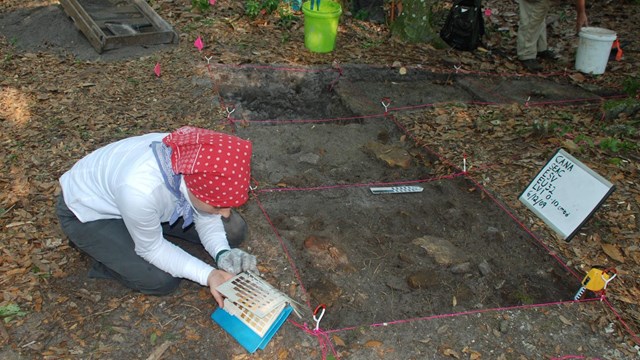
Test Unit 1 was placed on the southwestern side of the north grave stone. Shovel shaving here cleared a 3 m north-south x 2.5 m east-west rectangular area near the northern stone and revealed a dark brown rectangular (1 m north-south x 1.9 m east-west) stain. The stain was centered about 1.2 m southwest of the middle of the marker. This was interpreted as a possible grave. In the southeastern corner of this stain was a dark orange clay (0.4 m x 0.35 m) ovoid area which appeared to be an intrusive disturbance. At first, an attempt was made to remove the intrusive fill separately from the darker grave fill, but at 64 cm below datum (BD) the strata became too mixed with one another to continue with this method. All materials were subsequently removed together. Excavation continued to 91 cm BD, at which point the dark fill was no longer recognized. The moist, reddish, mottled sand which replaced it at this point was considered as noncultural, undisturbed subsoil.

No human remains were located in Test Unit 1, although the recovery of nails throughout the exposed feature suggests that it may actually represent a grave. The ovoid area of dark, orange clay in the eastern end of the "grave" is interpreted as a byproduct of removing the body, either through legitimate action or grave robbing.

Shovel shaving in the western corner of the cable-fenced enclosure at Test Unit 2 revealed a large, diffuse, ovoid stain which was approximately 2.8 m north-south by 2.3 m east-west. A 35 cm diameter circular feature of reddish-colored sand in the east-central portion of the stain (centered about 0.70 m in front of the grave marker) was a post hole.

Initially, the excavator attempted to remove only the dark organic fill as a means of identifying the feature boundaries. Its margins soon proved to be too diffuse to follow while viewing horizontally. The excavator turned to use of a 2 m (east-west) x 0.8 m (north-south) exploratory trench in an attempt to define the feature in vertical profile. This proved more successful, and as excavation progressed, a variety of artifacts were recovered, despite the increasing homogeneity of soil color. Soil texture proved to be the greatest ally of the excavator in following feature boundaries. In some instances, however, only positive signals from a metal detector enabled determination of whether further excavation was necessary.

Excavation ended at the upper surface of a yellowish, brown hardpan below which the metal detector received no positive signals. The pit boundaries were somewhat more evident when viewed in profile. These suggested that a grave pit with gradually sloping sides had been excavated only about 0.60 m (2 feet) into culturally sterile, compact, reddish sand. The shallowness of the grave feature suggests that burial was a relatively informal and hurried event.

No bone was encountered in the feature fill. Nevertheless, a variety of artifacts were piece-plotted on excavation maps. Among these were nails, a variety of buttons from Union and Confederate uniforms, a tinned spoon, firearms projectiles, and unidentified organic and ferrous metal objects (see "Historic Artifacts" below). Their presence in the feature suggests that at least one and perhaps two people may have been interred. The lack of human remains is probably a natural result of burial within highly acidic soil rather than because of past authorized or unauthorized excavation. The circular intrusion into the grave pit appears to represent activities of the farm's inhabitants sometime after the battle but prior to the property's acquisition by the U.S. Army.

As Test Units 1 and 2 were being explored, portions of the cemetery area inside and outside the cable fence were cleared using a front end loader mounted on a tractor in an attempt to locate additional Civil War-era burials. This technique quickly removed the upper 3-5 cm of soil from relatively large portions of a cemetery area. Cleared portions were then shovel shaved and examined for dark soil stains in the lighter yellow, brown, loamy sand and reddish-brown, clay subsoils. Only one such stain was observed during this procedure, centered about 2.5 meters west of the eastern grave stone.

The amorphous stain was somewhat rectangular in shape (about 1 m northwest-southeast x 1.5 m northeast-southwest). This became the location of Test Unit 3.

At first, the excavator tried to follow the boundaries of the stain as it went down into the soil but found that the stain became too diffuse to trace below 10 cm from the surface.

A 1.7 m north-south x 0.4 m east-west test trench was then placed across the stain to see whether the feature could be distinguished more clearly in cross-section.

A very compact subsoil was quickly encountered, however, which suggested that no cultural disturbance had occurred below this point. The only exception was a small (about 8 cm diameter) circular area of soft fill. A fencing staple in this feature quickly identified it as a post hole. This may be related to the fence post discovered in Test Unit 2. With the discovery of the compact subsoil, metal detectors were brought in to determine whether additional metal was in or near this feature. The unit was closed when there was no "hit."

Chapter 4 (continued)

Table of Contents