The Golden Crescent
The Golden Crescent, a region rich in history and prehistory, runs from Savannah on Georgia’s Atlantic Coast, south to the Daytona Beach area on Florida’s east coast, and west to Tallahassee and the Gulf of Mexico. This poster shows a spring harvest of clams—one scene from daily life during an earlier period in the Crescent.
Seminole Rest
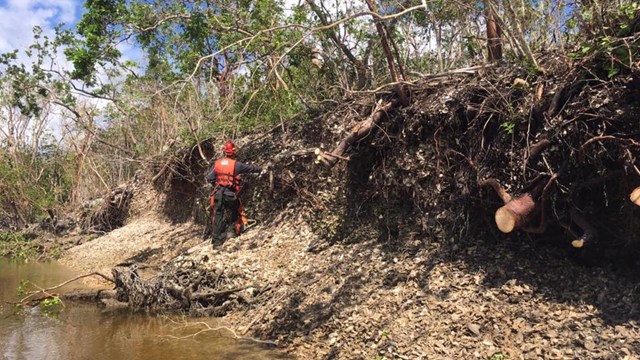
A number of aboriginal (meaning early or native) cultures used Seminole Rest—now an important archaeological site—from 500 to 4,000 years ago. Snyder’s Mound, the largest midden mound at Seminole Rest, is believed to be the location of a large seasonal clam processing station. This site covers four acres of land—about the area of four football fields. Because of its size, archaeologists call it a "megamidden."
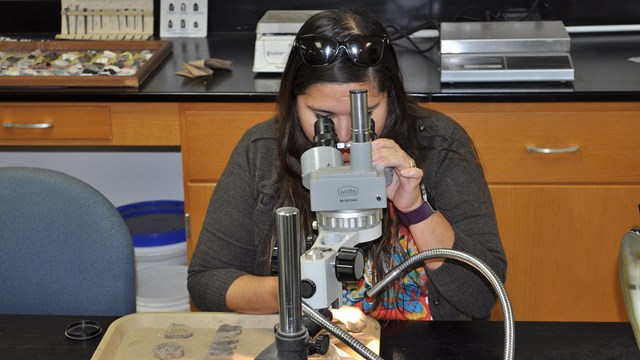
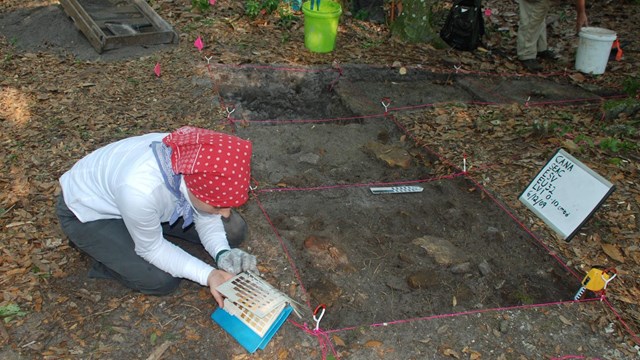
Midden sites are really trash dumps. They contain a variety of objects from daily life—ash, charcoal, botanical material, ceramics, food bones, and shells. Archaeologists analyze these remains to learn more about the lives and environment of early inhabitants of the Golden Crescent.
What Do You Think?
How do we dispose of our trash today? What would be a modern-day version of a midden? How are modern dumps and landfills different from prehistoric middens? How are they the same? What kinds of things go into today’s dumps that did not go into Indian middens?
The People and the Land
The coastal zone of southeast Georgia and northeast Florida is dotted with lakes, marshes, lagoons, and open prairies. Although they made limited use of beaches and dunes, Native Americans relied on the many natural resources of coastal marshes and lagoons. Here, for thousands of years, native populations gathered shellfish and fish, plants and animals.
What Do You Think?
What did Indians look for when choosing a location for a food processing station? What might cause them to return to the same spot again and again, or look for a new one? How did the Indians travel across lagoons? How did the Indians at Seminole Rest affect their surroundings?
Food Gathering
Archaeologists believe that women and children probably gathered shellfish from the shallow waters along the shore with their feet and hands, digging sticks, and perhaps some type of rake. Meanwhile, the men fished in the deeper waters of the lagoon or ocean, probably using fish traps, nets, and barbed arrows or spears.
Many cultural groups dried shellfish and carried it away from the collection area. The women prepared the "harvest" for future use by roasting, baking, or steaming it on top of a bed of hot coals. Once opened, the shellfish were removed from the fire, perhaps laid out in flat basketry trays, and allowed to dry in the sun. The meat of shellfish and other sea animals could also be dried or smoked on skewers or wooden grills.
What Do You Think?
What did the Indians at Seminole Rest eat? What other food items not shown on the poster might they have eaten? How do present-day means of getting food differ from prehistoric methods? Does your family grow any of your food, or fish or hunt for it?
Dwellings
Travelers’ descriptions of Indian shelters in similar settings offer us the best idea of what a prehistoric food processing camp might have looked like. The following is from an 1887 description of south Florida Indian houses:
The house is approximately 16 by 9 feet and is made from material taken from the palmetto tree. It is actually a platform elevated above the ground and is open on all sides without rooms. Only the space above the joists which are extended across the building provide extra space to place surplus food and general household effects. The roof is about 12 feet above the ground. Upright palmettos logs, unsplit and undressed, support the roof and many rafters sustain the palmetto thatching. The roof thatching is a mass of palmetto leaves which is held in place with heavy logs which are bound together and laid astride the ridge pole. The floor is made of split palmetto logs, flat sides up, upon beams which are lashed to the uprights by palmetto frond ropes. The covered platform serves to furnish the inhabitants with a dry sitting or lying down place. Household utensils, are suspended from the uprights or pronged sticks driven into the ground. (MacCauley 1887)
What Do You Think?
Make a sketch of a camp tent or cabin that you have seen or heard about. How does its use differ from the use of the shelters shown on the poster? In what ways are the shelters different? How are they similar? What kinds of tools would the Indians have needed to create a shelter? What would they have kept in the storage space above the joists? How do you store things in your home?
Getting Involved
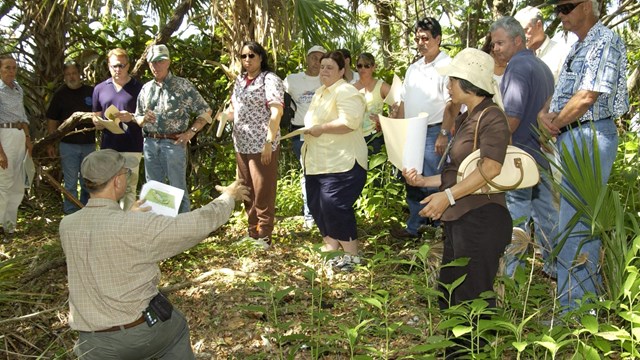
Archaeology provides many clues about the past and makes us think about how we live today. There are many ways you can become involved with archaeology and preservation. Find out about Archaeology Week/Month activities from your State Historic Preservation Office. Visit an archaeological site or a museum that displays archaeological artifacts (human-crafted objects). Think about places in your neighborhood that are or might become archaeological sites.
To learn more about the National Park Service and its sites, programs, and initiatives in southeastern United States, phone 404-562-3123 or visit these World Wide Web sites:
National Park Service — http://www.nps.gov
Southeast Archeological Center — http://www.cr.nps.gov/seac/seac.htm
Golden Crescent Georgia-Florida Initiative — http://www.cr.nps.gov/goldcres
Credits:
The National Park Service produced and provided funding for this poster as part of an initiative to educate the public about the
rich cultural heritage found in the
Golden Crescent—a cultural crossroads in south Georgia and north Florida.
The front illustration and the sketches on the hack of the poster were created by artist Martin Pate. The scene depicting a spring
harvest of clams and the "close-ups" of everyday life are artist's renditions based on archaeological
investigations and historical documents.
Portions of the text were adapted from: Archaeology of the Southeastern United States: Paleoindian to World War I, by Judith A. Bense (New York: Academic Press,
1994); Florida Archaeology hy Jerald T. Milanich and Charles H. Fairbanks (New York: Academic Press, 1980); Final Report on the Archeological
Investigations at the Seminole Rest Site (CANA063/8v0124): Canaveral National Seashore, Volusia County, Florida edited by Elizabeth A. Horvath (Tallahassee:
Southeast Archeological Center, 1995); Advances in Archaeological Method and Theory: Volume 10 edited by Michael B. Schiffer (New York: Academic
Press, 1987); and "The Seminole Indians of Florida" by Clay MacCauley (published in the 5th Annual Report of the Bureau of American Ethnology, 1883-1884,
pp.469-531,1887).