Fort Benning Public Education Plan

FORT BENNING PUBLIC AWARENESS & EDUCATION PLAN FOR CULTURAL RESOURCES

Information | Copies

Byline: This Plan proposes sharing information in an array of formats (see CONTENTS below) about the various eras of human occupation at Fort Benning by stirring the audience to recognize the value of cultural and natural resources and to appreciate the significance of Fort Benning in our national heritage


Published by Southeast Archeological Center, National Park Service and U.S. Army, Fort Benning, Georgia. 1997, 46pp.


Introduction

Most people look at a river and see only water. A rare few catch glimpses of the past flowing by. The same can be said of a stretch of land. Only infrequently does an observer look at a landscape and see beyond what exists and envision what once was. Yet, even if the majority does not easily picture the past without prompting, being curious about earlier times seems to be innately human. 

The Public Awareness and Education Project, of which this Plan is the first step, seeks to shed light on the rich cultural and natural heritage of Fort Benning near Columbus, Georgia and Phenix City, Alabama. Dozens of individuals generously contributed suggestions for this plan. Many also offered future assistance to implement various components. Their names and a synthesis of their ideas are presented in the following pages. 
  Eisenhower
As the home of the U. S. Army Infantry and a hub of military training, Fort Benning has long been a vital post in the national defense. The roster of famous officers once stationed on the post includes the names of Patton, Eisenhower, Marshall, and Powell, while soldiers trained at Fort Benning have participated in every major United States military conflict since World War I. 

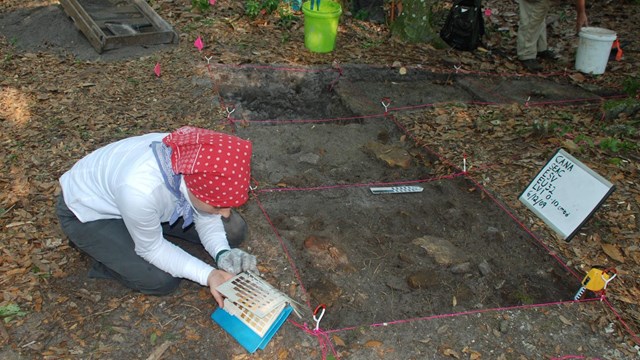
Before the establishment of Fort Benning in 1918, however, there were many others who occupied the ground, dating as far back as the waning Ice Age when PaleoIndians hunted in the region. Indeed, human beings have been an ongoing presence in the area for thousands of years, drawn by the teeming life in the Chattahoochee River and by other abundant natural resources. 

Native Americans were residents until the 1800's when they were removed by government order. However, many signs of their presence remain, including countless artifacts, as well as a long list of names for places - Cusetta, Coweta - and waterways - Upatoi and Ochille Creeks, to cite only a few. Farmers, slaves, and mill families followed in the footsteps of the Indians and also left reminders of their existence. Traces of their homesteads can still be found in the soils. And, while their numbers dwindle every year, there are still individuals alive who once lived on the land now occupied by Fort Benning and who have memories of growing up there. 

This Plan proposes sharing information in a variety of formats, including development of a Cultural Resource Curriculum and Teacher's Guide, about the various eras of human occupation on the approximately 182,000 acres now encompassed by the military reservation. The common goal among these approaches is to educate in an entertaining way, engaging the imagination and stirring the audience to recognize the value of cultural and natural resources and to appreciate the significance of Fort Benning in our national heritage. 

CONTENTS: 

I N T R O D U C T I O N
    Intended Audience
    Product Completion Date
    Product Costs 

P L A N  O F   A C T I O N
    Publication of a Cultural Resources Book (1998)
    Publication of a Brochure (1997)
    Development of Cultural Resource Curriculum
        Developing a teacher's guide
        Developing a study unit on archeology
        Publication of a booklet about local Native Americans
        Creating a continuing education program
        Programs for the early primary grades
        Game-oriented activities
        Color overhead transparencies
        Guest speakers
        Other visual displays
    Publication of a Natural Resources Book
    African-American History
    Paintings [see Doughboy Stadium poster]
    A video
    Pamphlets
    Public Archeology
    Exhibits at the Columbus Museum

R E S O U R C E S  S U M M A R Y
    Prehistoric Cultural Resources
    Historic Cultural Resources
 

 MORE INFORMATION: Dr. Chris Hamilton, Cultural Resource Manager/Coordinator for Native American Affairs, U.S. Army Infantry Center Directorate of Public Works, Attn: ATZB-PWN-P, Fort Benning, GA 31905; phone 706/545-2377; e-mail: hamiltonc@benning.army.mil.

 COPIES: A Limited number of copies of the Plan are available and can be obtained by contacting Fort Benning, or John Jameson, Southeast Archeological Center, National Park Service, 2035 Paul Dirac Drive, Box 7, Tallahassee, Florida 32310, USA; phone (850) 580-3011 x243.

"Fort Benning: The Land and the People" popular volume

"Fort Benning: The Land and the People" brochure