Map 1: Important PaleoIndian and Early Archaic Sites (98.4 KB).
(Click images to enlarge)
CHAPTER 2

The First to Arrive
9500 to 8000 B.C.
The Paleolndian Era
 

For two million years, the earth underwent a stark epoch geologists call the Pleistocene. This was a time when the uppermost portion of North America was covered by glaciers, thick ice sheets that shifted powerfully over the land, gouging out deep valleys and pushing huge boulders around as if they were pebbles. Near the end of this bitterly cold Ice Age, people first appeared along the Savannah River. 

 
These earliest arrivals must have been exceptionally hardy by modern standards. Strong enough to travel great distances by foot in the harshest weather, they carried with them what little they owned. With only stones and spears for weapons, they hunted animals, often many times their own size, for food and clothing. Their shelters were probably little more than temporary, but sturdy constructions of bent saplings, poles, and animal skins. While everyone - men, women, and children - was vulnerable to the vagaries of nature, they lived in a hunter's paradise brimming with wildlife. From where these original people came, and how, are questions more readily answered than the exact time of their arrival and what brought them. But any inquiries about the distant human past are difficult to answer because of the shortage of archeological evidence. While there are consequently many points of debate among those who study prehistory, there is general acceptance that major human evolutionary changes took place in Africa, Europe, and Asia before the first inhabitants arrived in North America. The first people on this continent, then, were not indigenous, or native to the land, but came from elsewhere. They were evolved to the point that we would recognize them as fellow human beings, despite probable stark differences in manner. 

To understand how the initial settlers came to North America, scientists look to the last of the many great glacial advances and retreats. By 70,000 years ago, the final ice drama was underway. So much water froze that sea levels sometimes dropped as much as 300 feet below those of today. As seas shrunk, land mass grew, exposing earth previously covered by water. This transformation was crucial to human occupation of the continent because a stretch of earth was uncovered for a time connecting Siberia and Alaska at the Arctic Circle. This land bridge, today submerged again under the icy waters of the Bering Strait, was then easily wide enough for travelers to cross, which is what is thought to have happened. 

Perhaps these people of long ago were tracking game. Fossils show that animals of the time were the same on both the Siberian and Alaskan sides of the land bridge. But it is unlikely that we will ever know for certain what prompted this journey across the continents. There is also doubt about when the first crossing occurred. The land link was exposed twice, between 50,000 and 40,000 years ago, and again between 28,000 and 10,000 years ago. Evidence is strong for human arrival during the latter part of the second period, although various archeologists argue that entry occurred much earlier. 

Their thinking is bolstered by possible artifacts, objects produced or shaped by people, discovered in Alabama, Pennsylvania, and in western states, which may indicate occupation as distant as 30,000 years ago. Also, sites in South America, including Flea Cave in the rugged mountains of Peru, have produced evidence suggesting human life there as long as 20,000 years ago or even earlier. These findings lead some to suggest that if people had reached South America that long ago they must have been in North America even sooner. But that conclusion is not unanimous, and is unlikely to become so until further evidence is uncovered.

There are also different theories about possible routes early people may have followed into North and South America. One proposed route follows the Pacific Coast, although no proof of this has been found so far. Another theory suggests that about 12,000 years ago, people moved through Canada into what is now the United States.

Setting the stage for this important event was a climatic change. Between 14,000 and 12,000 years ago, the weather warmed slightly and the Canadian glaciers split apart, leaving a wide, ice-free corridor through the center of western Canada, a path that led straight into the American West. Now there was a relatively easy route leading south for animals and a people archeologists call Paleolndians. The name PaleoIndian denotes members of a cultural tradition, a designation that separates them from later prehistoric inhabitants who are identified by other cultural traditions and titles.

We can only speculate about how this early human migration occurred and whether small groups traveled simultaneously or arrived over a span of many years. For perspective about how long ago Paleolndians ventured here, consider that the Spanish explorer Hernando de Soto reached the continent just 450 years ago.

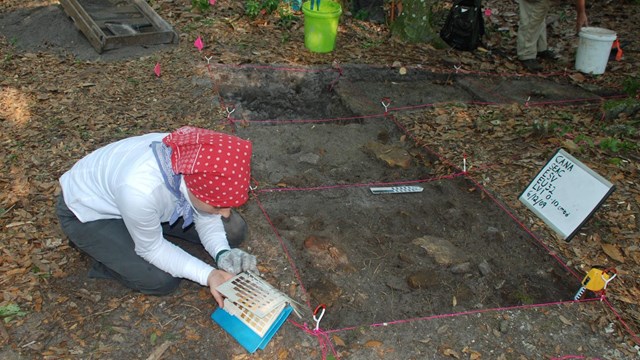
Few traces of human life can survive the natural ravages of 12,000 years, particularly in the wet climate and acidic soils of the southeastern United States, which destroy many of the clues important Figure 6: Excavating and sifting (70.1 KB).to tracking the past. As a result, uncertainty and ambiguity are inevitable companions to efforts to document this long-ago period of occupation. Fortunately, however, one sign people existed usually withstands the worst circumstances - stone tools.

Using scientific techniques-including studying the stratigraphy or layering of the soil where artifacts are found-archeologists have identified a particular type of sharpened stone spearpoint as the handiwork of the early Paleolndians. Called a Clovis point, its refinement and beauty belie the notion that the weapon was made haphazardly by unskilled hands. Indeed, the craftsmanship of Clovis points far exceeds that usually demonstrated in stoneworking in the thousands of succeeding years. A Clovis point eloquently conveys its creator's concern for symmetry and perfection as much as his need for a weapon.

While they vary in size by several inches, Clovis spearpoints share a distinct lance or laurel-leaf shape and smooth straight groove up the center. The groove, called a flute, often reaches half way to the top of the point. Experts speculate that this feature helped hunters attach the point to a wooden or bone spear shaft. Strips of animal tendons or intestines were wrapped around the bottom of the point to secure it to the spear shaft. The sharp edges at the base of the spearpoint were typically blunted to prevent them from cutting the binding. Some toolmakers even used a natural resin to glue their weapons together, as evidenced by Clovis points found with bone foreshafts in southwest Montana.

Some Clovis points have delicate parallel flaking with pronounced ridges along the sides resembling perfectly aligned ocean waves, which were painstakingly chipped out of the stones. Paleolndians also took care choosing the raw material for their weapons. Often they used chert or flint, favored for their superior qualities for flaking. Flaking is the removal of bits of stone to form the point. Clearly, there were many intricate steps required to produce the desired result a precisely formed projectile as deadly as a bullet.

How did prehistoric hunters use these devices and what were their prey? Animals of the late Ice Age included species such as the wolf and grizzly bear whose descendants still exist, although in drastically reduced numbers, as well as creatures that are now extinct. The majestic wooly mammoths fall among those vanished from the earth, perhaps in part because of the PaleoIndians who hunted them.

Like the elephant, which it resembled, the mammoth dwarfed all other creatures of the time, standing up to 12 feet tall and weighing thousands of pounds. Brown, shaggy hair protected its thick hide from the cold, while a pair of sharp tusks served as formidable defenses. Other than humans, however, the mammoth had no natural enemies.

Proof that Paleolndians hunted the mammoth is strong. Archeologists have actually found Clovis spearpoints lodged between a mammoth's rib bones. Other points were found close to fossilized mammoth skeletons in New Mexico, Arizona, Colorado, Wyoming, and Montana.

Hunting the mammoth required cunning and courage with only a stone point and spear as a weapon. If mammoths behaved similarly to their elephant counterparts, they were fiercely protective of their young. Mother elephants meet approaching danger with a terrifying charge. Stealth and planning, then, were crucial to the hunter's success, and even his own survival.

Speculation about ancient hunting techniques comes partly from studies in Africa by archeologists such as George Frison of the University of Wyoming. Paleolndians likely did not confront an entire mammoth herd, but watched and waited until one animal strayed and became vulnerable. Preferred targets were the young, sick, and weak animals. A team of hunters cautiously approached the selected beast, staying downwind of their prey and the herd until they were close enough to throw or jam their spears into the mammoth's belly.

Figure 7: Southeast Clovis Points (54.6 KB).But hitting their target far from assured success. A Clovis point was sharp enough to inflict a fatal wound, but death of the giant creatures was rarely immediate. Repeated spear jabs were necessary at perilously close range, and there were always the possibilities that the wounded mammoth could thrash violently and crush the hunters or charge them with a speed remarkable for its enormity. Or, if it was still strong enough to flee, hunters had either to abandon the pursuit or track the animal for many hours, even days, until it weakened enough for them to inflict further wounds. But their dangerous labors, if successful, were rewarded with enough meat to feed many people.

Where their distinctive spearpoints are found tells us not only what Paleolndians hunted, but also where they explored, a topic studied by archeologist David Anderson, who was closely involved with the Russell Reservoir research. His theory is that migrating Paleolndians encountered four major river systems after they reached the northern borders of the western United States. The rivers - the Missouri, Platte, Arkansas, and Red - all flow generally towards the east and south into the Mississippi River.

People have always tended to follow rivers as a source of drinking water and for other logical reasons-animals searching for water beat down paths along the rivers, making human travel easier and providing potential game; and the rivers themselves wear away valleys through rugged terrain, further easing the way for people. Therefore, Anderson theorizes that Paleolndians probably followed the Missouri, Platte, Arkansas, or Red Rivers into the center of the country, and that eventually some found their way across the Mississippi River into the eastern United States.

After crossing the Mississippi, Paleolndians likely slowed their journey. Some may have stopped altogether, settling in Alabama, Tennessee, Kentucky, and Ohio, where the most Clovis points have been discovered in the eastern United States. The travelers found ample resources in those places, including the preferred rocks for their spearpoints. Many may have stayed in these staging areas for a number of years, allowing them to bear and raise children without the stress of constant travel, as well as to learn how to exploit the bounties of a new land.

Observations of contemporary preliterate people suggest that Paleolndians probably clustered in small groups (called bands) of no more than 150 people in their beginning days in North America. These groups were probably extended families. Most major decisions were likely made by the dominant males, usually the most skilled hunters, although all adults, males and females, probably had fairly equal say in matters.

Gradually, between 11,200 and 11,000 years ago, as the population grew in the Ohio River Valley and the mid-South, new groups split off and moved to other areas. There is also evidence suggesting that even before then, Paleolndians may have explored widely in eastern North America. Artifacts found at Little Salt Springs on the Gulf of Mexico coast of southern Florida, for example, date to 12,000 years ago.

Certainly by 11,000 years ago, Paleolndians had covered considerable ground and also had begun to settle in favored spots throughout much of what is now the eastern United States. We know this because of the spearpoints they left behind.

The absence of spearpoints in some regions indicates areas Paleolndians avoided. They seemed generally wary of high, rugged mountains and places without the flint or chert they used for weapons.

Whatever their exact route was, Paleolndians eventually made their way to the land along the Savannah River and left their stone calling cards behind. Altogether, some 50 Clovis spearpoints have been found along the approximately 250 miles of the river's drainage system in Georgia and South Carolina. Only three of the points were discovered during the Russell investigations, despite widespread archeological excavations. And none of the Clovis points were located near tools or soil stains associated with the PaleoIndian period, suggesting the area was only minimally occupied. There were, however, major PaleoIndian population concentrations in South Carolina, northern Florida, and the ridge and valley section of northwest Georgia and northern Alabama where many more points were found.

The hunters who left the three points behind at different locations in the Russell area were probably searching for game or exploring. Perhaps they dropped the weapons as they moved quickly after animals or lost them when they stopped to rest. Nothing, however, remains to suggest that they lingered for long. Yet even these few remnants fill in more of the puzzle of their lives.
 

Making a Spearpoint

Once he chose a rock to make into a spearpoint, the prehistoric hunter used another rock called a hammerstone to help in the initial shaping...


Seeing the early Paleolndians' handiwork cannot help but stir the imagination about these ancient people. The Clovis point from Rucker's Bottom, which is displayed in the Russell Dam visitor's center in Elbert County, Georgia, is so delicately sculpted in glossy black chert that it suggests the skill of an accomplished artist concerned with aesthetics as much as function. Less than two inches long, the point has finely chipped grooves along its sides that are unquestionably the result of nimble fingers and a demanding eye.

The three Clovis points found in the reservoir area also provide other insights about their makers. The chert they used came from at least 100 miles away from where the points were discovered. One point was made from chalky-looking chert found in Allendale County, South Carolina, midway between Augusta and Savannah, Georgia. The blackish-colored rock for the other two points came from near Chattanooga, Tennessee.

Whether the Paleolndians traded with others for these spearpoints or simply covered all those miles on foot themselves is open to debate. However, in a study of artifacts discovered near the Savannah River, avocational archeologist Tommy Charles found that some of the earliest hunters did carry or exchange spearpoints up to 150 miles from a rock source.

Possibly only one band of between 50 and 150 early Paleolndians roamed the approximately 250-mile-length of the Savannah River. They probably also hunted in territory that included several adjacent river systems. According to David Anderson, a similar pattern possibly occurred throughout much of the East, with a small band at first using the land around several entire rivers to hunt. Then, as population grew and new bands formed and moved away, every group reduced its territory to only one major river system.

Exactly which animals Paleolndians pursued along the Savannah River is uncertain because the elements destroyed Ice Age faunal remains. However, Clovis points are linked with the prehistoric Bison antiquus and the giant land tortoise in Florida. And because the wooly mammoth, ground sloth, and other now-extinct creatures lived in the Southeast and Paleolndians hunted these animals in the West, most experts assume that they killed them in the South as well.

There is, however, a growing number who think that southeastern Paleolndians were not overly dependent on large animals because of the many other foods available to them in the ecologically-rich area. They could have eaten smaller animals, as well as seeds, berries, nuts, and roots. Again, observing preliterate people today, authorities note that they neglect few edible resources.

Like so many questions about these earliest prehistoric people, the answer to just how nomadic they were is elusive. They were constant wanderers, tracking game and other resources and rarely settling anywhere for more than a day or two, according to one theory. Another view sees Paleolndians as true nomads only during their earliest incursion into the eastern United States. Later, according to this theory, they became more settled.

William Gardner favors this latter idea. His studies in Virginia show that Paleolndians established basecamps, where they lived at least part of the year, near sources of rock preferred for their weapons. Gardner thinks other bands along the Atlantic coast behaved similarly, revisiting year after year places near sources of chert, called outcrops. Outcrops are exposures of rock above ground where hunters obtained stone for tools.

PaleoIndians used a range of camps or sites, according to this theory. Typically, at the rock source, they quarried the chert, chipping out large chunks. Then they carried the chunks to another site where they worked away more of the rock, reducing it to pieces small enough to take to their basecamps. At the basecamp, they finished the task of forming spearpoints and other tools. They also used still more sites as brief camps on hunting trips.

Research in Missouri and Arkansas by Phyllis Morse and Dan Morse supports the notion that PaleoIndians there maintained year-round basecamps by around 10,500 to 10,000 years ago. These camps tended to be established in the center of a band's territory and the Paleolndians also set aside special areas as cemeteries. Hunters, when away from the basecamp, probably set up short-term camps in outlying areas, and there were likely other sites where people collected and processed plant food.

But another archeologist, Michael Schiffer, looking at some of the same data examined by the Morses, argues against year-round settlements. He thinks Paleolndians in Arkansas and Missouri were much more mobile and may have alternated between summer and winter basecamps. He also thinks they sometimes traveled to short-term camps for hunting and gathering plant food.

Despite such differences of opinion, many archeologists agree that, at least by 10,500 years ago, Paleolndians had chosen to live in basecamps for at least part of the year. They still may have moved about extensively searching for food, but they eventually returned to places that could be called home.

We also know that their numbers steadily grew, another fact gleaned from their stone weapons. While only three Clovis spearpoints from the Early PaleoIndian period of 11,500 to 10,500 years ago were found in the Russell studies, 14 spearpoints from the Late PaleoIndian period of 10,500 to 10,000 years ago were found. These more recent artifacts, called Dalton spearpoints, tend to be smaller than Clovis points and are often distinguished by pronounced flared ears at the corners of their bases.

Figure 9: Dalton Spearpoints (42.0 KB).The change in points was gradual. Clovis points by the end of the early period began to show slight variations from one region to another, indicating that different traditions were developing. There is a design similarity between Clovis and Dalton points. The Daltons show a thinning at the base, not unlike the beginnings of a flute, supporting the idea that descendants of the earliest arrivals made the later points, not some new group that migrated into North America.

Why did Paleolndians alter a point style that had served their predecessors so well? Most likely because the world around them was changing. With the decline and ultimate disappearance of huge animals like the mammoth, hunters began to pursue smaller game more often. Consequently, smaller spearpoints resulted.

There were also other changes - the weather was warming, leading to different vegetation. Somehow, people adapted and continued to grow in population, their increasing numbers documented by the dramatic rise in the quantity of their artifacts found at various locations.

By the end of the PaleoIndian era 10,000 years ago, spearpoints were serrated with small, sharp teeth along the edges. These serrations are important because they show that hunters had learned how to cut more efficiently when they used the points as knives. Also, they had begun to resharpen and reuse their weapons.

Archeologist Lisa O'Steen has documented other changes in her study of an area along the Oconee River in Georgia near the Russell Reservoir area. She found that by 10,500 years ago, Paleolndians camped and hunted in the river floodplains as their ancestors did, but they also began to use the land in between rivers, called the uplands, more often.

Paleolndians also eventually made their spearpoints from more readily available rocks, a finding substantiated by the Dalton points uncovered in the Russell studies. Of 14 Dalton points found during the studies, 12 were made from quartz that could be found nearby; the other two were made of chert from some distance away. The change is significant because making their weapons mostly from nearby materials suggests that late Paleolndians probably lived at least part of the year in the Russell Reservoir area. They were not just passing quickly through as the earliest visitors are thought to have done. In other words, the people who made Dalton spearpoints were the first to make the upper Savannah River area their home.


Chapter 3: A Break with the Past

Return to the Table of Contents