PART I

The Prehistoric People

Figure 2: A Ritualistic Drinking Ceremony (64.7 KB).
(Click images to enlarge)


Figure 3: A Prehistoric Defensive Palisade (44.3 KB).
(Click images to enlarge)

CHAPTER 1

Along the River Bank


In the 1400's, about a century before the Spanish adventurer Hernando de Soto and his army hacked their way through the dense growth of Georgia and South Carolina searching for treasure, there was a prehistoric village on a terrace overlooking the Savannah River. Inhabitants of this village, who feared attack, shielded themselves from their enemies by digging a long ditch that nearly enclosed their entire settlement. In places, the ditch was almost eight feet wide and four feet deep.

As the people, using handmade tools of bone, wood, and stone, had slowly hollowed out the ditch, they loaded the dirt into baskets, which they carried back towards the village. When they were about 20 feet behind the ditch, they began forming another defense against assault-a stockade fence paralleling the ditch.

They dumped basket after basket of dirt into a long, low embankment to form the base of the fence. Then they trampled this soft earth with their feet and dug a small trench in the accumulated earth. The trench was the foundation for fence posts, which they closely aligned, creating the fort-like palisade between themselves and the dangers lurking outside.

Others who had lived on the same river terrace about 100 years earlier had felt little need for such deterrents from hostile forces. Yet, they were not completely free either. They paid tribute to a powerful leader living in a ceremonial center built around an earthen mound about seven miles away. The terrace dwellers gave part of their hard-earned food to this ceremonial chief, including the choicest parts of deer they had slain. They rendered this tribute because they thought the chief was favored by the gods and served as their intermediary with the spirits.

But the later villagers, who protected their homes with the ditch and stockade, were obligated to feed only their own people. They paid no duties to distant leaders, but kept all their game, which they butchered on a small bit of land about 400 yards from their houses beyond a swampy marsh.

The men and boys of the community kept their hunting and fighting skills honed through athletic games performed as entertainment for the other villagers who gathered along the edges of a big plaza to watch. A favorite sport was the "chunkey" game, usually played by two people. Each contestant held a spear or long pole, which he tried to throw exactly where he thought a rolling chunkey stone tossed in front of the opponents would eventually stop. The player whose spear landed closest to the stone won. They repeated the contest many times, sharpening both their throwing and estimating abilities, important skills for hunters and warriors.

They also increased their proficiency with bows and arrows in another way. A small hill of dirt was heaped in a part of the plaza where a mighty tree post stood, towering 30 to 40 feet high. From time to time, an agile youth shinnied up the post all the way to the top to hang something small that he and his companions then used as a target for their arrows.

But hunting supplied only some of the community's food. Villagers grew one of their most important staples, corn, in the fertile land deposited over many years by the overflowing river close by. The river itself supplied more nourishment in the form of fish, while the people gathered from nearby forests the acorns and hickory nuts and other plant foods that supplemented their diet.

Important matters affecting villagers were settled in a round council house, about 50 feet wide, erected near the plaza. Here the village leader presided, with his counselors in attendance, over discussions of pressing issues, including war.

Their decision making was often accompanied by a ceremonial pouring and drinking of a powerful hot liquid called a-cee or black tea.

Drunk from a special large seashell, the beverage was extracted from holly leaves and contained potent quantities of caffeine. The men drank copiously until they vomited, which they considered beneficially purifying, giving them clear heads, hearts, and stomachs for resolving issues important to their people. Those excluded from the deliberative meetings performed other duties, such as keeping the council house clean and swept of debris or supplied with river cane, burned for light.

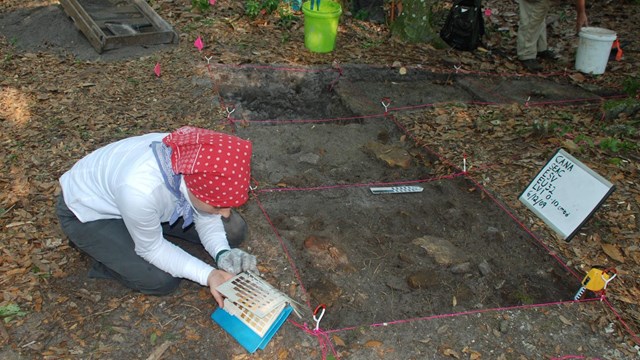
Figure 4: Excavations at the Rucker's Bottom Site.To sleep, the people retired to homes of varying sizes and shapes arranged around the plaza. Some dwellings were modest constructions, no wider than ten feet, while others spanned three times that much space. The shelters were built as either circles or rectangles shaped by wooden posts. For everyone, there were both winter and summer houses.

The winter shelters were snug constructions covered with woven branches and a thick insulating clay for maximum warmth, while summer homes were loosely made and open to allow cooling breezes to enter.

Interspersed among the homes were storage sheds set above ground on four posts, which were greased with animal fat to thwart scavenging creatures trying to get at the provisions kept inside. Like the winter houses, a layer of clay provided an exterior protective coating over the shed walls. Inside, the vital corn harvest and other foods rested on a cane floor.

Figure 5: Aerial View of the Rucker's Bottom Excavations in 1982.Life for the villagers was closely attuned to the changes brought by the seasons and to the river flowing steadily by them. In many ways, their lives were identical to those led by their ancestors. Mothers and fathers taught their children the same beliefs and customs they had learned from their parents, who had learned them from their parents, and so on for generations. And when death came, family members were not buried in some isolated spot rarely visited, but beneath the floors of their homes or in earth nearby.

Then, as if carried away by a wisp of smoke, everyone was gone. No new children took up the traditions so carefully passed down over the years in this riverside setting. And not only did these people disappear, but others for miles along the waterway also vanished. When the Spanish arrived in 1540, they found only lonely miles of lush uninhabited land, all but empty of human beings.

* * * * *

Five-hundred years later, as part of one of the most extensive archeological undertakings of its kind, traces of these two long-abandoned settlements emerged in a place called Rucker' s Bottom in northeast Georgia.

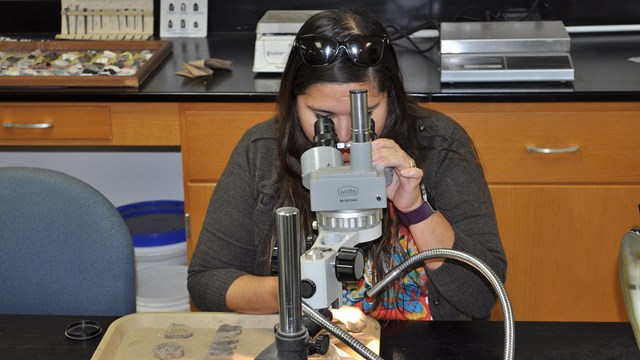
From analyzing fragments, some as small as pollen grains and as ephemeral as pale stains in the dirt, and by studying accounts written by the earliest European explorers, archeologists pieced together a partial portrait of what life was like for these people who had left no written records of their own.

But even with the abundance of knowledge gained in the years of investigations in the Russell Reservoir area, there are still blank areas on the canvas, still many remaining questions, questions that will keep those who study the human past occupied for many years. Among the more intriguing mysteries to be solved is why the people who once lived on this terrace overlooking the Savannah River disappeared.


Chapter 2: The First to Arrive

Return to the Table of Contents