
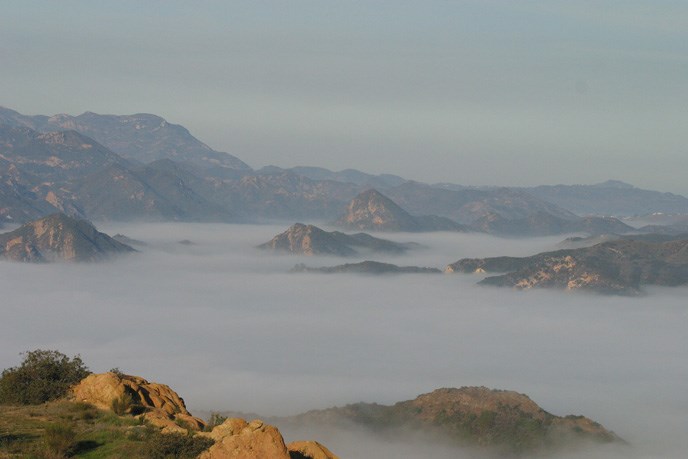
National Park Service The Mediterranean ecosystem occurs only in five relatively small areas around the planet: the area bordering the Mediterranean Sea, central Chile, the Cape region of South Africa, southwestern and southern Australia, and, of course, southern California and northern Baja California. These areas are distributed between roughly 30 and 40 degrees latitude – north and south – and are located along the western edges of continents where the climate, characterized by mild, rainy winters and warm, dry summers, is moderated by cold ocean currents offshore.
Throughout the world, the Mediterranean ecosystem is characterized by evergreen or drought deciduous shrublands. The chaparral of southern California is echoed in the old world Mediterranean maquis, the Chilean matorral, South African fynbos and the Australian mallee scrub communities. Due to the limited extent and isolation (almost island-like) of each area of the Mediterranean ecosystem, there is frequently a high degree of endemism in the flora and fauna.
The five Mediterranean regions have been highly favored and impacted by humans for habitation, agriculture and recreation. As a result, this ecosystem type (which only occurs on about two percent of the earth's total land area) is one of the most highly altered on the planet and contains the least undisturbed area of any ecosystem. The high degree of urbanization along the southern California coastline has resulted in the loss of significant natural areas and increasing human impacts to natural systems. Nevertheless the Mediterranean-type ecosystem of southern California has been identified as one of the world's "hot spots" for biodiversity. Additionally, the southern California bight, an ecologically unique area of near-shore Pacific Ocean coastal habitat extending from Point Conception south and encompassing the San Diego area, provides conditions that promote high species richness and diversity. |
Last updated: August 7, 2015