
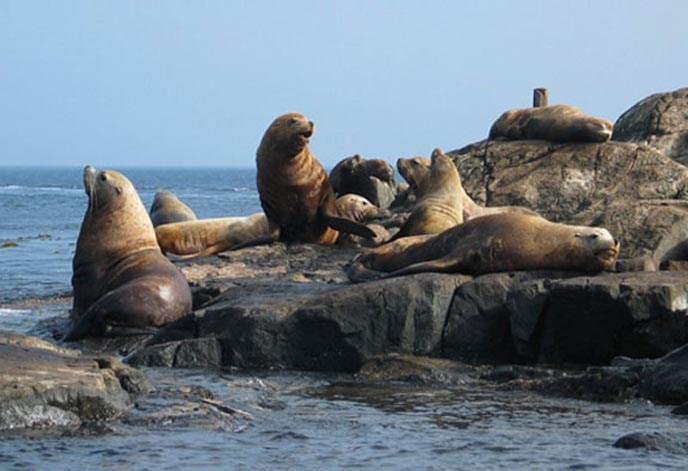
It's not unusual for a Northern sea lion to occasionally haul itself onto the beach to bask in the sun in one of the pocket coves between Grandma's Cove and South Beach at American Camp. Around the island, these gregarious sea lions are most often seen in the spring, resting on remote beaches and offshore rocks in groups of hundreds to thousands of individuals. Don't worry about finding them—you'll hear them first. Their growls and roars carry for a good half mile. With their broad forehead, thick neck, and light to golden brown coat, they are easy to distinguish from the Pacific harbor seal. One difference is that they have small external ear flaps and excellent hearing. Another is that their flippers are much longer, with fur on the top half. Plus, because their four web-like flippers contain the same bony structure as the legs of land animals, they can draw their hind flippers forward and "walk" on all fours. They can move surprisingly fast on land, but even more so in the water. They propel through the water with foreflippers, using back flippers as rudders for steering. They are playful, and are known leap clear out of the water. They can dive up to 650 feet for off-bottom prey, and feed on herring, squid, octopus and shrimp. They are prey to orcas and sharks. If you're fortunate enough to see one, steer clear—at least 200 yards—for their safety. Their deep, lion-like roar may warn you off. 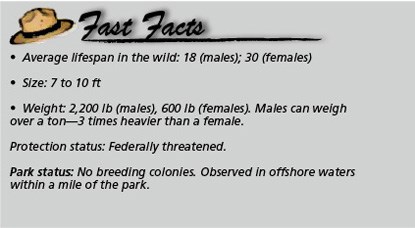
|
Last updated: March 1, 2015