
Mike Vouri If current trends continue, American Camp's prairie may become only a memory. Native grasses and wild-flowers are being crowded out by exotics (nonnative plants), and woody species are slowly replacing the grasslands. These changes are occurring because fire is no longer used as a way to regularly restore the prairie, and because Europeans who arrived in the 1850s introduced livestock and invasive, nonnative plants that continue to alter the habitat. Why Restore the Prairie: The prairie in its original state is integral to the history of the park, which was originally established to interpret the story of the Pig War. Also, this type of landscape is becoming increasingly rare in the Pacific Northwest, as nearly 95 percent of lowland Puget Sound prairie habitat has been destroyed or heavily altered. How do native and nonnative communities differ? There's a huge difference. Native plants include wildflowers like camas, chocolate lilies, lupines, blue-eyed Marys and shooting stars, plus lots of native grasses. It's like a little garden. If you go to altered areas, you'll see thistle and three or four species of nonnative grasses that form mats so dense they won't support any other plants. Initial studies: In the mid-2000s, preparation began, which included inventory and monitoring of plants, small mammals and birds; mapping remaining concentrations of native plants; and observing the life cycle and ecology of the rare Island Marble butterfly. NPS fire crews prepared the dark area, just down from the Redoubt, for replanting by Friday Harbor home-school students and other volunteer groups. Findings include three methods of restoration: • Removing invasive plants: Methods to control invasive, nonnative plants include pulling them by hand and selective treatment with herbicides to eliminate the most resistant grass species. Among the targets are Canada thistle, Himalayan blackberry and tansy ragwort. • Planting native plugs: Last year National Park Service biologists gathered seeds from the prairie for cultivation. The tubes you see adjacent to the visitor center contain the native bunchgrass, Roemer's fescue, which is being transplanted in designated sites on the prairie. Newly planted plugs are taking hold in the area west of and below the Redoubt. This year additional grasses and wildflowers will be cultivated as well. • Burning designated areas: Using fire as a way to encourage growth of valuable plants is a time-honored method that was practiced by the Indians. "Many native plants evolved in the presence of fire and need it in order to thrive," Dederich said. "For instance, chocolate lilies are one of the first plants that come back after a burn. There's no real substitute for fire. You can mow or cut back woody growth, but it never really completely duplicates the role of fire in restoring the ecosystem." What about the rabbits? Have you noticed the barren "moonscape" along Pickett's Lane, the stretch with no grasses or wildflowers in sight? This is an example of how destructive the European rabbit can be. A nonnative species brought to the island in the late 1800s, they are destroying the prairie by digging extensive burrow systems. Fencing constructed in recent years prevents them from entering certain areas targeted for restoration, and additional ways to control them are currently under discussion. How you can help: You can contribute to prairie restoration in the park! Many groups and individuals are helping by: • Growing native grasses and wildflowers at home. • Transplanting plugs on the prairie. • Pulling invasive plants such as tansy ragwort, thistle and blackberry. If you would like to participate, call Jerald Weaver, chief of resource management, at (360) 378-2240, ext. 2224. 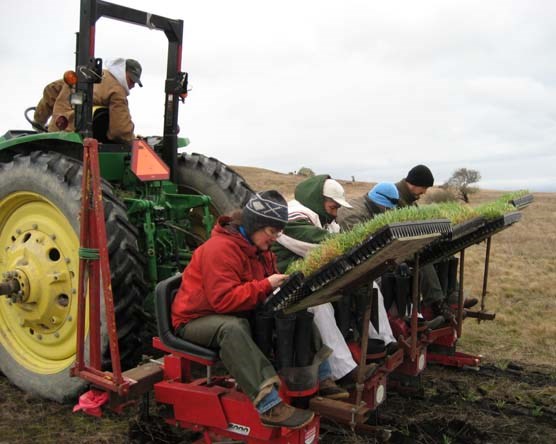
Andrea Weiser |
Last updated: March 1, 2015