
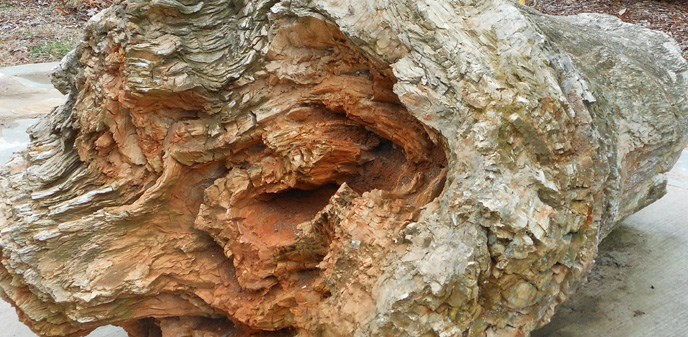
The petrified, or fossilized trees of Prince William Forest Park are believed to be Taxodium distichum, or bald cypress. Part of this opinion is founded in the fact that the fossil trees were found in the only area within the park where Cretaceous period sediments are found, that being the northeastern corner of the park. Taxodium were proliferate during the region during the Cretaceous period, and a side-by-side comparison of the fossils against their present-day counterparts makes the distinction rather easy. When was the Petrified Tree Alive?Scientific data suggests that the Earth is 4.6 billion years old; to put that into perspective, if that entire timeframe were to be compressed into a 24-hour period, then humans as a species have only existed for approximately 10 seconds. This immense timeframe has been divided into various eons, periods and epochs as a way of understanding the variations of life and climate that existed in this changing world. The Cretaceous ClimateDuring the portion of the Cretaceous period when our fossil trees were growing, Virginia was largely swamps with tremendously high humidity and daily temperatures over 100° daily. The swamp-like environment, coupled with the touching landmasses, allowed for a broad distribution of animals and explains why the same sorts of fossils found along the coast of Africa. How Did the Wood Turn to 'Stone'?In order for a plant to be fossilized, oxygen must be removed from the plants environment. Though this can happen in many ways (such as fire or volcanic explosions), in the case of our petrified wood, this occurred when the ancestral bald cypress trees fell over into the dense mud of their tropical environment. The lack of oxygen in this environment is called anaerobic. It is necessary to fossilize the wood because most bacteria, insects and other decomposers require oxygen to decompose the organic material of the tree. 
About Our Petrified TreeBald cypress is a large, slow-growing but long-lived, deciduous conifer, which frequently reaches 100 to 120 feet in height and 3 to 6 feet in diameter. Its trunk is massive, tapered and buttressed. The leaves are alternate, linear and flat with blades generally spreading around the twig. The bark is thin and fibrous with an interwoven pattern of narrow flat ridges and narrow furrows. Its male and female flowers form slender tassle-like structures near the edge of the branchlets. Bald cypress trees produce cone fruit, and there are approximately 5,200 seeds per pound. It develops a taproot as well as horizontal roots that lie just below the surface and extend 20 to 50 feet before bending down. It develops knees that grow above water providing additional support. 
NPS photo How Old was the Tree When it Fell?The larger of the two specimens, which has the truck section intact and is located outside of the visitor center, measures an average of two feet in diameter at the distal (narrow) end and 3'4" to 4'6" in variation across the bottom of the trunk. The length of the large specimen is approximately 6' on the average. On the distal end is a section of rings that are clearly visible and cover approximately 5" of radius before the mineralization of the tree obliterates the ring structures. There is a distinct bark ring surrounding the large specimen which varies in thickness between 1-1/2" to 1-3/4" and almost 3" thick on the trunk end. Allowing for this thick bark at the distal end, there is then a total of 40 rings clearly seen in the five inches of radius that is visible. Assuming that the rate of growth of the tree was normal and regular, without droughts or other interferences, we can say that the ring density is approximately eight rings per inch, given 40 rings within 5 inches seen. With a radius of 12 inches, subtracting 1 inch for bark, that would give us 11" of tree left, placing the approximate age of the tree at around 88-90 years of age before falling. |
Last updated: June 1, 2022