
• East view from Crissy Field overlook with old Coast Guard station on left and city on right

    Presidio of San Francisco

    California

There are park alerts in effect.
show Alerts »
  • CAUTION: Post Storm Damage to Coastal Trail

    The Presidio Coastal Trail segment just north of the Pacific Overlook and adjacent to Lincoln Blvd remains CLOSED indefinitely. We have posted signage to alert bicyclists and hikers and with information for safe trail alternatives. More »

Serpentinite

Serpentinite block

Large boulder of serpentinite embedded in sheared serpentinite matrix north of Baker Beach.

Will Elder, NPS

Serpentinite is a rare rock type that is most often developed in subduction zones, where one tectonic plate is subducted under another. The serpentinite at the Presidio is probably made from rock scraped off the bottom of ocean crust that is found east of the subduction zone. These deep ocean crust and upper mantle rocks were then altered by pressure and hot fluids that circulated through them in the subduction zone and on their way to the surface. They are now at the Earth's surface because the region has experienced uplift after subduction ceased, and because these altered rocks are now lighter than surrounding rocks and are therefore rising to the surface.

Since it is derived from mantle material, the chemistry of serpentinite is unlike that of most rocks in the earth's crust. Serpentinite rock is mostly composed of a mineral called serpentine. This mineral is low in potassium and calcium, both of which are plant nutrients, and also contains high levels of potentially toxic elements such as magnesium, chromium, and nickel. Plants that live on serpentinite are adapted to survive in these unusual chemical conditions.
Because serpentinite outcrops form small isolated areas of unusual soil chemistry, endemic plants adapted to these chemical conditions, and the microclimates of a particular outcrop, often evolve there. Several of the Presidio's endangered plant species (Presidio clarkia and Raven's manzanita) are endemic species adapted to the conditions developed on the serpentinite outcrops here.

Learn more about serpentinite.

 
Serpentinite
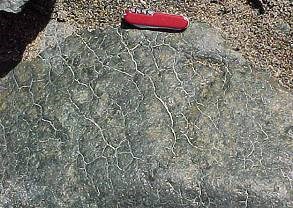
Serpentinite boulder on beach showing asbestos
vein network. Fibrous asbestos is one of the forms
of the mineral serpentine.
Will Elder, NPS

Did You Know?

Jonathan Letterman

Major Jonathan Letterman--after whom the hospital at the Presidio was renamed in 1911--was the medical director of the Army of the Potomac. A founding father of military medicine, Letterman organized forward first-aid stations, mobile field hospitals, and ambulance services during the Civil War.