
|
In the years between the two world wars, the Regular Army was severely under strength, including the Buffalo Soldier regiments. Despite attempts at modernization, the military failed to keep up with developments in Europe and Japan. The cavalry insisted their horses were indispensable. The men of the 9th and 10th Cavalry continued using horses just as their regiments had done since 1866. Racist attitudes in the army persisted. Black soldiers in the southern United States were subjected to Jim Crow laws, even when wearing their country's uniform. African American troops continued to be segregated on posts located in the United States, Hawaii, and the Philippines. Many racist leaders in the army and Franklin Roosevelt's War Department felt Blacks were unqualified for combat even though they had a long history of valor, and most African Americans were relegated to labor and service battalions. Despite the achievements of men like Colonel Charles Young, Colonel Franklin Dennison, Colonel Benjamin O. Davis, Sr., and the numerous Black Captains and Lieutenants of the First World War, most army commanders still felt by that Blacks were at their best when led by Caucasian officers. In 1941 there were only five Black officers in the regular army. Two of these officers were Benjamin O. Davis, Sr. and his son Benjamin O. Davis, Jr.; the other three officers were chaplains. Benjamin O. Davis, Sr. became the first African American promoted to the rank of Brigadier General. He served as a staff officer, primarily as a liaison between Black troops and higher command. 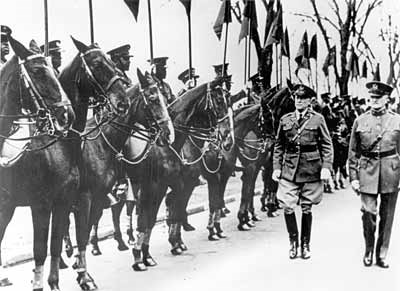
Credit: Golden Gate National Recreation Area, Park Archives By 1940 there were about 4,000 African Americans in the army, and about 3,000 serving in the National Guard. United States involvement in World War II began with the attack on Pearl Harbor on December 7, 1941. During the war, Blacks served in all branches of military service including the Army Air Corps and the Marines. (43) The Black 92nd and 93rd Divisions were reestablished as well as the 2nd Cavalry Division, which included the old Buffalo Soldier 9th and 10th Cavalry Regiments. African Americans felt they had the right and duty to fight for their country, but reactionaries in the War Department thought otherwise. It was felt that there was a shortage of personnel for service and supply operations behind the battle lines. The War Department sought to alleviate these shortages by converting combat-trained Black soldiers to support roles. In March 1944, the 2nd Cavalry Division arrived in North Africa, where the entire Division was inactivated and converted to service units. Among the victims of this manipulation of manpower were the historic Buffalo Soldier 9th and 10th Cavalry Regiments that had served with distinction since 1866. As in World War One, more Black volunteers saw action than combat-trained Black troops, serving bravely at Anzio, Omaha Beach, the Battle of the Bulge, and in many other critical assignments during the war in both Europe and the Pacific. The end of segregation in the United States Army began July 26, 1948, when President Harry S. Truman issued Executive Order 9981 declaring that "there shall be equality of treatment and opportunity for all persons in the armed services without regard to race, color, religion, or national origin." (44) Initially Black soldiers were gradually integrated into predominately white units. Caucasian soldiers were not integrated into existing Black units. Only two of the old Buffalo Soldier regiments remained part of the army. The 25th Infantry Regiment was deactivated in 1949, and in 1951 the colors of the 24th Infantry were officially retired. Former Lieutenant Vernon Baker, awarded the Medal of Honor in 1997 for bravery in World War II while serving in a segregated unit, modestly said "I was a soldier and I had a job to do." (45) After eighty-five years, the story of the Buffalo Soldiers ended as the army took the lead in establishing an integrated society. But the memory continues of their valor, patriotism, and dedication to duty, despite racism and adversity. A memorial monument to the Buffalo Soldiers stands at Fort Leavenworth, Kansas, facing west on a bluff overlooking the Missouri River. At the statue's dedication in 1993, then Chairman of the Joint Chiefs of Staff, General Colin Powell, said, "There he is, the Buffalo Soldier on horseback, in his coat of blue, eagles on his buttons, crossed sabers on his canteen, rifle in hand, pistol on hip, brave, iron-willed, every bit the soldier that his white brother was. African Americans had answered the country's every call from its infancy, yet the fame and fortune that were their just due never came. For their blood spent, lives lost, and battles won, they received nothing. They went back to slavery, real or economic, consigned there by hate, prejudice, bigotry, and intolerance. . . I am deeply mindful of the debt I owe to those who went before me…don't forget their service and sacrifice." (46) Overcoming the burdens of its past, today's U.S. Army is a truly integrated institution where non-white soldiers serve along side their white counterparts at all levels of responsibility. This legacy is a monument, though not one caste of bronze and stone, to the winning spirit of the Buffalo Soldiers. 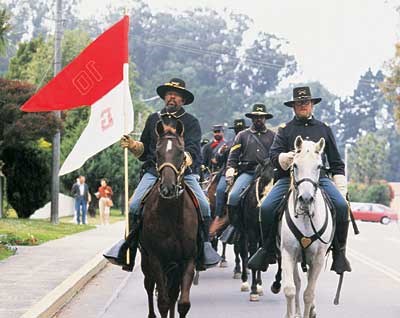
at the Presidio of San Francisco. Return to Buffalo Soldiers Home The Main Post Barracks |
Last updated: February 28, 2015