
National Park Service LogoU.S. Department of the InteriorNational Park ServiceNational Park Service
National Park Service:  U.S. Department of the InteriorNational Park Service Arrowhead
Presidio of San FranciscoCavalry barracks, built 1902
view map
text size:largestlargernormal
printer friendly
Presidio of San Francisco
Architecture: Greek Revival (1840 - 1860) & Italianate (1860 - 1880)
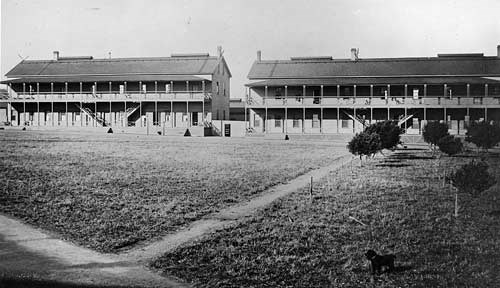
Buildings 86 and 87 circa 1930
National Park Service, GGNRA
Constructed on the Main Post in 1862, Buildings 86 and 87 served as cavalry barracks. Photo taken 1924-1938.
 
Constructed in 1862, Buildings 86 and 87 are the earliest wood-frame buildings still extant at the Presidio. These structures represent a simplified version of the Italianate and the Greek Revival styles, both popular at the time of the Civil War. The Italianate style was predominantly used in residential architecture, where the design and shapes were based on the classical villas of Northern Italy. Features of the style include low roofs, long overhanging eaves, decorative brackets, cupolas, and arcade porches. The Greek Revival style was based on the application of Greek temple shapes to all types of buildings—sometimes indiscriminately—through the inclusion of pediments, columns, bold moldings and heavy cornices. The simplest elements of these two styles were combined in the Quartermaster's building patterns for wood-frame structures.
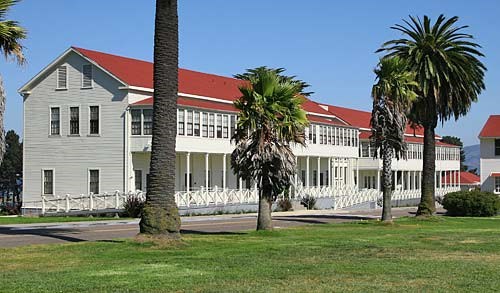
 
Buildings 86 and 87 today.
National Park Service, GGNRA
Buildings 86 and 87 as they appear today. Note the enclosure of the original second story porches.
 
The 6th Army Band during Alpert's service.  

Did You Know?
Herb Alpert, Grammy Award-winning bandleader of the Tijuana Brass, played in the 6th Army Band at the Presidio during the 1950's. Alpert later claimed the structure and discipline of the Army helped him with his music.

Last Updated: March 05, 2009 at 15:50 EST