
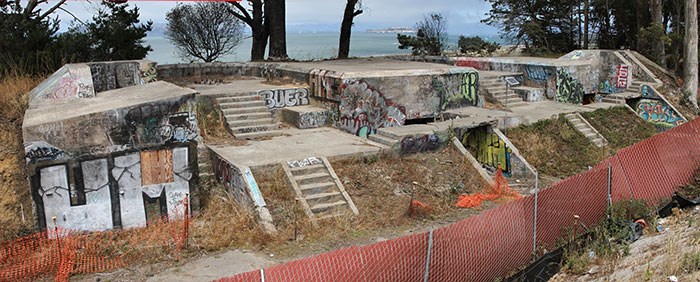
National Park Service, GGNRA General Information Completed in 1900, Battery Sherwood was built to protect the inner harbor with two rapid fire 5-inch guns mounted on pedestal mounts. These guns--part of a new generation of light caliber artillery--were the only such weapons in the bay area at the time. They could fire up to thirty rounds per minute for short periods of time and had a range of approximately seven and a half miles. When the submarine mines were moved to outside the Golden Gate, the Fort Scott boundary was redrawn to place Battery Sherwood within the Presidio of San Francisco. In 1917, the battery’s guns were moved to Battery Bruff at Fort Funston. Origin of Name Battery Sherwood was named in honor of Lieutenant Walter Sherwood, Seventh Infantry, who was killed in 1840 during a battle with Seminole Indians in Florida. Access and Current Condition Battery Sherwood is located at the Presidio near the San Francisco National Cemetery and the cavalry stables. There is currently no access to this battery during construction of the Presidio Parkway. The Battery is in good condition although graffiti has become a constant issue with the gun batteries in this area. |
Last updated: February 28, 2015