
National Park Service LogoU.S. Department of the InteriorNational Park ServiceNational Park Service
National Park Service:  U.S. Department of the InteriorNational Park Service Arrowhead
Point Reyes National Seashore Bolinas
view map
text size: largest larger normal
printer friendly
Point Reyes National Seashore
Salt Marsh
 
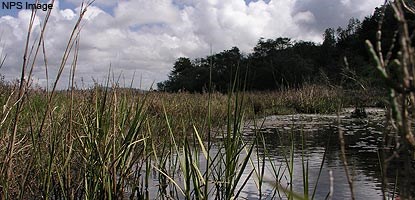
Salt marsh habitat
 

Grasses and short plants grow in the salt marsh. They tend to have stout stems, small leaves and the ability to rid their tissues of excess salt. Most of the plants you see are saltgrass, cordgrass and pickleweed. Saltgrass has special pores on its leaves where salt crystals can push out. Pickleweed also concentrates salt in its leaves. The leaves turn red as the salt concentration gets higher and eventually the plant simply drops its leaves.

Top of Page

bishop pine forest
Bishop Pine Forest
at Point Reyes
more...
coastal dune habitat
Coastal Dunes
at Point Reyes
more...
rolling coastal grasslands at sunrise
Coastal Grasslands
at Point Reyes
more...
coastal scrub at point reyes
Coastal Scrub
at Point Reyes
more...

You are exiting the National Park Service website

Thank you for visiting our site.

You will now be redirected to:

We hope your visit was informative and enjoyable.

Mineral crystals compared to size of a penny.

Did You Know?
Most of the distinctive light-colored rock characteristic of the Sierra Nevada is a granitic rock called granodiorite. A huge formation of this rock, called a batholith, lies within the Sierra. Some 400 miles long and up to 50 miles wide, the Sierra batholith is one of the largest in North America.
more...

Bull elephant seal © Richard Allen

Did You Know?
Four species of pinnipeds (seals and sea lions) rest onshore or breed at Point Reyes: the Northern elephant seal (Mirounga angustirostris), the harbor seal (Phoca vitulina), the California sea lion (Zalophus californianus), and the Steller sea lion (Eumetopias jubatus).
more...

Last Updated: January 30, 2011 at 12:50 MST