National Park Service LogoU.S. Department of the InteriorNational Park ServiceNational Park Service
National Park Service:  U.S. Department of the InteriorNational Park Service Arrowhead
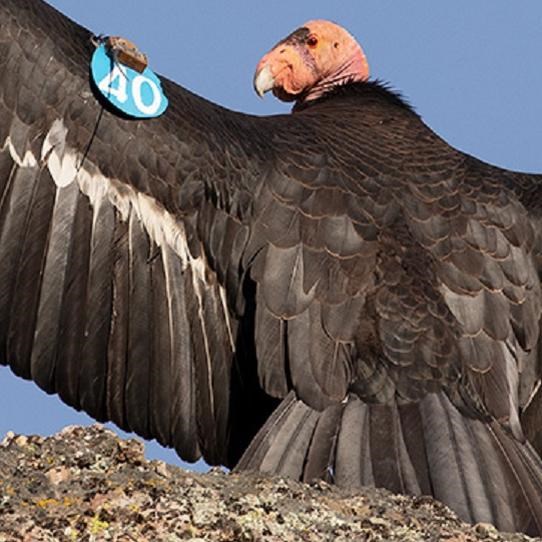
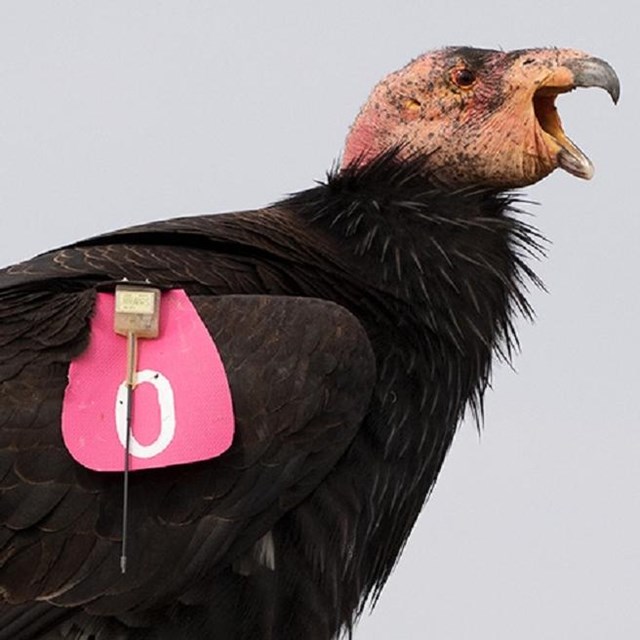
Pinnacles National Monument A California condor spreads its wings as it perches on a rock formation. Photo by Sara Bartels.
view map
text size: largest larger normal
printer friendly
Pinnacles National Monument
Profiles of the Pinnacles Condors
 
Pinnacles Condor 306

306
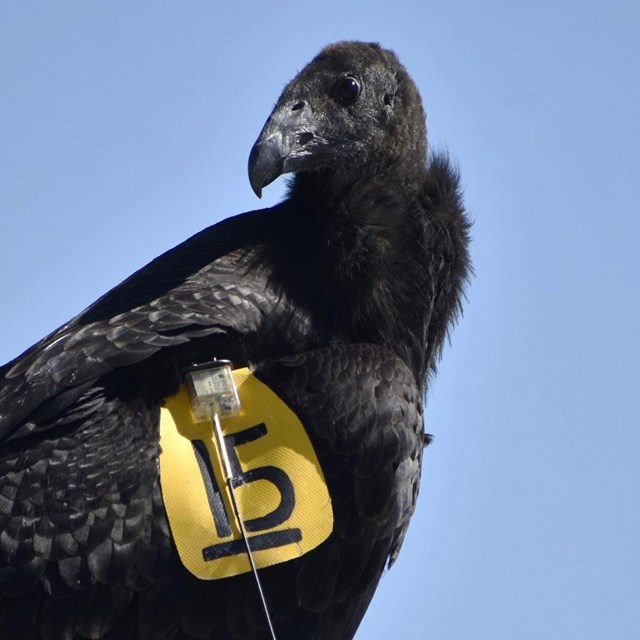
Condor 306 is the oldest condor in the Pinnacles flock. Her hatch date was 5/4/03 at the San Diego Wild Animal Park. She is also the older sibling of 335. She spends a fair amount of time alone but, if hungry enough, can be very assertive in a group. In the flight pen, she spent most of her time with the other LA Zoo condor: 317. Since her release in October, 2004, she has become a well integrated and relatively dominant member of the flock. Biologists selected her to be outfitted with one of the GPS transceivers.

 
Pinnacles Condor 310

310
This condor hatched on 5/11/03 at the LA Zoo. In the flight pen, 310 perched away from all the other birds and usually fed once the others had finished. However, upon release in 2004, she quickly came into her own and rapidly ascended the dominance hierarchy. Now, 310 is arguably the most dominant condor at Pinnacles and with her GPS transceiver continues to expand the known range of Pinnacles condors. As one of the oldest birds in the flock, she has been observed participating in breeding behaviors and successfully nested in the wild in 2010 with Big Sur male, 219. Their nestling is 574 and is managed by Ventana Wildlife Society.

 
Pinnacles Condor 312

312
Just three days after 310, Condor 312 hatched on 5/14/03 at the LA Zoo.  This condor is tracked with a GPS transceiver and is known to spend a lot of her time along the Big Sur Coast.  She and 310 were the first birds to fly from Pinnacles over to Big Sur in 2006.

 
313

Copyright 2011 Gavin Emmons

313
The older sibling of 332, this condor hatched just a day after 312, also at the LA Zoo. Condor 313 is the oldest male released at Pinnacles and typically tips the scales as one of the heaviest birds in the flock. A very dominant bird, he usually feeds first, roosts in one of the best perches and can often be seen bullying other condors to assert his dominance and affirm his position near the top of the hierarchy. 

He also successfully nested in 2009 with a Big Sur female, condor 303. He is the foster parent to 514. He successfully re-paired after the death of his mate 303 in 2009. In 2011 he was again successful at fledging a nestling. He is the foster parent to 598 along with his new mate, Big Sur female 375.

 
Pinnacles Condor 317

Copyright Gavin Emmons 2008

317
Hatched on 5/26/03 at the San Diego Wild Animal Park, condor 317 is the older sibling of 330. In the summer of 2008, 317 was trapped for routine health checks and was found to have an extremely high blood lead level. She had to be transported to the LA Zoo where she underwent chelation treatment. 317 is faring better now, once again flying in the wild and has paired with the Big Sur released male 318 and in February, 2010 laid the first condor egg seen inside Pinnacles National Monument since 1898.

 
Condor 330

330
A younger sibling of 317, condor 330 hatched on 4/19/04 at the San Diego Wild Animal Park. Of the 2005 cohort, condor 330 is one of the most dominant. 330 often feeds simultaneously with the older birds, is one of the largest birds in the flock and is known to fight back when confronted. 330 has taken to being a difficult bird to trap, he is elusive and enjoys spending time in the far reaches of San Benito County.

 
Condor 332

332
Hatched on 4/21/04 at the LA Zoo, this condor is also a younger sibling of 313. 332 is also a survivor; in the summer of 2007, he was seen with a large infected gash along his wing edge. He was taken into captivity and treated, but the veterinarians could not be sure if he would fly again. He was released after a few months and has been flying without any changes in behavior or flight since then.

 
Condor 335

Copyright Gavin Emmons 2008

335
A younger sibling of 306, this condor hatched on 4/23/04 at the San Diego Wild Animal Park. Along with many of the older birds, 335 continues to push his boundaries and frequently makes trips to the coast and back.

 
Condor 340

340
Upon arrival at the Pinnacles flight pen, 340 was by far the most active and aggressive juvenile. Perhaps he was aware of his distinction in being the first chick produced by the Oregon Zoo, where he hatched on 5/9/08. After a brief lull in activity immediately following his release, 340 started to expand his range and quickly ascended the dominance hierarchy.

He has been outfitted with a GPS tag and recently took a flight to southern California, within 50 miles of the Bitter Creek National Wildlife Refuge condor release site.  His continued exploratory flights make him a bird valued within the flock for his ability to lead others to new areas.   

 
Condor 345

Copyright Gavin Emmons 2008

345
Hatched on 5/16/04 at the San Diego Wild Animal Park, 345 was initially a very submissive bird but has since moved up in rank as younger birds have been released. He splits most of his time between Pinnacles and the Big Sur Coast. 

 
Condor 351

351
Similar in age to 340 and 345, condor 351 hatched on 5/28/04 at the LA Zoo. 351 seems to have a talent for finding carcasses outside the park. 351 is often the first bird at the feeding site and occasionally is also the last to leave. It comes as no surprise that he is also one of the largest condors of the flock.  Along with 345 he was one of the last to be released in 2005, and spends much of his time on the Big Sur coast.

 
Condor 400

Copyright Gavin Emmons 2008

400
The oldest of the 2007 cohort from the World Center for Birds of Prey (Boise, Idaho), condor 400 hatched on 4/11/06. The only female from this cohort, she and 401 were the first to released in their cohort and began exploring the free world on the same day in April 2007.  She has risen in the condor hierarchy as new birds arrive.

 
Condor 401

401
Another condor hatched by The Peregrine Fund at the World Center for Birds of Prey, 401 cracked out of his shell and emerged into the world on 4/13/06. Condor 401 has the distinction of being the first one from the 2007 cohort to make it to the Big Sur coast and was also first one of the ’07 cohort to become a free-flyer.

 
Condor 405

Copyright Gavin Emmons 2008

405
Much of 405's story remains to be written. He hatched on 4/18/06 in Boise, Idaho, made the long journey to Pinnacles in the back of a van, was released in late 2007 and has been exploring the local landscape ever since. He has become another very dominate bird in our flock, often flushing younger condors from carcasses or roosting spots. Along with 330, he has become an elusive bird, spending much of his time outside of the park.

 
Condor 411

411
His hatch date was 4/26/06 at the World Center for Birds of Prey. He is a male from the 2007 cohort. Generally a more submissive bird, he spends the majority of his time inside the park, so it came as a surprise when he was found to have high blood lead levels during the summer of 2008. However, after undergoing intensive treatment he was re-released. 411 has only made it to the Big Sur coast once, making him the “homebody” of the flock, enjoying the roosting spots over the Pinnacles campground.

 
418
418
She hatched at the LA Zoo on May 10, 2006. 418 acclimated quickly to the Pinnacles flight pen and bulked up from only 14 pounds when she arrived to a healthier weight of 20 pounds. She confidently feeds and socializes with the other juveniles. She was released on December 6, 2006. She has made numerous flights to the Big Sur Coast and is still expanding her range.
 
Condor 431

431
Once acclimated to the Pinnacles landscape in our flight pen, 431 was released in the winter of 2008. 431 is one of the eight condors rescued from the encroaching Big Sur fire that eventually burned the Ventana Wildlife Society flight pen where the condors were first brought to central California. In late June of 2008, a Coast Guard helicopter shuttled the condors (including 431, 438, 448, and 451) out of the Los Padres National Forest as Ventana Wildlife Society biologists made daring trips on an ATV between the pen and the helicopter landing area. National Park Service staff met the Coast Guard and gathered the condors up in a van for transport to Pinnacles.

Although hatched (4/12/07) at the LA Zoo, 431 originated as a wild laid egg in Big Sur. His parents were nesting for the first time so biologists swapped out the egg with a dummy in order to assess their skills at incubation. Later, to ensure genetic diversity in the flock, a separate zoo-laid egg was placed in the nest of parents 168 and 208.

 
438

438
She was released on December 6, 2008 along with 418. 438 was hatched on 4/21/07 at the World Center for Birds of Prey. While in the flight pen, she stayed very close to Hoi, the older mentor bird kept in the pen to help instill appropriate behaviors in the young birds. Once released she stayed close to Pinnacles for only a short time and then made her way to the Big Sur coast where she has enjoyed feeding regularly on sea lions and other marine life that washes up along the coast.

 
Condor 448

448
Also reared at The Peregrine Fund’s facilities in Boise, Idaho, 448 hatched on 5/8/07. One of the more curious birds from the 2008 cohort, 448 was the first to investigate the isolation pens (used to capture condors for health checks) while he was in the facility. He is also the older genetic sibling of 478 from the 2009 cohort.

 
Condor 451

451
The largest and most dominant condor of the 2008 cohort, 451 was also hatched (5/15/07) in Boise and was among the condors rescued from the Big Sur fire. He was the first of the 2008 cohort to be released, along with 448. He has extended his range and flies to areas south of the park regularly.

 
460_web

460
Released on November 29, 2009, 460 is one of two females in the 2009 cohort. 460 was hatched on March 24, 2009 and reared by foster parents at the World Center for Birds of Prey in Boise, ID. She is the lightest weight bird in the 2009 cohort, but still weights in at a healthy 17 lbs. 460 and 463 can be seen regularly feeding alongside one another. 

 
463b_web

NPS Photo by Gavin Emmons

463
Hatched at the World Center for Birds of Prey on April 2, 2008 and reared by foster parents, 463 was released into Pinnacles on November 24, 2009. 463 started out as and continues to be the most dominant bird of the 2009 cohort. He sometimes would crowd and push the other juveniles from the “best” perches while in the flight pen. 463 also began feeding before the other birds, with the exception of the adult mentor. Within his first year in the wild he explored most of the territory regularly visited by the Pinnacles flock.
 
478a_web
478
Hatched on April 23, 2008 at the World Center for Birds of Prey, 478 was released at Pinnacles on October 3, 2009.  478 was parent-reared and is the younger sibling 448.  This male juvenile stayed close to H'oi (our male adult mentor bird) while acclimating in our flight pen. The mentor helps instill appropriate behavior in the juveniles. 478 seems to be the least dominant of the 2009 cohort and got pushed from the “best” perches in our flight pen if he strayed from H'oi's side. 478 ventured outside of the park soon after his release.
 
481a_web
481
Hatched on April 27, 2008 and reared by foster parents, 481 is only the second Pinnacles bird to be reared in the Oregon Zoo (340 was the first in 2005). 481 started out as a bit of a loner, perching off by herself, but became more social as her time in the flight pen continued. She is a larger juvenile female weighing 19 lbs. She was released during our public released event on September 26, 2009. She too has begun to forage and explore the areas just outside of Pinnacles, and will continue to expand her range.
 
514_web
514
He is the first fledgling from a nest in San Benito County in over 70 years and was fostered from Big Sur female 303 and Pinnacles' male 313's nest. Over the winter of 2009-2010, he slowly expanded his range from the nest, taking short flights with 313. In March, 2010 he left his natal canyon and flew further afield in San Benito County, making it to within the park before April. 514 has established himself as a full member of the central California flock, having made multiple trips across the landscapes of San Benito and Monterey Counties to the Big Sur coast. He enjoys flying with the younger birds we've released in the few years since he fledged.  
 
525a

NPS Photo by Gavin Emmons


525
He is the only male in the 2010 cohort. Hatched at the Oregon Zoo on May 4, 2009, he seems to have an independent streak and likes to perch further away from the others in this cohort. He has no siblings amongst the Pinnacles flock. He was released into the wild on November 22, 2010.

 
534

534
She hatched on the 18th of May 2009 at the Oregon Zoo in Portland. She brings the total number of Oregon hatched birds in the Pinnacles flock to four. (joining 340, 481, and 525) 534 does not have any genetic siblings in the Pinnacles' flock. She is a rather curious bird, she was the first juvenile in this group to explore several of the traps and other areas of the flight pen. She was released along with 543 on October 12, 2010. She now enjoys spending her time along the beautiful Big Sur Coast, occasionally stopping in to Pinnacles for a visit.

 
543b

NPS Photo by Gavin Emmons

543
Female hatched from the World Center for Birds of Prey which is run by the Peregrine Fund. She broke out of her shell on May 29, 2009 and was parent-reared. She enjoys spending her time close to her fellow Boise hatchling 547. Along with 525 and 534, 543 also has no siblings in the Pinnacles' flock. 543 was the first of the 2010 cohort to stretch her wings in the wide open spaces of Pinnacles on October 12, 2010.

 
547

 547
She is the youngest of the 2010 cohort, having hatched on the 5th of June 2009 at the World Center for Birds of Prey in Boise, ID. She is the lowest ranking of the juveniles in the pen and spends most of her days perched near the adult mentor. 547 is the younger sibling of a couple of our older males, 313 and 332. She was released on November 16, 2010.

 
550

550

Condor # 550 was the nestling from the 2010 condor nest inside the park. Unfortunately, she had to be evacuated due to high levels of lead in her blood. Her lead levels were returned to normal while at the L.A. Zoo and she was finally able to take her first flight in the wild this autumn. Upon release she has become one of the regular condors soaring over the skies of Pinnacles National Monument. She has recently taken a flight outside of the park boundaries to further explore the wilds of San Benito County.

 
564

564

A male hatched at the World Center for Birds of Prey on April 17, 2010. He is the younger genetic sibling of 438, a bird released at Pinnacles in 2008. Though he has taken short flights outside of Pinnacles, 564 seems to enjoy spending time soaring over the High Peaks and staying close to the park.


In Memoriam

 
Pinnacles Condor 307
307
During the October 2004 release event, 307 delighted the crowd with her graceful flight away from the release pen. She was hatched at the LA Zoo on 5/5/03.  Equipped with a GPS transceiver, she continued to be one of the most adventurous condors in the flock and was always expanding her range which included San Benito, Monterey, Merced, Fresno, Kings and San Luis Obispo Counties.  She underwent multiple rounds of chelation and was released back into the wild.  Unfortunately, she was found dead of unknown causes in May of 2007.
 
Condor 336

Copyright Gavin Emmons 2008

336
On 4/28/04, condor 336 hatched at the San Diego Wild Animal Park. Condor 336 was the only female of its cohort and had the smallest range of all the Pinnacles birds.

Unfortunately, Condor 336 died in early September, 2008. It was found shaking and weak, and extremely underweight in Big Sur, California. Blood tests showed Condor 336 had high levels of lead (Pb) in it's system and was rushed to the LA Zoo for emergency treatment. Nevertheless, the condor's health continued to degrade and it finally succumbed to lead poisoning less than two days later.

 
422

422

422 was raised at the LA Zoo, and was the least aggressive of the juvenile condors in the 2008 cohort. 422 was a female and hatched on May 14, 2006. She was released from the Pinnacles’ flight pen on January 4, 2009. After only six-months in the wild, 422 was found dead of unknown causes on July 12, 2009.


You are exiting the National Park Service website

Thank you for visiting our site.

You will now be redirected to:

We hope your visit was informative and enjoyable.

Last Updated: January 25, 2012 at 10:21 MST