




Public Domain Understanding the Role of HuntingViable, thriving ecosystems include checks and balances. Hunting has been part of the natural balance for thousands of years, depending upon grazing and browsing animals. Scavengers like condors can benefit from eating the scraps that hunters or predators leave on the land. Hunters that use non-lead ammunition carry on the proud tradition of wildlife conservation by preventing condors and other animals from being exposed to lead, a toxic substance. Impacts of Lead Bullets on Condors and Other WildlifeMost lead-core rifle bullets fragment into hundreds of tiny pieces when they strike animal tissue. Lead-tainted meat may become part of scavengers' food supplies when any of the following occur: a wounded animal escapes a hunting attempt, an animal shot as a pest is not retrieved from the field, or when gutpiles remain on the landscape after a hunt. Over the past 3 decades, California condor recovery efforts have brought to light how this lead pathway in the ecosystem can threaten even the very survival of a species. But as you will see, impacts extend to many other wildlife species also. 
NPS Lead Poisoning is the Biggest Threat to California CondorsNumerous scientific studies have reached a consensus: lead poisoning is the biggest threat facing the successful recovery of the California condor. Semi-annual test results show that the majority of free-flying condors at Pinnacles National Park have blood lead levels that exceed 10 ug/dL (micrograms per deciliter), which is the same threshold used by the Center for Disease Control as an initial warning sign that a human child is at risk. Some condors have been measured with blood lead levels higher than 800 ug/dL, a value that would potentially kill a human. By the time condors at Pinnacles reach breeding age of 7 years old, almost all of them have received emergency, life-saving chelation treatment at least once. Numerous condors in the flock have now required multiple chelation cycles. Scientific studies have documented that the primary source of this lead is from spent ammunition that remains in carcasses after they are shot. When a lead rifle bullet traveling at almost 3 times the speed of sound strikes animal tissue, it quickly begins to expand and loses hundreds of tiny pieces as it continues its journey. The organs and other bloodshot areas that are trimmed away and left behind are usually contaminated with these lead fragments. Because condors feed on dead animals and are group feeders, even small amounts of lead can sicken or kill many condors. Also, since all of their meals come from dead animals, condors are more frequently exposed to lead bullet hazards than most wildlife. More than 500 scientific studies published since 1898 have documented that worldwide, 134 species of wildlife are negatively affected by lead ammunition. 
Human Health ConcernsStudies are increasingly showing that lead fragments can also be found in wild game meat processed for human consumption, even though best attempts are made in the field to remove sections that are within the bullet wound channel. A recently published scientific study examined the prevalence of lead bullet fragments in packaged venison. Thirty different white-tail deer were harvested using lead rifle bullets and then given to 30 different game meat processors. Researchers randomly selected 324 packages of ground venison and whole cuts from the processors and x-rayed them to document how many contained lead bullet fragments. Of the 324 randomly selected packages of ground venison, 34% contained metal fragments; some packages contained as many a 168 separate pieces. Further analysis positively identified the metal as 93% lead and 7 % copper. Also, when these tainted packages were fed to domestic pigs, blood levels became elevated with 2 days of ingestion. This demonstrates that while the results are preliminary and much further study needs to be done to better assess risks to humans, it appears that the if lead bullets are used, odds are high that you will ingest lead particles in ground game meat. 
Peregrine Fund Lead Bullet Fragmentation
Figure 1 compares a lead bullet (top) with a non-lead bullet (bottom) when fired into gelatin. The lead bullet fragments into many pieces that would spread throughout the wound channel in an animal, while the non-lead bullet remains intact. 
Figure 3 shows a radiograph of a wild pig skull that was shot twice with 9mm Barnes non-lead bullets. As you can see, the bullets remained intact and didn't fragment throughout the animal. 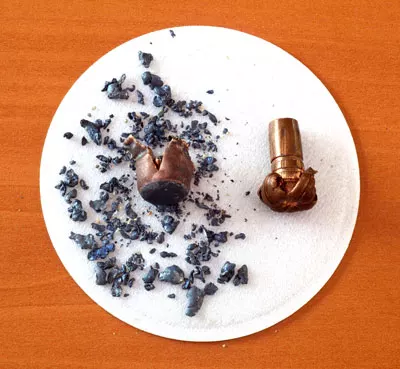
Further Reading:To further understand the effects of lead bullet fragmentation on condors and other species, explore these informative websites.
Lead StudiesExtensive scientific studies on lead and its effects on humans and wildlifeLead has been studied extensively for over 100 years because of its negative impacts to life on earth. Lead causes widespread damage to cells and organs when it is ingested, inhaled, or absorbed in surprisingly small quantities. Explore the links to the right to read though numerous scientific papers about the proven harmful effects of lead for both hunters and scavenging wildlife. |
Last updated: April 4, 2024