Point of Contact: Howard Levitt, Chief of Interpretation and Education, Golden Gate National Recreation Area
The Partners: The 200-ton Whirley Crane was moved to its new location in November 2005
to help interpret historic Shipyard No. 3. The project was a partnership of the National Park Service, The
Rosie the Riveter Trust, the city of Richmond, and the local business community.
"Community collaboration on this project made it possible," said Martha Lee, Superintendent of Rosie the
Riveter/World War II Home Front National Historical Park. "The people of Richmond, their elected officials,
and the business community made a statement through this crane about the importance of linking the city's
future to its historic past. The donation and relocation of the Whirley Crane is a great example of how our
nation's heritage can be preserved when local government, citizens, businesses, community partners, and
the National Park Service come together."
The Project
One of the last remaining massive WWII-era Whirley Cranes was moved on November 4, 2005 to Kaiser Shipyard No. 3 in
the Port of Richmond. The use of Whirley Cranes was a major innovation in the mass production of ships. Whirley
Cranes were used in tandem to position large prefabricated ship and sections to be wielded together to form
ships in the basins. The crane and Kaiser Shipyard No. 3 in Richmond are particularly important features of Rosie
the Riveter/World War II Home Front National Historical Park. The Kaiser operations in Richmond from 1941-1945
were emblematic of the extraordinary industrial production brought about by World War II.
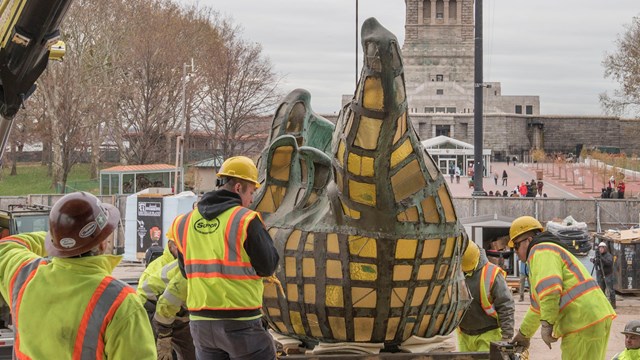
The 200-ton crane was attached to cables, carefully lifted and lowered onto a barge by a larger floating crane
lent by Manson Construction and transported approximately one mile along the Richmond waterfront to Kaiser Shipyard
No. 3 where it was positioned on newly installed rails and secured by custom tie-down brackets.
The crane joins the SS Red Oak Victory ship berthed at Kaiser Shipyard 3 and the historic buildings. Its
new location next to historical shipyard buildings is a huge step at the park.
How They Did It
The project cost approximately $200,000 in contributed funds and services. In-kind services accounted for
$125,000 of the cost, while NPS direct costs totaled approximately $25,000. Over $30,000 of the funds were made
available through the Rosie the Riveter Trust. Of those funds, $18,000 was used to purchase materials for
structural support for the historic Whirley Crane at its new location.
Levin-Richmond Terminal Corporation donated the historic crane to the City of Richmond valued at $40,000.
Manson Construction donated $40,000 worth of barge/crane services to hoist, float and re-lift the artifact into
position at its new home. Mark Howe of MSH Construction donated $25,000 of labor to reinforce the dock at
Kaiser Shipyard 3 to support the weight of the crane. Performance Structures donated $5,000 worth of custom
tie-downs. San Francisco Maritime NHP donated a project site manager for the move and installation.
Interactive Resources of Point Richmond provided pro bono architecture and structural engineering services
valued at $15,000. Chevron, California Oils Corporation, Plant Reclamation, Eagle Rock Aggregates,
Saarman Construction, the Globe Newspapers, Richmond Sanitary Service, Auto Warehousing Company, the Rotary Club
of Richmond, and Dale Robertson and Katherine Harps, and Jonathon Lawlis all donated funds. Performance
Structures, Sims Metal, Tudor Saliba, and Sugar City Concrete provided in-kind contributions. The Bay Conservation
and Development Commission (BCDC), City of Richmond and Port of Richmond expedited permit approvals.