-
Closings and service reductaions due to Federal Budget Cuts announced.
The public will experience reduced hours and services provided by Ozark National Scenic Riverways due to the budget cuts that became effective March 1, 2013. Please check back often for further details or changes. List of closed facilities, click "MORE." More »
Wildflowers in the Ozarks
Marsh Blue Violet (Viola cucullata) This violet is rare in Missouri, and flowers from April to July. Look for it in wet, low-lying areas. Rare Wildflowers of the Ozarks
Loesel’s Twayblade, (Liparis loeselii). This member of the orchid family was first found in Missouri in 1936 in Shannon County. Although no additional sightings occurred until 1979, it is now known in six Missouri counties. Its yellow-green flowers are visible in May and June, and it is most likely to be seen in fens (grassy wetland areas), alder thickets and at the edge of sinkhole ponds.
Showy Lady’s Slipper (Cypripredium reginae) A large, rare and extremely beautiful member of the orchid family, it can be found at the base of north facing limestone bluffs along small streams, and in fens and wet swales. It flowers from the middle of May until early June.
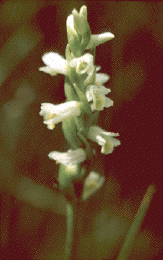
It flowers from May through September, and can be seen in remnant prairies and open woods. In Missouri, it is known only in the Ozarks.
This rare orchid produces greenish- yellow flowers in June and July, and can reach a height of two feet. In Missouri, it is known to occur in only five counties.
NPS photo by Dan Swofford Ozarks Wild Crocus (Tradescantia longipes) This beautiful flower is found in the Ozarks, and nowhere else on Earth. Its variably colored flowers (magenta, purple, purplish-blue) are visible in April and May in heavily forested areas surrounding the Current River and its tributaries. The Nature Conservancy can be contacted at: For more detailed information and range maps, go to the USDA Plant Database. You can look up any native plant by common or scientific name.
|
Did You Know?
Ozark National Scenic Riverways' glades are rocky, desert-like area on hilltops. Kept open by periodic fires, they are home to collared lizards, tarantulas, scorpions, cacti and other species more typical of the desert southwest. More at www.nps.gov/ozar More...