
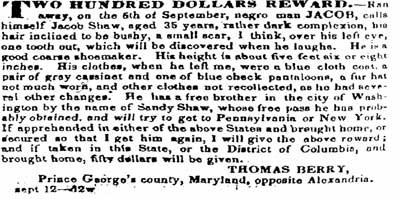
Courtesy of the Maryland State Archives. In 2005, Oxon Cove Park was accepted as a member of the National Underground Railroad Network to Freedom for the discovery of the Jacob Shaw story. Jacob Shaw was enslaved on the Berry Plantation, which today comprises the southern most part of the park. Although there are no structures left from this period, there is a compelling story to be told. Thomas Berry enslaved a large number of people for much of the Antebellum Era. With other enslaved people toiling close to the Berry Plantation, particularly those on Dr. John Bayne's Salubria Plantation, cross-plantation communities among the enslaved peoples developed. These connections were important in escape attempts because enslaved people from neighboring plantations often sought freedom together. Indeed, when Sam Tyler fled Salubria in December 1840, his enslaver suspected that he had run off with Jacob Shaw, from the Berry Plantation. Because Washington, D.C. promised enslaved people who served in the army freedom, freedom-seekers from these nearby plantations faced fewer obstacles than others from more distant areas. |
 |
|
Last updated: June 5, 2022