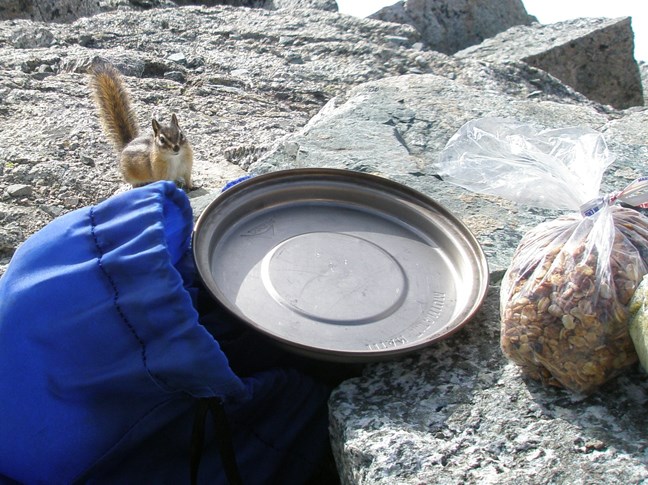
Many types of wildlife, not just bears, can be tempted by or get into any unattended or improperly stored food. Although it provides an opportunity to have a close encounter with wildlife, the interaction usually has negative outcomes for both the wildlife and for humans. Photo by NPS
It only takes one instance of poorly stored food to create a bad habit for wildlife. The backcountry is their only home. As temporary visitors to the backcountry, we have the responsibility to protect their home and a responsibility to leave camps safe for other visitors. Thanks for doing your part to keep wildlife--and wilderness--wild and safe.
This bear track was seen 200 yds from the lower bivy area in Boston Basin.
K. Beckwith
NOTICE OF FOOD CANISTER REQUIREMENT FOR SOME BACKCOUNTRY LOCATIONS
Food canisters are required for camping at certain camps and zones between June 1 and November 15 every year, see our Backcountry Food Canister Policy for more details.
Proper food storage is essential and required (by law) for the health and safety of humans and animals in North Cascades National Park Complex. Many bears (black bears, but including the occasional grizzly bear) make their home in the North Cascades, and sightings are not uncommon. Bears are opportunistic, omnivorous eaters who will take advantage of easily available food sources, particularly in the fall when they are fattening up for the winter.
Deer, mountain goats, marmots, squirrels, chipmunks, mice, and some birds are also opportunistic eaters who will take advantage of unattended or improperly stored food. In a quest to obtain food, all of these organisms have chewed and/or ruined tents or other unattended gear.
Animals learn quickly and will return to areas where they obtain food. This can be unhealthy for the animals, who can lose their natural wariness and foraging ability, and problematic for you and/or the next visitor.
An example of improper food storage. If you can stand under a food hang and touch the bag a large black bear standing on its hind legs can also reach your food. While this food bag was hung the proper distance from the tree trunk (5 ft/ 1.5m), it is not hung sufficiently high enough (15 ft / 4.5m).
NPS
Help protect yourself, your gear, and all wildlife by using one of these methods to store your food properly:
Food hang: bring a waterproof sack dedicated to food and garbage storage and at least 50 feet (15m) of lightweight cord on your camping trip. Hang the food, garbage, cooking gear, and other scented items (such as toothpaste, deodorant, soap, sunblock, etc.)at least 15 feet (4.5 m) above the ground and 5 feet (1.5 m) out from the limb and from the tree trunk. Since trees with large limbs are not always present, this technique can require some time and ingenuity.
Food canister: This is an excellent alternative to a food hang. Food canisters are available free of charge for loan at the Wilderness Information Center and some other Ranger Stations. Canisters that are available through the Park Service have been tested on bears and approved for use by the Park's bear biologist.
Any improper practices can result in property damage, loss of food, or personal injury to yourself or to parties visiting the area later. Improper food or trash storage can also result in a federal citation.
Examples of UNSAFE or illegal food storage include:
Keeping food or toiletries in a tent, whether at night while sleeping or left unattended during the day, including leaving food in your tent or around camp while gone on a day-hike or while fishing. Wildlife can be active any time of day, including bears. Tents only present a visual barrier to wildlife, but most terrestrial wildlife find food using their sense of smell. All wildlife have a much more sensitive sense of smell than humans and, since tents are not air-tight, they can pick up the scent of any food or any other scented item stored in a tent. Also, once an animal has discovered the presence of potential food through their sense of smell, thin tent fabrics present a minor physical barrier to them. Mice, chipmunks, squirrels, and marmots can gnaw a hole in the side of a tent in minutes, and bears can rip open the side of a tent with one swipe of their claws. Campers storing food or other "smell-ables" in their tent at night have had mice or other rodents gnaw holes through their tent while they were sleeping and have been woken by bears that have been attempting to get into or have actually gotten into their tent. Fishermen who have gone out to fish and hikers who have left camp for as little as five minutes have had food eaten by chipmunks, squirrels, marmots, or bears. In camps where chipmunks or squirrels have become habituated to getting food from previous campers, leaving food around camp for less than a minute can result in contamination or loss of food.
Food stored in coolers. Similar to tents, coolers are not air-tight and present very little physical barrier to large animals (see discussion of tents above). Black bears can pick up the scent that escapes from coolers and, since they are stronger than most humans, can easily open a cooler or knock it onto the ground causing it to open. In some areas near the Park (around Mt. Baker), ravens have learned how to break into coolers and steal food.
Dirty dishes left in camp. Food smells on dirty dishes attract animals to camp.
Attempting to burn excess food or tea bags or coffee grounds in a fire. Burning organic matter completely requires a very hot fire, hotter than the vast majority of campfires. Rangers have found partially burned food in fire pits, including clumps that were charred black on the outside but completely unburned on the inside. Food in fire pits will draw animals into camps.
Pouring off excess cooking liquid or dish water onto the ground or into a fire pit. Pouring off liquid that contains food scraps presents an obvious attraction to wildlife. Any mixture of liquids and food scraps should be poured through a strainer in order to remove the scraps. Even an extra bandana can function as a strainer. Since strained liquids can still smell strongly of food, straining should be done well away from tent areas and at least 200' from water sources. Pouring cooking liquid or wash water into a fire pit can draw animals into your camp. After straining, food particles should be transferred to your trash bag, such as a re-sealable plastic bag, and the bandana can be rinsed and hung to dry with the food hang.
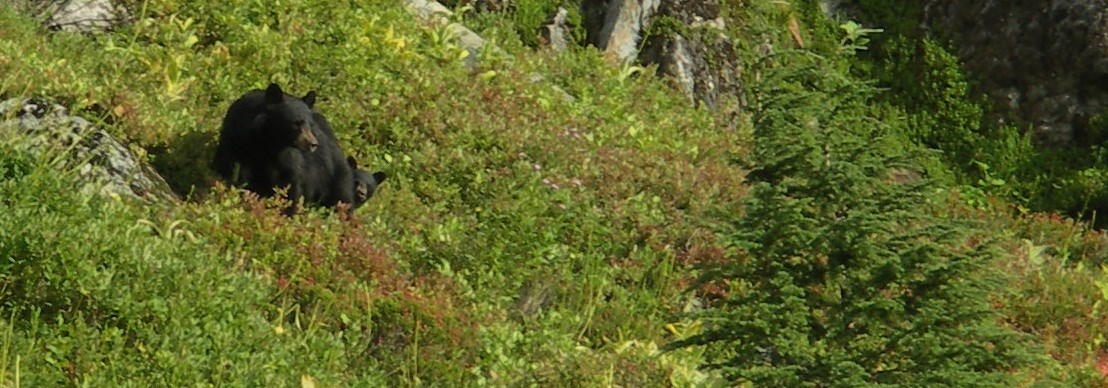
Black bears (here, a mother and her cub) are common in the North Cascades.