An official website of the United States government
Here's how you know
Official websites use .gov A
.gov website belongs to an official government
organization in the United States.
Secure .gov websites use HTTPS A
lock (
) or https:// means you've safely connected to
the .gov website. Share sensitive information only on official,
secure websites.
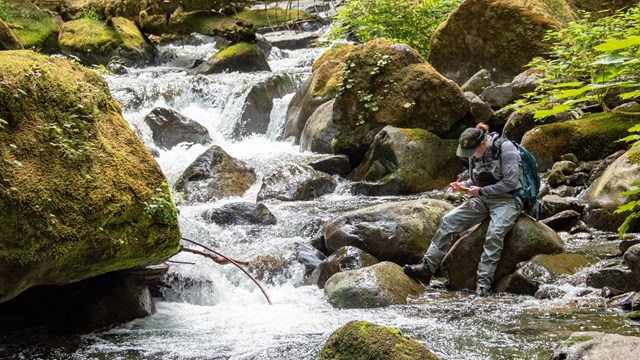
Mount Rainier is the largest single mountain system of glaciers in the contiguous 48 states with 28 major glaciers covering 30 square miles. These glaciers create many of the 470 mapped rivers and streams that occur within the park. Streams and rivers within Mount Rainier have been altered very little by humans and represent outstanding examples of pristine aquatic ecosystems of North America.
One of the least known but regionally most important components of these ecosystems are fish communities, which park staff have been inventorying since 1999. The present status of native fish populations in the park is not well understood due to construction of dams outside the park, and previous stocking activities. The Electron Dam on the Puyallup-Mowich drainage, Alder and LaGrande Dams on the Nisqually, and the Mud Mountain Dam on the White River have historically blocked passage of fish to these rivers and their upstream tributaries within the park. On the White River, all salmonids are transported around Mud Mountain dam, and the Electron dam on the Puyallup constructed a fish ladder in 2000, allowing improved fish access to headwater habitats. The Carbon River is the only major drainage without man-made dams blocking fish passage, but contains a steep canyon outside the park which likely reduces anadromous fish passage.
Native Fish at Mount Rainier National Park
A native species is defined as one that is naturally occurring in the ecosystem, has the capability of self-sustaining its population, and has evolved alongside unique environments. Native fish species play an integral role in the greater aquatic ecosystem, maintaining ecosystem resilience and playing their part in the food web. Most native fish within Mount Rainier National Park are members of the Salmonidae family – which include salmon, trout, char, and whitefish.
Native Bull Trout heading upstream to their spawning grounds in Mount Rainier National Park. USFWS Video - 2012
No Audio. Description: An underwater view of a large fish swimming over a rocky river bed and around foaming white water spilling over a fallen log.
Description: Bull trout are listed as a threatened species under the Endangered Species Act. They are gray to silver with white leading edges on their fins and are distinguished from brook trout by the lack of pigmentation or spotting on the dorsal fin. They are not true trout, but are instead classified as a char. They are closely related to brook trout and have the potential to hybridize. Bull trout within the park are known to have multiple life history strategies including headwater residents, and mainstem river migrants, and are also known to be anadromous.
Distribution: Bull trout are found in a variety of stream environments. They are often encountered in the White and Carbon river watersheds and may be encountered in the Puyallup, West Fork White, and Mowich watersheds. Bull trout require very cold water for spawning and migrate further upstream than most other species.
Description: Three subspecies of cutthroat trout can be found within the park: native coastal cutthroat trout (O. clarkii clarkii) as well as non-native westslope cutthroat trout (O. clarkii lewisi) and Yellowstone cutthroat trout (O. clarkii bouvieri). While native coastal cutthroat trout can be anadromous, only resident populations are found within the park. Cutthroat can be distinguished by dark small spots on a light body and a bright orange-red slash marks under their jaw. Cutthroat subspecies can be difficult to distinguish from one another.
Distribution: Native coastal cutthroat trout are found in all park watersheds and have been stocked into many mountain lakes and previously fishless streams.
Description: Rainbow trout are a popular sportfish and have been introduced to many water bodies worldwide. They are light colored fish with small dark spots and typically a pink flush along their sides. Though similar to cutthroat trout, they can be distinguished by the lack of an orange slash underneath their jaw and a smaller mouth.
Distribution: Rainbow trout are common throughout the Northwest. They are native to all park watersheds, but have been stocked into many mountain lakes in which they historically did not exist and in previously fishless streams.
Puget Sound Steelhead Trout (Threatened)
Oncorhyncus mykiss
Description: Puget sound steelhead, Washington’s state fish, are a distinct population of steelhead that are listed as threatened under the endangered species act. The steelhead is genetically the same species as rainbow trout but fulfills an anadromous rather than a resident life history. Steelhead often have dark spots scattered over the entire fish including the tail, with slight to pronounced rainbow coloring.
Distribution: Steelhead are very rare within park waters, but may be encountered during their summer or fall runs within the White, West Fork White, Carbon, and Mowich watersheds.
Pink Salmon
US Fish & Wildlife Service
Pink Salmon
Oncorhynchus gorbuscha
Description: Pink salmon (also known as humpback salmon) are most easily distinguished by the large hump that males develop during spawning season. They have large dark spots on their back and may have tones of pink, olive, silver, and white. Most runs of pink salmon in Washington State occur during odd numbered years, during which the White River may host runs of pink salmon numbering into the 100,000’s.
Distribution: Pink salmon typically spawn in low elevation, low gradient rivers relatively close to the ocean. They can be found within the park during the fall spawning season in the lowest elevations of the White River watershed, near the park boundary.
US Fish & Wildlife Service
Chinook Salmon (Threatened)
Oncorhynchus tshawytscha
Description: Chinook salmon, who may also be called King or Tyee salmon, are the largest Pacific salmon and may travel hundreds of miles to return to their spawning grounds. They have large wavy spots on their back and black gums, and often turn dark red to brown during the spawning season.
Distribution: Chinook salmon are rarely encountered within park waters, but are present within the White, West Fork, Puyallup, Mowich, and Carbon watersheds.
Coho Salmon
US Fish & Wildlife Service
Coho Salmon (Species of Concern)
Oncorhynchus kisutch
Description: Coho are sometimes called silver salmon due to their shiny coloring, which turns to orange-red or bright pink during the spawning season.
Distribution: Coho salmon are rarely encountered in the park, but are present in the White, West Fork, Puyallup, Mowich, and Carbon watersheds.
Mountain Whitefish
Dale Russell, Wild Fish Conservancy Photo
Mountain Whitefish
Prosopium williamsoni
Description: Mountain whitefish have silver sides and belly fading to a gray or bronze back. They have a deeply forked tail and a small mouth.
Distribution: Mostly found in mountain streams in deeper waters and open channel areas. They are uncommon in Mount Rainier National Park but are likely present within the Carbon, Puyallup, and White River watersheds.
Shorthead Sculpin
USFWS/Roger Tabor Photo
Sculpins
Cottus spp.
Description: Sculpin are scaleless, minnow-sized fish with a wide mouth for bottom-feeding and upward-facing eyes. They are often a dark mottled brown and are well camouflaged into their surrounding environments. There are several species of sculpin within Mount Rainier National Park, including torrent sculpin (C. rhotheus), shorthead sculpin (C. confusus), and prickly sculpin (C. asper). They are the only fish found at Mount Rainier National Park that is not in the Salmonidae family.
Distribution: Sculpin species live in a variety of habitats including streams, rivers, and lakes. They are found in all watersheds in the park and have been introduced into Lake George and Mowich Lake.
A pack team hauls fish to stock Sunrise Lake, 1940.
NPS Photo
Non-native Fish Species
Between 1915 and 1972, over nine million fish were stocked into lakes and streams within Mount Rainier National Park. Non-native fish include both species that are not naturally occurring within Mount Rainier's watersheds as well as species native to the park that have been introduced into areas historically not occupied by that species. Non-native fish compete with native fish and amphibians for food and habitat resources, may predate on native species, and in some cases may hybridize with native species. Fish commonly stocked into Mount Rainier waters include Westslope and Yellowstone cutthroat trout, Eastern Brook Trout, and kokanee salmon, as well as rainbow trout stocked into areas not historically occupied by that species.
Stocking was halted after 1972 consistent with new NPS management policies. Approximately 35 mountain lakes within the park continue to support breeding populations of non-native fish to this day.
Description: Technically a char and not a trout, brook “trout” are a popular non-native game fish. They are characterized by dark skin with light and red colored spots, often with a blue halo around the spots. They have worm-like patterning on their back and dorsal fin. They compete with native bull trout for space and food, and have the potential to hybridize with native bull trout.
Distribution: Native to the Eastern United States, brook trout are found in many park lakes and streams throughout the park.
Kokanee Salmon Non-Spawning (left) and Spawning (right).
Description: Kokanee are a small, landlocked version of the sockeye salmon that are non-native to the park but have been stocked into park waters. For most of the year, they are silver and have a greenish blue back with faint speckling and few if any spots. During the fall spawning season, their body turns a dramatic red, a significant hump develops on their back, and their head becomes an olive green.
Distribution: Present only in the Nisqually watershed and Mowich Lake and its tributaries.
Fish Predation
Fish predation affects food webs in lakes, altering nutrient cycling and the structure of macro invertebrate communities. Fish predation has also been shown to have a major impact on amphibian abundance, behavior and distribution, especially salamander populations. Research on the ecological history of high mountain lakes and techniques for restoring these aquatic ecosystems, including fish removal, are a high priority for the biological monitoring of high lake ecosystems.
You can help us monitor and manage our fish populations within the park. Harvest of fish populations and effects of non-native species on native species are also a concern for park managers. If you think you've spotted a fish or caught one while in the park, please fill out this observation form. This video provides more detailed instructions on how to submit your observation. Please follow fishing regulations to protect our aquatic resources.