
The Pennsylvania Railroad Took Statements of its Employees
STATEMENTS
Of employees of the Pennsylvania Railroad Company, and others in reference to the disaster to the passenger trains at Johnstown, taken by John H. Hampton, at his office in Pittsburgh, by request of Superintendent Robert Pitcarin; beginning July 15th, 1889.
The object of this investigation is to determine whether the Company is liable in law for the loss of the lives, or property of passengers, and put into proper form a defence to any actions that may be brought against the Company for damages.
Statement of Robert Pitcairn
Q. Mr. Pitcairn, state how many years you have been superintendent of the Western Division of the Pennsylvania Railroad.
A. For nearly 25 years since the last time I came on.
I had charge of the region one or two years before; I have been on the mountain division since 1853.
Q. State if you please, at what time, as near as you can tell, you became acquainted with the location of what is known as the South Fork dam?
A. I remember the South Fork dam since 1853, but became interested in it while temporarily in charge of the Pittsburgh Division, in 1862 when it broke.
Q. You recollect the year the dam broke?
A. I think it was in 1862.
Q. Was the dam or reservoir owned at that time by the Pennsylvania Railroad?
A. Yes, sir.
Q. It was known as the Conemaugh feeder of the canal?
A. I believe so.
Q. What effect had the water, if any, in 1862 when it broke, on they [sic] valley of the Conemaugh from South Fork dam to Johnstown?
A. It damaged the abutments of the South Fork bridge, and I think somewhat damaged No. 6 bridge, and I think somewhat damaged No. 6 bridge, and washed our tracks away slightly; very little damage altogether? [sic]
Q. Do you recollect what was the swell of the water in height from the dam when it broke?
A. I couldn't say personally. The water was very high at South Fork, but dispersed itself.
Q. Well, comparing that with the flood of water that came from it the last time, was the last flood a much greater volume of water than the other?
A. I should judge that the flood in the North Fork was higher then the dam breaking in 1862.
Q. Did the Pennsylvania Railroad Company ever rebuild that dam?
A. No, sir.
Q. What became of the property after the dam broke?
A. It was sold to John Reilly. He took up the pipe, for the purpose of which he bought it, and sold the pipe.
Q. What pipe do you allude to?
A. The pipe that conveyed the water from the dam to Johnstown to the canal.
Q. That pipe was owned by the state, and put in there?
A. Yes, sir.
Q. It was motal , was it?
A. Yes, sir.
Q. The purpose of that pipe being put there was to get the water out of the reservoir in summer season and fill the canal at Johnstown?
A. Yes, sir, it was to fill the canal during dry weather
Q. Do you know to whom Mr. Reilly sold the property?
A. (H)e sold the property to Mr. Ruff and some other genleman [sic].
Q. Do you recollect about what time the sale took place?
A. It was about '78.
Q. Go on and state now what you did in relation to keeping up your knowledge of the dam; whether you visited it, and if so, the purpose of your visit.
A. The first information that I had on the matter was on the commencement of the rebuilding of the dam; when it was about nearing completion, there were rumors that the dam leaked. I called the attention of Mr. Ruff to the subject, visited there a\ [sic] number of times, sent the supervisor and his assistant up there a number of times, went there with the supervisor and assistant, and with Mr. Ruff thoroughly went over the work, and the only point that we were afraid of, was the leaks at the bottom of the dam increasing.
Q. At this point, let me ask you if Col. Ruff was a civil engineer and contractor?
A. He was a contractor; he was not an engineer but from his own evidence, he was better than any engineer.
Q. Well, he was familiar with construction work, was he?
A. He had done a great deal of construction work in his time.
Q. What was the character of it? Embankment work, railroad work, etc? Was he reputed to be an expert in his business, and faithful in his duties?
A. (H)e was a man who had a good reputation as a contractor, as (b)eing good safe work, a thoroughly competent man, and one who enjoyed the confidence of railroad men generally. Mr. Ruff at that interview, promised to make everything safe, increase the strength of the breast, use horse manure and all the material suggested to him to stop the leaks, and expressed it as his opinion that the leaks did not come from the breast of the dam, but from springs on the west side, I instructed the supervisor----
Q. At what point?
A. Of the division between Altoona and Conemaugh, to see that Mr. Ruff did the work as he promised, to send his assistant up there at least once a week, and to report when it was done He [sic] reported that the work had been done, when I sent the Supervisor to inspect the work, and he reported that it was safe and all right. My engineer, Mr. Holliday, also inspected the work.
Q. Where is Mr. Holliday now ?
A. He is Superintendent of the Lewistown division.
Q. Do you recollect what rear that was?
A. That was somewhere about 1881 or 1882.
Q. Did Mr. Holliday make a report to you in writing, or verbally?
A. My memory is that Mr. Holliday made it in writing, and I sent this report with other papers to Mr. Ruff.
Q. Have you a copy of it now in your office?
A. I have not been able to find it\. [sic]
About that time, Mr. Morrell, General Manager of the Cambria Iron Company, who was with me in sympathy opposed to the rebuilding of the South Fork dam, became a member of the South Fork Club, and as he was a resident of Johnstown, with most of his wealth in that city, and an owner of the Cambria Iron Company, I was thoroughly convinced then that the dam was perfectly safe in every particular, but took the precaution to notify the Agent at South Fork, and also Mr. Wilson, the Superintendent of the Argyle Coal Company, in whose coolness and judgment I had great confidence, to keep a lookout, at the same time, directing the supervisor not to forego any care and precaution in watching the dam. These parties were so vigilant that they made quite a number of reports to me, which upon investigation were found to be untrue, about the safety of the dam, as for example, the dam was reported unsafe, and when we sent our men there, it was a bridge west of the dam; so that we were continually getting more or less rumors which were always proved to be untrue.
Q. Do you recollect the persons whom you sent up on different occasions to make examinations of the dam after receiving these reports from Mr. Wilson and others?
A. Supervisor Fred. Ehrenfeld was the supervisor of that section and the orders were directed to him. Of course, we understood that he would send his Assistant, the Assistant Supervisors on our division being educated engineers.
Q. Did they report to you?
A. They generally reported to me that the dam was all right; that everything was safe.
Q. Had you at any time after making a personal examination of the dam, and after your interview with col Ruff, any suspicion that the dam could be swept away by an ordinary flood, and do the damage that it did do in May last?
A. I was thoroughly convince that the dam would ne ver [sic] break from high water, and I considered that the breast of the dam would be strong enough to hold any water. I have been a good deal over the country back of it until it reached the southern declivity, and I could not imagine where water would come from that could break the dam. My only fear when the dam was rebuilt was on account of leaks.
Q. If the dam was to give way at all, from what you saw, it would be because there were leaks away below the breast of the dam, that might undermine the embankment?
A. That was my idea; that it would increase the leaks.
Q. But you never had any fear that the dam would be broken by water running over the top of it?
A. We never had such damage at those points. At Lilly where the Little Conemaugh commences, we have a very low bridge, or rather stringers over a small stream, and have had a little trouble with water overflowing there, but never had to the slightest degree such a water as I saw the evidence of, and was reported to be at this time.
Q. How long have you known Mr. Walkinshaw, the Yard Master at Conemaugh?
A. Over 25 years, I think.
Q. Has he been at that point that length of time?
A. No, he was a freight brakeman, and freight conductor; came up in the tri n [sic] service; but he has been at Conemaugh quite a number of years.
Q. Do you consider him as a trusty, careful man with any duty given him to perform?
A. I consider Mr. Walkinshaw a man who could be more trusted than any of our yard masers in looking after the company's interests in a case like this, although he has the consumption and is not very efficient as a yard master, and has not been very able to stand the physical strain.
Q. I mean his capacity mentally to comprehend and make disposition of trains.
A. I consider him one of our best men in that regard, and in using good sound judgment.
Q. You have learned, have you, of the disposition he made of the Mail Train and the two Day Expresses on arrival at Conemaugh?
A. I have learned where they were placed, and had evidence on the ground of where they were placed.
Q. Have you learned also, Mr. Pitairn, that the water had washed the tracks out to a considerable extent immediately west of Conemaugh?
A. Immediately w est [sic] and immediately east.
Q. That was after the trains we have mentioned had arrived at Conemaugh?
A. It was washing the tracks west of Conemaugh slightly before the trains arrived, and the Mail train and the two Day Expresses were stopped at Conemaugh on account of a slide and obstructions immediately east of Conemaugh.
Q. With that condition of things, and even with the water running over the dam, would it, in yourjudgement, [sic] have been a prudent or imprudent act for Mr. Walkinshaw to have allowed those two Day Expresses and the Mail to have proceeded east, considering that they were in a place of safety at Conemaugh?
A. The passenger trains being at Conemaugh, it would almost have been criminal for the Yard Master at Conemaugh either to attempt to send them east or send them west, if he apprehended that the South Fork dam would give way.
Q. And even with all the information which he may have had, and which you have learned that he did have as to the water running over the dam, even then, in your judgment, it would have been criminal in him to have ordered the trains east or west?
A. Either east or west; and from the location and bend of the river at Conemaugh, there was no track, nor any spot on the track more safe than where he put those trains.
Q. Mr. Pitcairn, I wish you would state whether you made calculation, as requested by me, of the distance of Conemaugh from the South Fork dam by the course of the Conemaugh itself.
A. I made a calculation, and raking (?) three miles from South Fork station to South Fork dam, and it is 6.9 miles from SouthFork [sic] station to Conemaugh by rail, the railroad running parlllel [sic] with the river, and the river taking two bends of I should judge a mile around at Mineral Point, and the same at No.6 [sic] bridge east of Conemaugh, making eleven miles and nine tenths in all.
Q. So that those three trains at Conemaugh were practically about twelve miles from the South Fork dam?
A. Just about twleve [sic] miles by the Conemaugh river and the South Fork.
Q. And by yourknowledge [sic] of the winding of the stream and the valleys it passes through, and the volume of water that might be in the dam when it was full, would you, from all you know of it, have had any apprehension that if the dam broke, it would bring such a deluge of water to Conemaugh that it did?
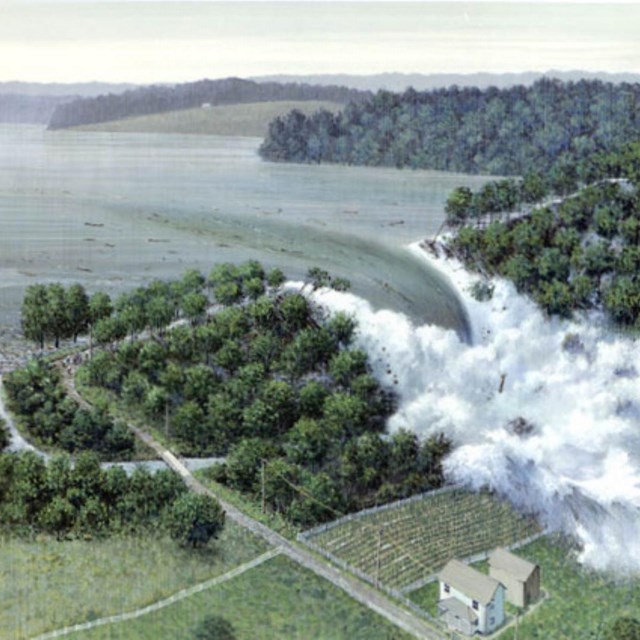
A. The breaking of the South Fork dam was a perfect revelation to me, and with the many wide places in the valley, and turns to stop the water, that it did the damage that we s w, [sic] and I can only understand it from the theory that there were two or three breaks by the water backing up.
Q. by the water being backed and arrested two or three times in its course?
A. Yes, sir, and increasing its velocity by the obstruction.
Q. Have you read the statement Mr. Trump has given here on that subject?
A. Yes, sir.
Q. State, sir, whether you coincide with him or not in the vi ew [sic] he takes.
A. That is the only theory I can explain it on.
Q. Is there any other theory reasonable in itself that can be given as an explanation of that tremendous flood?
A. I can't imagine any.
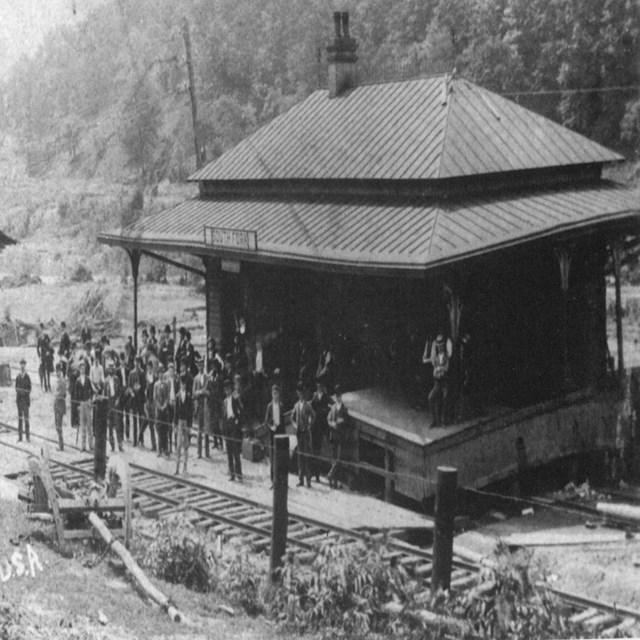
Q. How many years have you known Mr. Dougherty, the Agent at South Fork?
A. Well, I guess about 26 years.
Q. Has he been at that point that many years?
A. No, sir. He was one of our oldest and best freight conductors, and considered by us a first class railroad man, but when we adopted the color blind test, he was found to be color blind, and we have since endeavored to take care/of [sic] him, but his education being all in the train\ [sic] service, and as we could not use him as a yard master, or anything connected --- the trains, I appointed him Agent at South Fork, intending to give him a better agency when the opportunity occurred. I think he has been at South Fork about two years.
Q. Is he a careful, competent, sober man, and does he enjoy a good reputation as a railroad man?
A. He is thoroughly sober, very respectable, of first class moral character, and considered by all a man of judgement above the rodinary [sic].
Q. Have you/read [sic] the statement htat [sic] he has given in reference to this disaster, which we took here at the office?
A. Yes, sir.
Q. After reading it carefully , is there anything you see that man could have done other than he did do to get timely notice to you, and to the people at Conemaugh and Johnstown as to the condition of that dam?
A. I think he did more than could be expected under the circumstances.
Q. Mr. Pitcairn, how is the telegraph service of the Pennsylvania Railroad organized on the west ern [sic] division? Has it ha [sic] head to it? [sic]
A. The telegraph service is organized with the Division Operator in charge.
Q. And who is your division operator?
A. G. (?) H. Sheaffer.
Q. You know Mr. Wilson, who is the Superintendent of the Argyle Coal Works at South Fork?
A. Yes, sir.
Q. How long have you known him?
A. I never can count the years; a long time; quite a number of years.
Q. I wish you would state whether you ever gave Mr. Wilson, or Mr. Dougherty, the Agent at South Fork, instructions to look after the safety of the South Fork dam, and report to you.
A. Mr. Wilson accompanied me on a trip back of the South Fork dam on the line of a proposed railroad to reach the Ashtola Lumber Company, and some large coal tracts, and there is where I got my impression that the South Fork dam would never break by a flood of water. we stopped at the South Fork dam at that time to see low we could get around ------ it with the railroad, and we talked over the South Fork dam matter, and I made a special request that he watch it carefully and repot [sic] I talked with him in reference to its safety, and in regard to keeping a close watch on it.
Q. Mr. Pitcairn, is Mr. Wilson a man of shrewdness as a business man, an intelligent man, and above the average of man?
A. Mr. Wilson is a man well up in years, calm, collected, methodical, and away above the average not only in intelligence but as a business man, and more or less a leader in that section of the country.
Q. Have you read the statement that Mr. Wilson has given us as to what took place on Friday when the dam broke?
A. I have read his statement.
Q. From your perusal of it, do you think Mr. Wilson did all he could do to protect the lives and property of people at Conemaugh and other points along the river to Johnstown?
A. I think he did all he could do, and more than was expected of a man in his position.
Q. He was not an officer, nor in any way connected with the Penna. Railroad Company as an employe? [sic]
A. He was not in any way connected with the Pennsylvania railroad company, but his coal company delivers coal to the eng--gines [sic]; but he has always manifested a sympathy with the Pennsylvania Railroad Company, and helped them in every way possible, and we consider him one of our friends in that section of the country.
Q. The men who were in charge of the Mail Train and the two Day Expresses, I wish you would state whether those conductors were men of experience, sober, tried men, and trustworthy in the discharge of their as conductors?
A. They were all considered our best men, efficient men, and all sober men.
Q. State whether they have been trained as conductors in the service of the Penna. Railroad Company.
A. They have all served as apprentices, and been brought up in the passenger department from the bottom.
Q. The engineers of those trains, were they men whom you felt you could trust with the lives -- of people, and such trains as they had charge of?
A. The enginemen were among out best men, and we have the rputation [sic] and consdier [sic] our passenger train enginemen the very best in the country.
Q. In relation to the conductor and enginemen of the Limited that passed Conemaugh that morning and went to South Fork, ad [sic] got over the bridge before the flood came, were they men of experience, and tried, and sober men in the discharge of their duties?
A. They weremen [sic] of experience and first class men.
Q. The division foreman who had charge of the watching and the repairing of the track east and west of Conemaugh, were they tried and reliable men whom you could trust, and had trusted?
A. They were some of our men on that portion of the track who were thoroughly so, as is natural on such a difficult portion of the road.
Q. Now, you can state as a fact whether commencing at Conemaugh and to the top of the mountain very extraordinary precaut ion [sic] had been taken for years before and down until the time of the flood to insure the safety of that mounti n [sic] tract.
A. Every precaution had been taken.
Q. How many years is it since you commenced erecting on your division these telegraph towers to inaugurate that system you have now of running trains and controlling the movement of trains by telegraph through these towers?
A. Since about 1872.
Q. Have you foundd [sic] that an efficient way of managing your trains
A. We find that it is the safest way that has yet been tried, and about the only was we could move our traffic.
Q. Who is it, and at what point on the road is he located, that directs the movement of trains, where they are to be stopped and when run past these places.
A. The block station operators give the clear track when they have a clear block. The train despatchers, located at Union Station, Pittsburgh, would direct them to be stopped for any unusual purpose.
Q. He is practically at the head then of the movement of trains on the western division?
A. The Train Despatchers at Union Station, Pittsburgh, have practically the direct control of all the block stations and movements of trains on the division, under my name.
Q. And is there such an arrangement here at Union Depot, Pittsburgh, that the despatfher [sic] or despatchers know the location of every freight and passenger train on the division?
A. They know of the passage of every train, freight, passenger, and extra, at every block station on the division.
Q. Mr. Pitcairn, you can st ate [sic] now from your observation what destruction the flood caused the Pennsylvania Railroad Company commencing at South Fork and coming down to Johnstown.
A. The destruction from South Fork to Johnstown stone bridge was about as complete as could be imagined. there were several short pieces of track favorably located that were left more or less in tact, but no one who did not personally see the devastation at the outstart could conceive of such devastation.
Q. Mr. Pitairn, from your observation, what was the destruction wrought by the flood at Conemaugh?
A. Most thorough.
Q. From your observation at Conemaugh after the flood, you can state whether the water,after [sic] it broke over at thatpoint, [sic] carried the passenger station away.
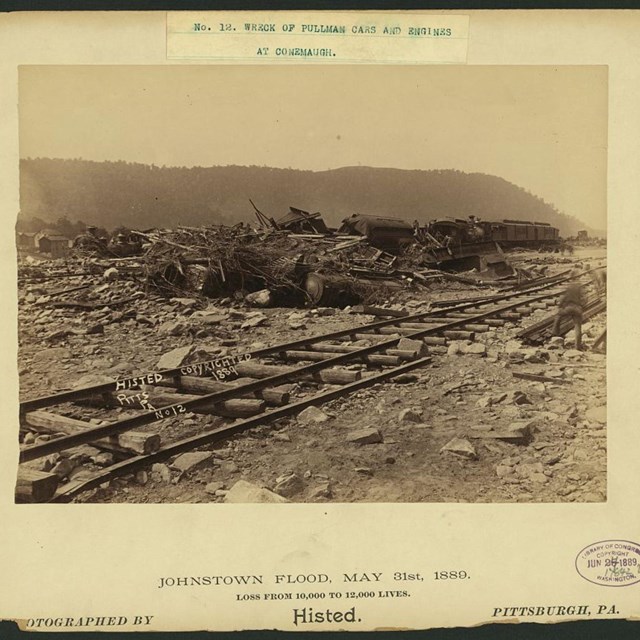
A. The flood carried the passenger station away. The Day Expresses and the Mail Train being west of the passenger station alongside of a street; the cars were left on the track with the exception of two cars that were washed away, and that was the only spot around there that was left in any kind of order to the south side of the street, where there was a row of houses that were all taken away with the passenger station and with loss of life, so that with the way the volume of water swept over Conemaugh station, and the track these three passenger trains passed, down an embankment of five or six feet into the street of Conemaugh and flooded the town, and the fact that the trains and passenger cars remained where they were, while all the balance of the tracks with the dwellings and property in Conemaugh on the south sid [sic] with the engine house, and with sufficient force to carry the engines out of the house a great distance, shows conclusively that whether by foresight or otherwise, Mr. Walkinshaw put the passenger trains on the safest portion of the line between Johnstown station and east of Conemaugh.
Q. Were there lives lost that you know of in Conemaugh by the rush of water there?
A. On the north side of the street and south (of) the railroad and the tracks where the passenger trains were put, there were lives lost, but I am only personally cognizant of the carrying away of the house of Engineer McHugh with his family his wife and two or three children being lost, two of his daughters, the only survivors, being caught by the men at the woolen mill west of Conemaugh and saved.
Q. Where was the round house containing the locomotives situated with reference to these passenger trains?
A. The round house was on the north side of where these passenger trains were located, and a little east, or about opposite the passenger station.
Q. What effect had the flood upon the round house, and on the engines? What number of engines were in there as near as you can tell?
A. There were over 26 engines, and about all that I could see of the remains of the round house or anything near it, w as [sic] part of the large heavy stone at the center of the turn-table, in fact, that was the only means by which we could locate the round house, after the trouble.
Q. What became of these engines?
A. They were carried down three or four hundred feet and over.
Q. State whether after the trains w ere [sic] put upon the sidings at Conemaugh by Mr. Walkinshaw , it would have been more safe to have taken those passengers out, in your judgment, and put them in the passenger station, or was it better to let them remain in the cars, considering it was raining very hard and the river rising rapidly?
A. If the passengers had been put in the station house, or any of the company property, it would have been likel y [sic] that they would all have been lost, unless they had run, as they did from the passenger cars. Conemaugh is a small village and there are no hotels there, and in my judgment, Mr. Walkinshaw or anybody else would have been highly culpable for ordering these passengers
-------- among whom w ere [sic] women and children out to the hills in this drenching rain, and there was no time for Mr. Walkinshaw or anybody else to arrange with the occupants of private houses to take them in, and in my judgement, he did the best he could, and if the passengers had remained in the cars, which it is not reasonable to expect with the confusion that existed when the flood was soon to be coming, they would have been safe. The Passengers, as I am informed, and know from the evidence, w ere [sic] as thoroughly posted as any of the crew or Mr. Walkinshaw, and were personally observant of the height of the flood and of the surrounding circumstances. The fact that the conductors of the Day Expresses knew, or that Mr. Walkinshaw knew, and were quienly [sic] in the passenger car trying to dry their clothing is sufficient evidence that they apprehended no danger, nor had any reason to.
Q. Mr. Pitcairn, what time did you leave Pittsburgh to go up to look after the destruction that the flood had wrought?
A. May the 30th being a holiday, I went home about two o'clock and was at my telegraph instrument in my house until about 11 o'clock, making frequent inquiries in regard to the rain. On Friday morning, I came to the office on the early train and the Chief Train Despatcher was waiting for me with the reports reports [sic] of the extraordinary flood of water at Lilly. The reports of this trouble with water at Lilly station kept growing more grave. The supervisor reported that the dump east of Plane No. 3 was being washed away, and the water rushing down on the south side on the Lilly Branch, where --- there [sic] is no stream, and forcing its way over into Bens Creek, and through the dump which is parallel with the Little Conemaugh; so that Mr. Trump and I consulted about the matter and decided it wise that he sould [sic] get an engine and a passenger car, our Master Carpenter, Assistant Engineer, Chief Operator and as many telegraph line repairmen as we could get(for [sic] at that time, the report was that the telegraph poles were being washed away), and all the force we could gather up and go to the place of the trouble. I arranged to take the Pay Car and go on No 18 at 1 o'clock and go to Lilly where we could feed and sleep the men if kept out all of Friday night. I left Pittsburgh on No. 18, and when I got to Bolivar noticed the Conemaugh river. I received telegrams at different points that the trouble with the water was getting more serious, and in fact, though I cannot find any message, yet I understood that morning before I started that the people at Johnstown were warned out by Mr. Unger. I could hardly see how Mr. Unger could warn them out, as he had no telegraph line; and in fact paid but little attention to any reports about the South Fork dam, as they had bee n [sic] made perhaps nearly every year; in fact, one year the report was that the water was going over the breast of the dam, but whether it was so or not, I cannot remember positively. That, however, made but little impression upon my mind from the fact that my thoughts were centered on the Lilly trouble, and when I reached Bolivar, and saw the immense body of water, very much higher than I had ever known during my connection with the Pennsylvania Railroad, I attributed it to the North Fork of the Conemaugh river, and as I proceeded and saw the water rising, and at Lockport up to the north track, which I never heard of or saw before, I thought the Stony Creek had assisted in the great rise of water. At the east end of Sang Hollow middle track about four miles from Johnstown, we were stopped at the block; I went up to the tower to see if we could get any word from Johnstown of what the trouble w as, [sic] and we found that we could not get anybody east, and the operator could not allow us to proceed from the fact that he had not a clear block. I was about making up my mind to proceed cautiously, running c arefully, to find the trouble, when in looking east, I saw some debris. The water before this had been muddy, but very little drift. The debris attracted my attention from its singular appearance, being broken up wood entirely, and in very small pieces. In a short time, the telegraph poles commenced to break down, and threatened to take the tower down with it. The next matter that attracted my attention was a man coming down on some of the debris. The water must then have been going about 15 miles per hour or over. Then I say some men and rushed out to see what we could do to save them, but found that nothing could be done. I then returned to the telegraph office to see what word I could get, when the people came down by the scores; the water rising very rapidly, and men women and children on the drift, and we perfectly helpless. About that time, I was driven out of the tower; after doing What I could to save people and only succeeding in saving seven out of the hundred and over that had passed us. We asked them where they came from and they said from Morrellville and Cambria City, and then I was convinced that the trouble was with the Stony Creek water, as we could find no one from the east side of Johnstown. I then decided to back two freight trains which were there, the water rising and coming up to the track, and went back to the block station at the west end of Sang Hollow middle siding, when I mad my judgement that it would be running the freight trains into a risk by backing them, and I decided to wait at the west Sang Hollow block, and watch the progress of the water, and I staid there until we were driven out to that tower by the telegraph poles being broken down, and I went down and staid on the track prepared to get the passengers and run for the hillside. I then discovered by watching close that the water was on a stand still, and it gradually receded, and I decided to hold the freight trains on Sang Hollow middle siding, and take all the passengers back to Pittsburgh, giving them the option to stop off at New Florence if they desired to and they could get accommodations there, and take the balance back to Pittsburgh. It took us some time to get back to New Florence on account of the water being on the track. On reaching New Florence, I went to the block station, wrote a message directed to the editors of all the morning papers, requesting them to call a public meeting of all the citizens of Pittsburgh, from the fact that I had seen enough people go down the river to know that there would be terrible distress. I kept this message until about 10 or 11 o'clock, when I got word from my supervisor, Mr. W. (H?). Hays, whom I knew was at Johnstown bridge with his work train, notifying me that Johnstown was swept away. I then sent the message to the Pittsburgh papers, and an order to collect all the men from the western lines, and material to repair the damage, and started for Pittsburgh, being detained at Lockport and different points by little slides and the water over the tracks at low places, reaching Pittsburgh somewhere about 6 o'clock in the morning. The water when I was going east, at points where the valley was one, two, and three miles wide was thoroughly -- overflown, and that was before the South Fork water came down.
Q. Where did you see that, Mr. Pitcairn?
A. I saw that first at Lockport, west of New Florence, and then at Ninevah. The water at Sang Hollow by what I can see was the South Fork dam flood, from the fact that observing the water at the time, it must have risen about six or eight feet in from one half to one hour.
Q. I understand then at these points mention, the flood extended over the low ground or flats. You can state in this connection whether the Conemaugh at New Florence is not a considerable distance from the station, from a half to three quarters of a mile.
A. The river at New Florence is perhaps from a half to three quarters of a mile off. The station w as on a high elevation and wasn't touched by the water. The water extended east and west of New Florence village over the valley.
Q. The point I want to get from you is the fact that New Florence is about three quarters of a mile from the river where the township road crosses over by a bridge.
A. Yes, sir.
Q. Was that taken before or after the dam broke?
A. I don't know, but the Bolivar bridge was taken before the dam broke.
Q. Was that a railroad bridge?
A. It was an iron township bridge. It was taken before I got there. I looked out for it and saw it was gone. That is, what I understood about the matter, but it is very difficult to see the bridge from the passing train.
Q. Isn't there a long stretch of flat country from a few yards west of Florence to Lockport?
A. From just west of Florence where the river is from a half to three quarters of a mile from the station, to Lockport, where the river is near, it is a wide, low valley, and the houses on the farms and at the houses in the valley as near as I could see, the was two or three feet above the foundation.
Q. So that all that valley was covered with water to the depth of three or four feet before the dam broke?
A. Yes, sir.. [sic]
Q. After you reached Pittsburgh, what measures did you take to place the Pennsylvania Railroad car service at the disposition of people who were disposed to relieve the Johnstown sufferers?
A. On my arrival at Pittsburgh on Saturday morning, I got into communication with the General Manager and President of the Pennsylvania Railroad, and reported all the facts that I knew, and the fact that I had called this public meeting; and I was notified by Mr. Pugh that my action was appreciated, and to attend the meeting, and if Pittsburgh people could be aroused to subscribe any ways liberally, to subscribe $5000.00 for the Pennsylvania Railroad Company, and put the whole equipment and men at their service to secure and transport relief to the Conemaugh valley [sic] sufferers, which I did. Finding however, that the Mayor had not called the meeting, I sent for some friends to urge him to call it as soon as possible The arrangement was to call it at 10 o'clock, but we didn't meet until about noon. Seeing that the people did not appreciate the magnitude of the disaster, I made them a short address, which seemed to stir them up, and they stopped talking, and subscribed liberally, appointing their committee which met five minutes afterwards, and that afternoon , relief was on its way to Johnstown by trains furnished by the Pennsylvania Railroad Company free.
Q. Now, Mr. Pitcairn, did you continue from day to day to give the suffering Johnstown people your attention and aid in every way you could, as an officer of the Pennsylvania Railroad Company in their distress?
A. At the meeting, I suggested the name of Mr. James McCrea General Manager of the Pennsylvania Company, feeling that most of the work would have to be done by him, and knowing that I would be consistently occupied for many days thereafter. The whole Pennsylvania Railroad was put at the disposal of the public to the detriment of their prompt repairing and re-establishing their own lines. In fact, the public had full possession of the Pennsylvania Railroad line w est [sic] of Johnstown, and the committee acted with myself in the relief of the people.
Statement of William Adams
Q. Where do you reside, sir?
A. Conemaugh.
Q. How long have you lived there?
A. About 28 years.
Q. Have you seen freshets or floods in the Conemaugh there?
A. Yes, sir, never one as big as this one though.
Q. Before the present flood which you have alluded to, when was there a flood prior to it that approached it to any degree?
A. Oh, I can't recollect.
Q. Wasn't there one in June two years ago?
A. Yes, I think there was.
Q. How much higher do you think this last flood was before the dam broke, then anyone you ev(e)r [sic] saw in the Conemaugh?
A. Well, it must have been three or four feet higher.
Q. You never saw such high water as that?
A. Yes, sir; I know it never came around my house before, or near it.
Q. Where is your house with reference to the station house?
A. My house is right at the bridge that went across in the yard; we were right in the flat there on the Franklin side of the river, opposite from the station.
Q. What was you employed in on that day of the flood?
A. I have been running on that road for a long time; since '55 (?); I was coupled on ahead of the first section of No. 8 to help her up the hill.
Q. What was your position?
A. Engineer.
Q. What was the number of your engine?
A. 437.
Q. What, if anything, do you know about any warning or telegram being received as to the condition of the South Fork dam?
A. I don't know anything at all, for my part. I was on the engine all day from the time the first section of Day express came up until the water came. We were laying down below the crossing or bridge, and they pulled the train up on the back track up to the station. I went over to Capstick, the Round House Foreman, to get some one to watch my engine until I went over to get my wife out. We got Tom. Sheridan to come out and take the engine until I got my wife on the hill. Just after I went over, the flood fell a little. We had taken up the carpet on the parlor floor and got the furniture upstairs, and I went out to see where the water was and where we would go. My wife is a cripple, and we had to carry her out. She was walking on crutches. Well, I went to the river, and just as I got to the river, I heard an engine whistling up above the round house, and I thought there might be some danger. I ran to my house and told my wife to get out as quick as she could; I said "Get on my back, and I'll carry you", and just then Joe Schry, an engineer, came along, and grabbed her and ran out on the street with her, and we got a chair and put her in it, and carried her away as quick as we could. We just got over the old Portage Railroad when the houses were all going.
Q. You know Mr. Walkinshaw very well, don't you?
A. Yes, sir.
Q. Considering the ehight [sic] of the water, and the way the track was torn up west of Conemaugh, and obstructed and torn up east of it , do you think he could have put those trains in any safer place than he did?
A. I don't think he could; I don't know what his orders were.
Q. Suppose there were no orders?
A. Well, he couldn't have put them in any better position than where he had them. He moved all the trains to a place where he thought they would be safe. I was there, and seen him doing that.
Q. And you think as a prudent, careful man, he did all with those trains any man could do?
A. Yes, sir.
Q. Did you see the flood coming?
A. Yes, sir.
Q. What did it look like?
A. It just looked like a great body of high water, as high as a house, 30 feet, full of timber, logs, trees, and everything.
Q. What became of your train?
A. The engine that we had, we had cut loose to let a passge [sic] into the station house; and it was washed down near the furnace, about a quarter of a mile, and the other engine was washed off the track, and the train staid there, because the coal scaffold was knocked down and made a big drift right above the trains. The first and second No. 8's were laying together side by side, and No. 12 was laying over on the south side. Second No. 8, I believe, took fire that night some way or another.
Q. Now, except for this extraordinary burst of water from the dam breaking, don't you think those trains were in a perfectly safe place?
A. I would think they were. If I had been on the engien [sic] any other place or any other time---I [sic] wasn't on the engien [sic] at that time when it was coming,---if [sic] I had been on the engine, you couldn't have got me off it. I wouldn't have ever dreamed of anything of that kind taking the engine away.
Q. What did your engine weigh?
A. 50 tons, I think they count them; 114,000 pounds, I think.
Q. It carried it a quarter of a mile?
A. Oh yes.
Q. How many engines we re [sic] there in the round house?
A. Some say 33 and some say 23. They were all scattered around; and there was no engine left on the track at all.
Q. Did the water that swept over these trains pass over into the town of Conemaugh?
A. Yes, sir.
Q. And swept the houses out?
A. Yes, sir.
Q. How many people were drowned living in Conemaugh?
A. There was 18 drowned in Franklin Borough and I think they counted eight in East Conemaugh, besides the passengers; there were some of them lost.
Q. Do you remember of the dam brea king [sic] in 1862?
A. Yes, sir.
Q. Where wre [sic] you living when the dam broke in 1862?
A. Just where I do now.
Q. What effect had the breaking of the dam on the yard at Conemaugh? Had it any effect at all? How much of a swell did it make?
A. Oh it made the water pretty high; just a regular high water.
Q. Was it out of its banks?
A. It was bank full, but it didn't do any damage at all.
Q. You recollect the fact that the dam did break in 1862?
A. Yes, sir, I recollect it well; I was working for the Company then the same as I am now.
Q. What time of the year did the dam break?
A. Well, now, I could hardly tell that.
Q. Was it in the Spring, Fall, or Summer?
A. It appears to me it was in the Fall, but I wouldn't be certain about that.
Q. So far as you know, did the water from the dam breaking do any damage above Conemaugh and about South Fork?
A. Not that I know of, no, sir.
Q. Didn't it take any bridges away or anything of that kind?
A. No, sir.
Statement of S. H. Allshouse
Q. Were you in the employ of the Pennsylvania Railroad Company in May last?
A. Yes, sir.
Q. At the time of the flood?
A. Yes, sir.
Q. In what capacity?
A. I was flagman of the train that Mr. Keltz run.
Q. What was the number of the engine?
A. 1165
Q. How long had you been on the road?
A. Pretty near four years.
Q. Well, now , from what point did your train start on Friday?
A. We left Conemaugh Friday morning.
Q. What time?
A. About 7 o'clock, as near as I can tell.
Q. Where did you go to?
A. To South Fork.
Q. And where was your train put?
A. We backed the train in back of the tower, and left it there for orders.
Q. Was it moved any time afterwards?
A. No, sir, it wasn't moved at all after that.
Q. Did you go to the tower for orders?
A. The conductor and engineer were in the tower for orders.
Q. Were you down about the tower?
A. No, sir, I was on the engine.
Q. How far was your train from the river where it was put?
A. Well, I can hardly tell. It wasn't very far; not more than 100 feet.
Q. When yourtrain [sic] got to South Fork, was the water over its banks or not?
A. No, sir, it wasn't outside of the banks then.
Q. Did it get outside of the banks at any time up until the water came from the dam?
A. No, sir, not at South Fork.
Q. Did you (h)ear [sic] anything said in relation to the safety of the dam, or danger of it going out?
A. W ell, [sic] I heard in the morning that it was about two feet runningover, [sic] after we had laid there probably an hour.
Q. Now, where were you when the flood came from the dam?
A. I was laying on the engine, on the engineer's box sleeping.
Q. Did the water waken you up?
A. No, sir, the engineer hollowed to me and the fireman; he hollowed at us to get up and run;--again [sic] that time, they had the engine cut off and started over the bridge, and there was a tree hit it, and they all left the engine then but me; (I) stuck to it, and shut it off and got it stopped.
Q. Did you go over on the engine?
A. Yes, sir. I got off the engine after I stopped her, and then started to run.
Q. How far did you go?
A. I ran up on the bank in South Fork town.
Q. Did the water catch you?
A. Yes, sir.
Q. How deep about?
A. About a foot deep.
Q. Was there anybody lost off of your train?
A. There were two brakemen lost.
Q. How did that occur?
A. I don't know. I seen Henderson at dinner time; that was the last I seen of him. I don't know whether they w ere [sic] in the cabin car or not; I wasn't at the cab after dinner.
Q. Was your train swept away?
A. Yes, sir, all taken but the engine.
Q. What sort of a load had you? What was in the cars?
A. Some were loaded with coke; I don't know what was in the box cars.
Statement of S. E. Bell
Q. You were conductor on what train?
A. First No. 8; first Day Express.
Q. That was on Friday?
A. Yes, sir.
Q. What day of the month, do you recollect?
A. The 31st of May.
Q. Did you leave Pittsburgh on time?
A. Yes, sir, we left on time.
Q. Where was the first stop you made?
A. East Liberty was the first place we stopped.
Q. What time did you reach Johnstown, Mr. Bell?
A. On time at 10.13.
Q. What was the condition of the river when you got there?
A. Well, the river was high, and Johnstown was flooded to some extent.
Q. Do you know how high the water had gotten up in the houses a [sic] at that time?
A. Well, I think it was up in the first floor at that time.
Q. You mean the first or second floor?
A. The first floor, I would call it.
Q. Did you ever see such a flood as that in the Conemaugh before?
A. Well, I think it was as high as it was at that time (10 o'clock when we got there) two years ago.
Q. Now, you left Johnstown on time---
A. No, we arrived there on time, and laid there twelve or fifteen minutes.
Q. Did you get orders there?
A. We got orders to follow Mail carefully under green signal to Conemaugh.
Q. Which you did?
A. Which I did, yes, sir.
Q. Well, now, Mr. Bell, go on in your own way, without my asking any questions, and tell the whole story.
A. Well, we reached Conemaugh; we made the run up there in ten minutes. When we got there, they were going to back us on the river siding, next along the river, but the track had been washed out some there, and finally the dispatcher ordered us over on the other side of the main tracks, on the north side of the main tracks, and we backed in there, and laid until I suppose half-past one or two o'clock. That was west of the tower on the north side of the main tracks: then as ordered us to pull up above that, in next to the station. O r [sic] train was then standing on the second track from the station with the engine right in front of the station house door. The second section pulled up on the track next to the station, right alongside of our train, on the north side of our train. Well there were some freight cars right in front of us, in front of our helper; (we had coupled a helping engine on there to take us up the mountain). We had to cut this helping engine loose, and run it up to clear this station house crossing, or the platform to walk out to the main track; and right in front of it were some freight cars on the south side loaded with limestone, on the next track south of us;
Q. Now, after you got your train on siding, what did you do?
A. Why we staid [sic] around within call of the telegraph office, watching the flood.
Q. Were you in the rear car of the Mail Train at any time that morning?
A. Yes, sir.
Q. What were you doing there?
A. Well, I went in there to get out of the rain. It was raining and we went in there and intended to build a fire, but had only been in there three or four minutes when the alarm whistle sounded.
Q. What alarm whistle?
A. A work train engine that had been up the road doing work.
Q. It came down whistling an alarm, did it?
A. Yes, sir.
Q. Well, what did you do?
A. I jumped out of the car, and saw the flood coming--
Q. Now describe it.
A. It looked to me like a wall about thirty feet high; I don't suppose it was that high, but it looked like that to me, and I thought the only salvation was to get to the hill.
Q. How many passengers had you on you train?
A. As near as I can tell, we had about 92 pay passengers and 12 or 15 dead-heads--free.
Q. How long was it from the time you was at your train until you saw the flood coming, or heard the alarm?
A. Oh I had been at the train a short time before that. They were in the train then out of the rain.
Q. Was there any talk about the dam giving way?
A. There were rumors about there to that effect.
Q. Did you hear them at the time?
A. Yes, sir.
Q. Did you communicate them to the passengers?
A. No, sir, it was only rumors going through the crowd.
Q. As far as you knew, was there any reason for apprehension of a flood that would strike these trains?
A. No, sir; I had no apprehension. I thought the train was in a safe position. It was on the highest ground we could get at Conemaugh.
Q. Well, when you were in the Mail Car; I mean in the rear car of the Mail train; how near was the water up to the top of the bank?
A. Oh the water at that time was all in the channel.
Q. And then in a very few minutes, when you heard the alarm,along [sic] came this tremendous wave or volume of water?
A. Yes,sir. [sic]
Q. How many of your passengers do you know escaped?
A. Well, that I couldn't tell: they had a list of them which was taken by the Agent at Conemaugh, but I never saw it or received a copy of it.
Q. How was it you got away and didn't get caught yourself?
A. I made a good run for it. I ran to notify my people, and crossed over the front of the smoking car, and the smoking car at that time was empty.
Q. On your train?
A. On my train, yes, sir.
Then I saw that I had to go for my life, and I barely made it.
Q. Had you time to call out to the passengers of the other train?
A. As I ran up along, I called out to make for the hills, all I could within the hearing of the passengers. This freight train was standing between me and my train as I ran up, and the first place I could get over without crossing these cars was the front end of my smoker, right behind the baggage car.
Q. Did Mr. Walkinshaw give you any notice that he received a dispatch about the water running over the dam?
A. He told me that the dam was liable to go, and that we would pull up there and be safe. That was his idea of it.
Q. Did he make the change in the trains after he got that dispatch about the water running over the dam?
A. Yes, sir, that was his reason form moving us off of the other siding. My understanding from him was that they would notify us when it did break.
Q. How long have you been running on the road, Mr. Bell?
A. I have been running as conductor 17 years.
Q. You know the track through that whole country there pretty well then; the track of the Penna. Railroad?
A. Oh yes.
Q. Are there any places that you could have gotten that train, safer than where it was?
A. Well, there are points that are on higher ground.
Q. What I mean is; could they have gotten there? Wasn't the track washed out east and west of you?
A. Well, the track was reported washed out right above Conemaugh;
Q. And you would have had to encounter that difficulty, wouldn't you, if you had started there with the train?
A. Yes, sir.
Q. And how far was your train away from the river bank where it stopped the last time?
A. It must have been 150 yards.
Q. So that when this wave that you saw, broke, it struck the bank, and went clear over all that space to where the train was?
A. Yes, sir; the only thing that saved us, I think, was the curve there; it threw the main body of the water against the other hill.
Q. You mean above Conemaugh?
A. Yes, sir.
(Handwritten)
Q. So that you only got the sweep of the side of the cut?
A. Yes, sir.
(Typed)
Q. How many cars had you in your train?
A. 7 cars.
Q. Had you any Pullman cars?
A. We had one Pullman car.
Q. And the others were coaches, were they?
A. Yes, sir. the others were coaches.
Q. Who beside yourself was in the last car of the Mail train, before the flood came?
A. Why, there was conductor Easton, and Warthen, John G. Miller, and myself, and I can't think of any more.
Q. Do you know whether the passengers had gotten out of the train, and were walking about there looking at the flood?
A. Yes, sir, they were before this shower of rain came up: the track was full of people watching the flood; a great many of them my passengers.
Q. State whether or not this wave of water that you saw coming came with great velocity or not?
A. Well, I think it was traveling about 25 miles an hour.
Q. How far could you see it from where you were in the coach?
A. Well, not over 500 yards.
Q. And as you saw it, you sprang up and made as hard as you could for the hills, did you?
A. No, I first went to my train, and then ran. I couldn't stop long at the train;--I [sic] went and looked into the smoking car, and saw the passengers were all out, and yelled for the others to go, and was yelling all the time I was running up along there.
Q. How far was it from where your train was until you reached a place of safety, or higher ground?
A. 50 or 60 yards;--I [sic] guess it must have been further than that. I think there was a street ran right back of the warehouse, that I made for.
Q. Along whhere your train stood, there was an embankment , was [sic] there not? and the street in Conemaugh town was right below A. it, wasn't it? [sic]
A. Yes, sir.
Q. And this wave of water that swept over the tracks went down into the town?
A. Yes, sir, it took one whole street out there between my train, and the hill.
Q. About how many people do you suppose were swept away in the town of Conemaugh?
A. I don't know how many there were.
Q. Well approximately, how many people and houses were swept out by that rush of water?
A. Well, there must have been forty or fifty houses along there, probably more, all taken away.
Q. And a great many people drowned, were there not?
A. Yes, sir, they had to make good speed to get out, and if they couldn't make it, they were lost; it wouldn't have done to run into the houses, for they were all taken away.
Q. Were there any of your cars swept away?
A. The baggage car and one coach.
Q. Was that an ordinary coach or a Pullman?
A. It was an ordinary passenger coach, P. W. & B. 41.
Q. Did your engineer and fireman escape?
A. Yes, sir.
Q. And your brakemen?
A. Yes, sir, all escaped.
Q. Do you know where your brakemen were a little while before the flood came?
A. They were there at the train, I believe.
Q. At your own train?
A. Yes, sir.
Following is a list of cars on first Day Express, as given by Conductor Bell(May 31): [sic]
P. R. R. Baggage car #80
P. R. R. Passenger car #384
P. W. & B. Passenger car #41
P. W. & B. Passenger car #153
M. C. Passenger car #60
Pullman Palace Co. Parlor car "Chloris"
P. & B. C. Passenger car #532