The Election of 1860
|
The Election of 1860 Tensions often run high as Americans prepare to cast their vote for president of the United States. But perhaps no election carried more weight for the United States than the election of 1860. For a nation standing at the brink of civil war, a nation where four million lived in bondage, a nation whose entire economic system lay threatened by its outcome, the election of 1860 poised the United States at the edge of an uncertain precipice from which the great American experiment would either soar or plunge to its untimely demise.
Library of Congress The Issues and the Candidates The issues on the minds of Americans in 1860 were varied, with some still in the political arena today. Political debate covered:
The principal issue was the clash of slavery and its expansion. For the voters of 1860 this was not merely an issue of human rights. The economic system based on slave grown cotton not only controlled the south but the entire United States, and reached across the ocean as well. For four million enslaved Americans who could not share their voice by the vote, the outcome of this issue and the election meant hope for a life of freedom.
Library of Congress The Candidates The race for president started out on uneven footing with major candidates from four parties vying for the win. The Democratic Party had split in two after the southern delegates walked out of the convention and chose their own candidate. Many southerners were not happy with either the Republican or Democratic Parties so they formed the Constitutional Union Party, which was based entirely on the words of the constitution.
Library of Congress Abraham Lincoln of Illinois represented the Republican Party. He wanted to stop the spread of slavery in new territories and states.
Library of Congress John Bell of Tennessee represented the Constitutional Union Party. He believed in protecting slavery as it was allowed in the Constitution, but wanted to prevent its spread to keep the peace and preserve the Union.
Library of Congress John Breckinridge of Kentucky represented the southern faction of the Democratic Party. He wanted the right to own slaves to be protected in the territories by a federal slave code, and when a territory became a state for the settlers to decide if slavery should be allowed.
Library of Congress Stephen Douglas of Illinois represented the northern faction of the Democratic Party. He adhered to the idea of popular sovereigntythat the people have the right to decide for themselves if slavery will exist in territories and new states, without a federal slave code.
Library of Congress The Voters and the Polls In 1860 the population of the United States was around 31.5 million. Approximately half of that number met the age requirement to vote but women and, in most states, minorities were excluded. Around 6.9 million, or just fewer than 45% of the age eligible population, had the option to represent the nation at the polls. On November 6, 1860, 81% of eligible voters, compared with 57.5% in 2012, cast their ballot for President of the United States of America.
Harpers Weekly There was not yet a national standard for voting qualifications and requirements varied by state. In the state of Virginia you could only vote if you were:
The states of Massachusetts, Rhode Island, Maine, Vermont, and New Hampshire allowed African Americans to vote in 1860.
Library of Congress In 1860, the polling place operated differently than it does today. Voting men would receive a paper ticket for the party of their choice. On Election Day the official would announce each vote out loud before placing it in the ballot box. Rather than voting for individuals a man would be voting for the entire list of candidates from that party, from the local to national level. Obviously the public nature of the voting process left room for corruptionimagine your boss standing at the polling place to hear if you voted for his candidate!
Library of Congress The Outcome Today we recognize that geography plays a role in the outcome of an election. We watch the political map as red states and blue states appear in regional clusters and the geographic and ideological makeup of a state can often be used to guess its outcome. In 1860 geography was a huge factor in the way the election would play out.
Library of Congress Ultimately, Abraham Lincoln was elected the 16th President of the United States of Americathe first president ever to be elected with less than 50% of the vote. Lincolns victory was an amazing feat considering that he won only two counties in the entire south and he did not receive a single vote from the nine Representatives and Senators from Maine.
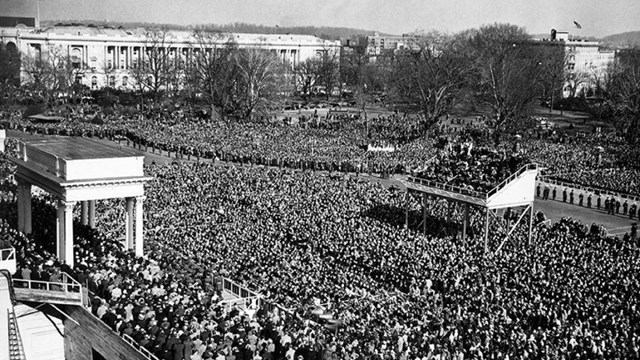
Library of Congress The discontent was immediate. The election of 1860 proved to be the breaking point for an already unstable nation. By Lincolns inauguration in March, 1861 seven states from the Deep South had already left the Union. Lincoln closed his first inaugural address with the plea that his nation not be torn apart by war. "I am loath to close. We are not enemies, but friends. We must not be enemies. Though passion may have strained it must not break our bonds of affection. The mystic chords of memory, stretching from every battlefield and patriot grave to every living heart and hearthstone all over this broad land, will yet swell the chorus of the Union, when again touched, as surely they will be, by the better angels of our nature." Lincoln did not get his wish but would instead guide his shattered country through four years of war. In true democratic fashion, it would be up to the citizens of this nation and the president they elected to write the future of the Union and the promise of freedom for all. |
Did You Know?
John Marshall was appointed Chief Justice of the Supreme Court of the United States by President John Adams in 1801. This appointment was an important element of Adams's final list of actions as President.