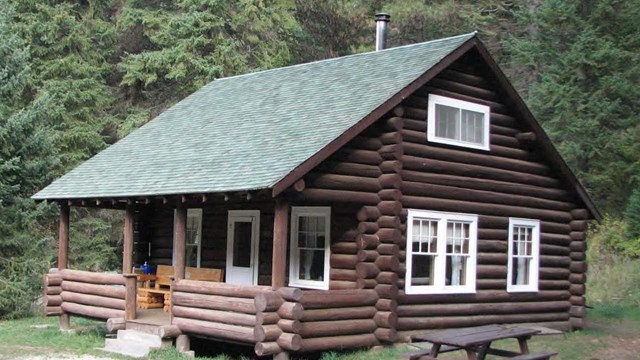
| LAMAR BARN Yellowstone National Park Wyoming In the 1930s, Yellowstone National Park set out to revive the wild buffalo herd. To meet this important goal, the park set up a buffalo ranch on the northern edge of the Lamar Valley. The project saved the buffalo, but all that remains of the Lamar Buffalo Ranch are two residences, a bunk-house (home of the Yellowstone Institute), and a horse barn. Built in 1936, the horse barn is like thousands of other log structures constructed in the rustic style between the late teens and World War II. The two-story barn is made of Lodgepole Pine logs, daubed with mortar on the out-side, chinked with wood on the inside, and set on a stone and concrete foundation. Typical of this type of building, the intersecting log wall crowns extend 12" to 28" from the corners of the building. The log rafters and purlins originally extended about 8" beyond the roof eaves and rakes, but were cut back years ago. Magnificent in its massive scale and bulky appearance, this simple barn presented a major preservation problem because of its distinctive design. Problem An inspection of the Lamar Barn revealed few surprises. Wood protected by the roof was in good condition; portions of the logs directly exposed to the weather were deteriorated. The culprit in every case was moisture. It was easy to predict where to find the greatest pockets of decay. Log crowns extending beyond the drip edge of the roof were in the worst condition. Sill logs, particularly on the north side of the building, were also badly deteriorated. The amount and depth of decay in both instances followed a pattern: the further out from the roof they extended, the greater the deterioration After about sixty years, decay had taken its toll. More than half of the extending crowns were so rotten that it and was possible to pull large chunks of the heartwood out of the exposed ends. In some cases, the log crowns were almost totally gone. In others, the shells of the crowns had given way and the soft mulch-like interior had fallen out. In the most severe cases, the decay had penetrated beyond the notch where the logs intersected and had traveled into the log as much as ten to twelve inches. This impacted both the visual and the structural integrity of the walls and their appearance. Logs should be repaired rather than replaced in log structures whenever possible to preserve the historic structure s Integrity and character. Options for Repair There are only a few ways to treat this type of deterioration: 1) replace the deteriorated logs; 2) stabilize or repair the deteriorated portion of the crowns; 3) remove the deteriorated crowns; or 4) saw off the deteriorated portion and leave as is. In the past, the most expedient treatment was chosen. In an attempt to stop the rot, the decayed rafters and purlins were simply sawed off. It did not work. Unfortunately, this is the most frequently chosen treatment in such situations. The greatest problem with this technique is that it irreparably alters the architectural character of this type of building, which derives much of its appearance from these extending roof and corner elements. Their removal flattens the surface and dilutes the rustic qualities of the barn. For this reason, Option #4 was immediately rejected. Option #1, replacement, was not a viable choice either. More than half of the logs in the building were deteriorated to some degree. Such extensive replacement would have raised serious questions about the physical integrity of the historic building. Intervention on this scale would also have created other problems. It would have required dismantling many features connected to the exterior log walls. These included interior stalls and walls, windows, doors, frames and jambs. The exterior appearance of the building afterwards, and the notching in particular, would have looked entirely different because it would not have been possible to obtain logs with minimal taper like the original logs. Finally, replacing most of the logs in the building would have been costly as well as harmful to the historic character of the barn. Then Option #2, patching, was also rejected. Repairing or patching decay in wood is possible only when there is enough sound wood on which to bond repair material. A good case in point is when the shell of a log is still intact. The decayed wood can be stabilized with an epoxy patch material to make the repair. In the Lamar Barn, however, there was not enough sound wood for an epoxy patch in the extending crowns. Option #3 involved cutting off the deteriorated log crowns at the area of greatest decay (the intersecting notches), and splicing on replacement crowns of the same size, configuration, and texture. This approach had several advantages: § Only the deteriorated portions
of the wall logs would be replaced, thus preserving sound historic
material. For these reasons, Option #3 was chosen over the other alternatives. Each of the deteriorated log crowns was carefully photographed and documented. Diameter, length from the wall and surface configuration of the cut end of the log were recorded. Then the crowns were cut off, at an angle towards the notch. Next, the original logs were drilled back to the center line of the intersecting walls, using a plumber's bit. This gave a flat surface to begin the new crowns. The recessing with a flat surface to the center line of the wall was more difficult than first anticipated because the barn builder had anchored each log with four galvanized square spikes 8" x 3/8". These spikes had to be chiseled and sawn back to a flat surface so the new crowns could be properly anchored. In a few cases, deterioration penetrated beyond the center line of the wall, and more material had to be cut back to reach sound wood. A rotary rasp, not unlike a king-size dental drill, was used to remove remaining decay at the center line. The sound wood surface was treated with an epoxy consolidant to encapsulate remaining soft absorbent wood, thereby retarding future decay. Where the decay had traveled into the log walls, sufficient wood was removed and the surface flattened to permit new faces to be attached to the logs. These new faces were notched to match the log surfaces removed. Due to a short work schedule, it was not feasible to treat the new wood with a wood preservative such as CCA (chromated copper arsenate). Such a treatment, however, would have been desirable. Pressure-treating with CCA in a salt solution would have left the wood tinted a light green, but with aging and an applied stain, it would have been unnoticeable. A surface- applied preservative was not considered, because it would not penetrate to the center of the 9"- to 12"-diameter logs. This is the area where deterioration is likely to occur first. The logs were, therefore, left untreated. Replacing the Log Crowns The photographs of the deteriorated crowns were used to reconstruct the replacements. Each replacement log crown was cut and fitted until it matched the notch of the original. A wood framing not unlike cribbing was constructed at each corner to hold the replacement log crowns as they were marked, cut, and fitted in place from the bottom level up. As much as possible, checks in the wood were placed in a downward position to prevent water from collecting in the wood. As the crowns were extensions of the logs and not supported by the ground, it was necessary to provide temporary support until the replacement crowns were epoxied in place. The log crowns were not anchored until all had been stacked in place with all notching complete. They were then marked to ensure proper alignment when anchored. The new crowns were anchored to the original logs by fiberglass reinforcing rebars (fiberglass rods that have spiral ridges to enhance bonding) embedded in epoxy bonded to the wood. Three fiberglass rebars were used for most of the connections, one long fiberglass rebar at the top of each new crown to resist the tension forces (from the weight), and two small fiberglass rebars used at the base to counteract any lateral movement. This made a three-point connection. Because buffalo sometimes rub against the building corners, an additional top tension rebar was used on the lower crowns. The three materials making up the connection were the fiberglass rebars, the structural grade epoxy, and the pine wood of both the original wall logs and the new replacement crowns. The tensile strength of the fiberglass rebar is 80,000 psi (pounds per square. inch), with the bonding shear strength of the rebar at 60,000 psi. The shear strength of the epoxy is 3000 psi; thus all the new synthetic materials are substantially higher in shear strength than the pine, which has a shear strength of only 60 to 90 psi. The wood was the weakest element of the connection. Since the crowns were in effect to be cantilevered from the main wall section, it was necessary to calculate the diameter and length of the reinforcing fiberglass rebars necessary to hold the ends in place and to keep the wood from shearing away from the epoxy. The reinforcing rebars were intended to counteract the natural force
of gravity pulling the crowns away from the wall, due to the weight
of the crown itself, from the accumulation of snow and ice, or from
lateral loads. With a 12"-28" long log crown 9" to 12" in
diameter, it was determined that a 1/2" diameter reinforcing rebar
set 12" into sound wood of the upper section of the wall log and
12" into the attached crown was necessary to combat the combined
forces of shear, bending moment and vertical loading. (The drilled
holes were slightly longer and wider to accommodate the reinforcing
fiberglass rebar and the epoxy.) In addition, for horizontal or lateral
movement, two 1/2" diameter fiberglass rebars were imbedded 4" into
the lower sections of the log walls and a matching 4” into the
crowns. The length, diameter, and the placement of the rebars were
based on calculations intended to keep the wood fibers from shearing
away from the imbedded rebars. Another situation might require different
dimensions. Installation Working with epoxy is difficult. Setting times depend on the type of formula and the ambient temperature. Some epoxies set up in less than 15 minutes; others can be formulated to dry over a three-day period. The epoxy for this job set in less than 45 minutes, and for that reason, only small amounts were mixed at a time, and work was not undertaken in the direct sun, as this further reduced the effective working time. Curing took place in about 24 hours at temperatures between 60 to 80°F. The cribbing construction supporting the crown ends was kept in place until all the crowns were fully cured. Figure 6. A flexible tube was stapled onto a caulking gun in order to fill the 12"-12 1/2" deep holes that had been drilled into the sound end of the historic log. The individual hole was filled two-thirds with epoxy adhesive and a 1/2" diameter fiberglass reinforcing rebar was then inserted. Photo: Harrison Goodall. Finishing Once the epoxy cured and cribbing was removed, the log crowns were stained. A first coat of oil-based stain was used on the log crowns and eventually the entire building was stained. Had the new wood been treated with a salt-impregnated preservative solution, a full year of aging would have been required prior to staining. It is anticipated that every 3-6 years the building will need re-staining in addition to an annual coating of the new log crowns with a water repellant. Evaluation While there is a tendency to caulk the cracks in wood, It has been found that in many instances it is best to leave small checks open to let wood breathe naturally. For this reason the joints between the log crowns and the original log walls were also left open and not sealed. The new crown ends are expected to last between 10 and 30 years. The upper crowns directly under the roof runoff are likely to deteriorate first. These can be replaced as required. As with any completed preservation project, the better the routine maintenance the longer the work will last and the more cost- effective it will be in the long run. PROJECT DATA: Building: Owner: Project Date: Contractor: Epoxy Supplier: Project Costs: Project Included:
PRESERVATION TECH NOTES are designed to provide practical information on innovative techniques and practices for successfully maintaining and preserving cultural resources. All techniques and practices described herein conform to established National Park Service policies, procedures and standards. This Tech Note was prepared pursuant to the National Historic Preservation Act Amendments of 1980, which direct the Secretary of the Interior to develop and make available to government agencies and individuals information concerning professional methods and techniques for the preservation of historic properties. Comments on the usefulness of this information are welcomed and should
be addressed to Tech Notes, Preservation Assistance Division, National
Park Service, P.O. Box 37127, Washington, D.C. 20013-7127. This publication
is not copyrighted and can be reproduced without penalty. Normal procedures
for credit to the author and the National Park Service are appreciated. |
Home | Search | E-mail | Technical Preservation Services | NPS History & Culture