TPS graphic header with link to ParkNet

Evaluation

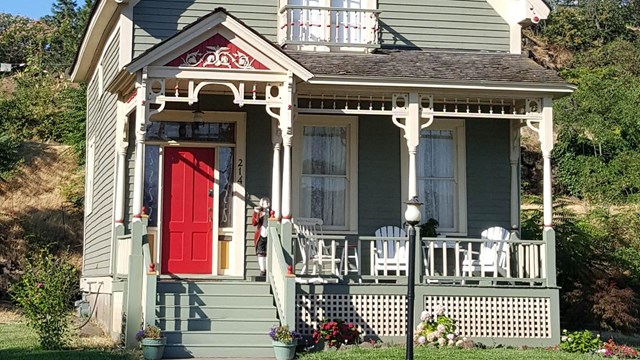
Areas on the Truman home where paint was removed with the heat guns and then lightly sanded provided an excellent painting surface (see figure 6). By using workers experienced with thermal removal of paint, very few scraper tool marks were left that were noticeable. The new paint bonded well to the wood and should perform well for about 7 years before repainting is necessary.

Proper planning and an awareness of safety concerns were important to the successful removal of paint from the Truman home. It cannot be overemphasized that anyone considering exterior paint removal using heat guns should thoroughly evaluate the structure for susceptibility to ignition under a hot air blast. Where thermal removal of paint is the selected method, fire prevention and health safety measures should be stressed emphatically to workers throughout the project.

Detail of freshly painted siding
Figure 6: A typical section of the finish painted siding shows that little damage was done in removing the paint. Photo: Michael Lee

Removal of paint using a heat gun is slower than utilizing a propane torch because the temperature of the gun is only half that of the torch flame which can reach as high as 1500°F. Use of an open flame is strongly discouraged because of the far greater fire risks involved as a result of the higher temperature. Such intense and concentrated heat not only compounds the existing fire risks already identified with the heat gun but also presents additional ones. For example, nails in the siding may conduct concentrated flame heat, thereby causing deadening boards, wall cavity debris, or untreated cellulose insulation to ignite. In addition to the unacceptable fire risks with the propane torch, use of an open flame inevitably scorches the wood surface considerably—damage that is totally unnecessary.

Even with heat guns, however, scorching and tool mark damage may result. Patience is required; working too fast can be counter productive, causing damage to the wood surface and heightening the fire risks. The hot air blast from the heat gun will soften the paint by raising the latent oils. If a worker is impatient and either works too large an area or gets the paint too hot before it is scraped, the oils will be driven off and the paint will harden again. If this occurs, continued application of heat will not soften the paint again, instead it will eventually ignite.

Inexperienced laborers should be taught the mechanics of using heat guns on non-significant woodwork, perhaps even on another building, prior to work on a significant historic structure. Workers need to be familiar with different scraper sizes and the range of flexibility in scraper blades and putty knives. They should also know how to grind scrapers to match molding profiles in the wood work, know the appropriate angles in which scrapers should be set and used, and how to round the edges of knives and scrapers to avoid gouging the wood. Once rudimentary skills are learned, a worker should then begin on a simple, easily accessible portion of the structure to build confidence in this technique.

Regardless of the skill level of the workers, test patches should always be undertaken. Approved test patches thus serve as the standard of workmanship for the entire project and the basis as acceptance or rejection of the work. If after careful planning and examination of the test patches there is any doubt as to the ability of a structure or portions thereof to withstand thermal removal of paint, then alternative means should be considered.

Project Data: 

Building:
Harry S. Truman National Historic Site
Independence, Missouri
Owner:
National Park Service
Harry S. Truman National Historic Site
Independence, Missouri
Project Dates:
October 1984—November 1985
Contractor:
Campos Construction Company
Ernest Callaway
Contractor’s Site Superintendent
Omaha, Nebraska
Project Staff:

Midwest Regional Office
National Park Service
Omaha, Nebraska

Alan O’Bright
Project Architect

Michael Lee
Preservation Specialist

Lee Jameson
Preservation Specialist

Skip Brooks
Facility Manager
Harry S. Truman National Historic Site
Independence, Missouri


Project Costs:
For paint removal using heat guns on 5,800 square feet of siding and 1,000 square feet of porch deck, the labor costs averaged $4.00 per square foot. For the 2450 square feet of decorative millwork, the labor costs averaged about $5.50 per square foot. Total investment in paint removal equipment including heat guns, putty knives, extension cords, and lights was approximately $950. In addition there were substantial costs for temporary electrical outlets and scaffolding. The total cost for paint removal by heat gun, scraping and sanding, and chemicals from all surfaces including siding, millwork, 74 window sashes, 7 door openings, 200 brackets, porch ceiling, soffits, and fasciae was about $57,000. The above figures do not include contractor’s overhead and profit.

This PRESERVATION TECH NOTE was prepared by the National Park Service. Charles E. Fisher, Preservation Assistance Division, National Park Service, serves as Technical Coordinator for the PRESERVATION TECH NOTES. Special thanks go to Don Wilson, Ernest Callaway, and the work crew of Campos Construction for providing cost and technical information; Michael Lee for his technical assistance; and Harry S. Truman NHS Superintendent Norm Reigle and his staff for their input and patience throughout the project. Thanks also go to Hugh Miller and Randy Biallas, Park Historic Architecture Division, National Park Service; tc Susan LeVan, Forest Producers Laboratory, U.S. Department of Agriculture; and to Phillip Marshall, Architectural Artisanry Program, Swain School of Design, for their comments and assistance in the preparation of the Tech Note. The following Technical Preservation Services staff contributed to its production: Theresa L. Robinson, Brenda Siler and Michael Auer. Cover Photo: Al O'Bright.


PRESERVATION TECH NOTES are designed to provide practical information on innovative techniques and practices for successfully maintaining and preserving cultural resources. All techniques and practices described herein conform to established National Park Service policies, procedures, and standards. This Tech Note was prepared pursuant to the National Historic Preservation Act Amendments of 1980 which direct the Secretary of the Interior to develop and make available to government agencies and individuals information concerning professional methods and techniques for the preservation of historic properties.

This publication is not copyrighted and can be reproduced without penalty. Normal procedures for credit to the author and the National Park Service are appreciated.


Introduction

Introduction Link


Contents


Print Version (42k)


Home |  Search |  E-mail |  Technical Preservation Services |  NPS History & Culture

Technical Preservation Services Home National Park Service Home