Identify, Retain and Preserve

Identifying, retaining, and preserving restoration
period buildings and their features as well as features
of the site. Site features may include circulation systems
such as walks, paths, roads, or parking; vegetation
such as trees, shrubs, fields, or herbaceous plant material;
landforms such as terracing, berms or grading; furnishings
such as lights, fences, or benches; decorative elements
such as sculpture, statuary or monuments; water features
including fountains, streams, pools, or lakes; and subsurface
archeological features which are important in defining
the restoration period.
Re-establishing the relationship between buildings
and the landscape that existed during the restoration
period.
 |
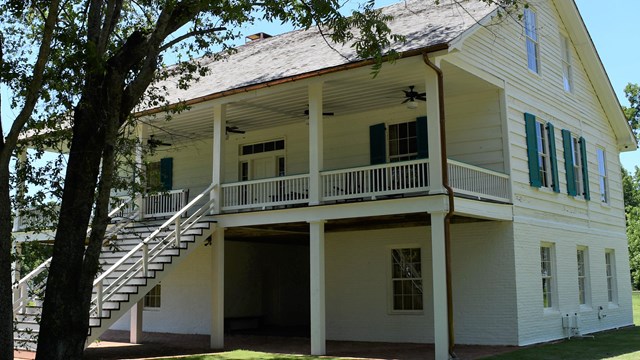
Oatlands Historic District, in Leesburg, Virginia,
consists of
George Carter's 19th century plantation acreage containing the main house, the barn (shown
here) and other outbuildings. Photo: HABS Collection, NPS.
|
Altering buildings and their features or site features
from the restoration period.
Failing to properly document building and site features
from the restoration period which may result in their
loss.
Retaining non-restoration period buildings or landscape
features.

Protect and Maintain

Protecting and maintaining buildings and the site
by providing proper drainage to assure that water does
not erode foundation walls; drain toward the building;
or damage or erode the landscape.
Minimizing disturbance of terrain around buildings
or elsewhere on the site, thus reducing the possibility
of destroying or damaging important landscape features
or archeological resources.
Surveying and documenting areas where the terrain
will be altered during restoration work to determine
the potential impact to landscape features or archeological
resources.
Protecting, e.g., preserving in place, important
archeological resources.
Planning and carrying out any necessary investigation
using professional archeologists and modern archeological
methods when preservation in place is not feasible.
Preserving important landscape features from the
restoration period, including ongoing maintenance of
historic plant material.
 |
The historic birch allee at Stan Hywet Hall,
Akron, Ohio, which had suffered from borer
infestation and leaf miner, was
preserved through a series of
carefully executed steps that
took 15 years to realize. Photo: Child Associates.
|
Protecting building and landscape features against
arson and vandalism before restoration work begins,
i.e., erecting protective fencing and installing alarm
systems that are keyed into local protection agencies.
Providing continued protection of building materials
and plant features from the restoration period through
appropriate cleaning, rust removal, limited paint removal,
and re-application of protective coating systems; and
pruning and vegetation management.
Evaluating the existing condition of materials and
features to determine whether more than protection and
maintenance are required, that is, if repairs to building
and site features will be necessary.

Failing to maintain adequate site drainage so that buildings
and site features are damaged or destroyed; or alternatively,
changing the site grading so that water no longer drains
properly.
Introducing heavy machinery into areas where it may
disturb or damage important landscape features or archeological
resources.
Failing to survey the building site prior to beginning
restoration work which results in damage to, or destruction
of, landscape features or archeological resources.
Leaving known archeological material unprotected so
that it is damaged during restoration work.
Permitting unqualified personnel to perform data recovery
on archeological resources so that improper methodology
results in the loss of important archeological material.
Allowing restoration period landscape features to be
lost or damaged due to a lack of maintenance.
Permitting the property to remain unprotected so that
the building and landscape features or archeological
resources are damaged or destroyed.
Removing restoration period features from the building
or site such as wood siding, iron fencing, masonry balustrades,
or plant material.
Failing to provide adequate protection of materials
on a cyclical basis so that deterioration of building
and site features results.
Failing to undertake adequate measures to assure the
protection of building and site features.

Repair

Repairing restoration period features of the building
and site by reinforcing historic materials. The new
work should be unobtrusively dated to guide future research
and treatment.

Replacing an entire restoration period feature of the
building or site such as a fence, walkway, or driveway
when repair of materials and limited compatible replacement
of deteriorated or missing parts are appropriate.
Using a substitute material for the replacement part
that does not convey the visual appearance of the surviving
parts of the building or site feature or that is physically
or chemically incompatible.

Replace

Replacing in kind an entire restoration period feature
of the building or site that is too deteriorated to
repair if the overall form and detailing are still evident.
Physical evidence from the deteriorated feature should
be used as a model to guide the new work. This could
include an entrance or porch, walkway, or fountain.
If using the same kind of material is not technically
or economically feasible, then a compatible substitute
material may be considered. The new work should be unobtrusively
dated to guide future research and treatment.
Replacing deteriorated or damaged landscape features
of the restoration period in kind or with compatible
substitute material. The replacement feature should
be based on physical evidence and convey the same appearance.

Removing a restoration period feature of the building
or site that is unrepairable and not replacing it; or
failing to document the new work.
 |
 |
When the American Elm (left) was plagued with
Dutch Elm Disease, many historic properties relied
on the Japanese Zelkova (right) as a substitute
plant.
Compared to the American Elm, it is readily apparent
that the form and
scale of this tree is really quite different,
and would be an inappropriate plant material within
a restoration project. Photos: NPS files.
|
Adding conjectural landscape features to the site such
as period reproduction lamps, fences, fountains, or
vegetation that are historically inappropriate, thus
creating an inaccurate depiction of the restoration
period.
The following Restoration
work is highlighted to indicate that it involves
the removal or alteration of existing historic
building site features that would be retained
in Preservation and Rehabilitation treatments;
and the replacement of missing building site features
from the restoration period using all new materials..
Removing Existing Features from Other Historic
Periods

Removing or altering features of the building
or site from other historic periods such as a
later outbuilding, paved road, or overgrown tree.
Documenting features of the building or site
from other periods prior to their alteration or
removal.

Failing to remove a feature of the building or
site from another period, thus creating an inaccurate
historic appearance.
Failing to document features of the building
or site from other historic periods that are removed
during restoration so that a valuable portion
of the historic record is lost.

Re-creating Missing Features
from the Restoration Period

Re-creating a missing feature of the building
or site that existed during the restoration period
based on physical or documentary evidence; for
example, duplicating a terrace, gazebo, or fencing.
 |
 |
This ca. 1900 photograph (left) would
be invaluable to guide restoration of the
deteriorated house (right) to its documented
earlier appearance, complete with decorative
trim, shutters, polychromed exterior, and
fencing. Photos: Courtesy, North Carolina
Department of Archives and History.
|

Constructing a feature of the building or site
that was part of the original design, but was
never actually built; or constructing a feature
which was thought to have existed during the restoration
period, but for which there is insufficient documentation.
|
|