Identify, Retain and Preserve

Identifying retaining, and preserving restoration
period building and landscape features of the setting.
Such features can include roads and streets, furnishings
such as lights or benches, vegetation, gardens and yards,
adjacent open space such as fields, parks, commons or
woodlands, and important views or visual relationships.
 |
Mount Auburn Cemetery, Massachusetts, established
a new type of burial ground in the late 19th century
that influenced landscape architects of the day--it
was Boston's first suburban park. Because of its
historical significance, the materials, features
and spatial relationships from this period need
to be preserved to the greatest extent possible.
Photo: HABS Collection, NPS.
|
Re-establishing the relationship between buildings
and landscape features of the setting that existed during
the restoration period.
Altering features of the setting that can be documented
to the restoration period.
Failing to properly document restoration period building
and landscape features which may result in their loss.
Retaining non-restoration period buildings or landscape
features.

Protect and Maintain

Protecting and maintaining building materials and
plant features from the restoration period through appropriate
cleaning, rust removal, limited paint removal, and reapplication
of protective coating systems; and pruning and vegetation
management.
 |
When restoration work is being undertaken on one historic building, it is important to protect buildings
in the vicinity against damage. Depending upon
the nature of the adjacent project, protective
measures may include documenting and monitoring
the historic structure or encompass a broader
plan that includes encasing windows, independent
review of excavation procedures and a range of
other precautions. Photo: NPS files.
|
Protecting buildings and landscape features against
arson and vandalism before restoration work begins by
erecting protective fencing and installing alarm systems
that are keyed into local protection agencies.
Evaluating the existing condition of the building
and landscape features to determine whether more than
protection and maintenance are required, that is, if
repairs to features will be necessary.

Failing to provide adequate protection of materials
on a cyclical basis which results in the deterioration
of building and landscape features.
Permitting the building and setting to remain unprotected
so that interior or exterior features are damaged.
Stripping or removing features from buildings or the
setting such as wood siding, iron fencing, terra cotta
balusters, or plant material.
Failing to undertake adequate measures to assure the
protection of building and landscape features.

Repair

Repairing restoration period features of the building
and landscape by reinforcing the historic materials.
Repair will generally include the replacement in kind--or
with compatible substitute material--of those extensively
deteriorated or missing parts of features where there
are surviving prototypes such as porch balustrades or
paving materials. The new work should be unobtrusively
dated to guide future research and treatment.

Replacing an entire restoration period feature of the
building or landscape setting when repair of materials
and limited replacement of deteriorated or missing parts
are appropriate.
Using a substitute material for the replacement part
that does not convey the visual appearance of the surviving
parts of the building or landscape, or that is physically,
chemically, or ecologically incompatible.

Replace

Replacing in kind an entire restoration period feature
of the building or landscape that is too deteriorated
to repair--when the overall form and detailing are still
evident--using the physical evidence as a model to guide
the new work. If using the same kind of material is
not technically or economically feasible, then a compatible
substitute material may be considered. The new work
should be unobtrusively dated to guide future research
and treatment.

Removing a restoration period feature of the building
or landscape that is unrepairable and not replacing
it; or failing to document the new work.
The following Restoration
work is highlighted to indicate that it involves
the removal or alteration of existing features
of the historic setting that would be retained
in Preservation and Rehabilitation treatments;
and the replacement of missing features from the
restoration period using all new materials in
order to create an accurate historic appearance.
Removing Existing Features from Other Historic
Periods

Removing or altering features of the building
or landscape from other historic periods, such
as a later road, sidewalk, or fence.
Documenting features of the building or landscape
dating from other periods prior to their alteration
or removal.
 |
 |
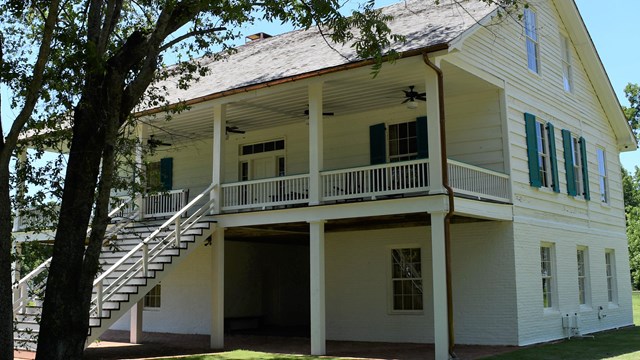
The Bronson-Mulholland House in Palatka,
Florida, ca. 1845, is shown (left) before and
(right) after the treatment, Restoration. Over
the years the east (far right) side of the
veranda had been filled in as a sixth bay.
During the restoration, this later infill
was removed and the east veranda, together
with its flooring, stairs, and foundation,
restored. The landscape was returned to its original appearance, based on documentation. Photo: City of Palatka, Community
Development Department.
|

Failing to remove a feature of the building or
landscape from another period, thus creating an
inaccurate historic appearance.
Failing to document features of the building
or landscape from other historic periods that
are removed from the setting so that a valuable
portion of the historic record is lost.

Re-creating Missing Features
from the Restoration Period

Re-creating a missing feature of the building
or landscape in the setting that existed during
the restoration period based on physical or documentary
evidence; for example, duplicating a path or park
bench.

Constructing a feature of the building or landscape
that was part of the original design for the setting
but was never actually built; or constructing
a feature which was thought to have existed during
the restoration period, but for which there is
insufficient documentation.
|
|
 |

|