|

Identifying spaces, features, and finishes from the
restoration period so that code-required work will not
result in their damage or loss.
Complying with health and safety codes, including
seismic code requirements, in such a manner that spaces,
features, and finishes from the restoration period are
preserved.
Removing toxic building materials only after thorough
testing has been conducted and only after less invasive
abatement methods have been shown to be inadequate.
Providing workers with appropriate personal protective
equipment for hazards found at the worksite.
Working with local code officials to investigate
systems, methods, or devices of equivalent or superior
effectiveness and safety to those prescribed by code
so that unnecessary alterations can be avoided.
 |
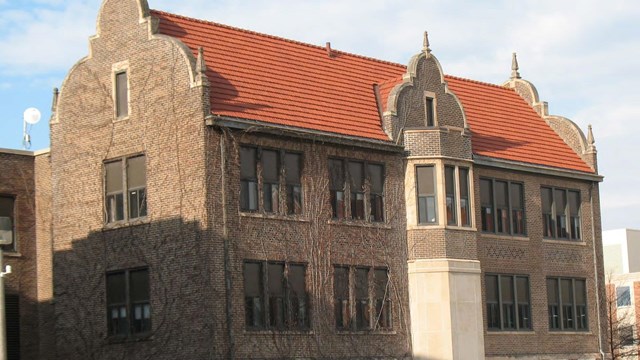
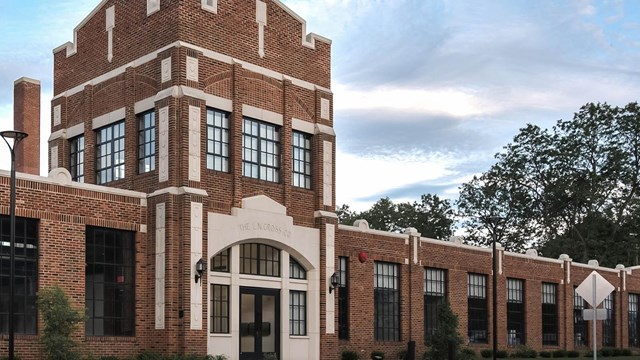
Upon completion of an extensive seismic retrofit project, the changes to this ca. 1932
Gothic Revival building to add base isolation at
the foundation were not visually apparent.
Photo: © Jonathan Farrer.
|
Upgrading historic stairways and elevators from
the restoration period to meet health and safety codes
in a manner that assures their preservation, i.e., so
that they are not damaged or obscured.
Installing sensitively designed fire suppression
systems, such as sprinkler systems, that result in retention
of features and finishes from the restoration period.
Applying fire-retardant coatings, such as intumescent
paints, which expand during fire to add thermal protection
to steel.
Adding a new stairway or elevator to meet health
and safety codes in a manner that preserves adjacent
features and spaces from the restoration period.
Undertaking code-required alterations to a building
or site before identifying those spaces, features, or
finishes from the restoration period which must be preserved.
Altering, damaging, or destroying spaces, features,
and finishes while making modifications to a building
or site to comply with safety codes.
Destroying interior features and finishes from the
restoration period without careful testing and without
considering less invasive abatement methods.
Removing unhealthful building materials without regard
to personal and environmental safety.
Making changes to historic buildings without first
exploring equivalent health and safety systems, methods,
or devices that may be less damaging to spaces, features,
and finishes from the restoration period.
Damaging or obscuring stairways and elevators or altering
adjacent spaces from the restoration period in the process
of doing work to meet code requirements.
Covering wood features from the restoration period
with fire-resistant sheathing which results in altering
their visual appearance.
Using fire-retardant coatings if they damage or obscure
features from the restoration period.
Altering the appearance of spaces, features, or finishes
from the restoration period when adding a new code-required
stairway or elevator.
|