Identify, Retain and Preserve

Identifying, retaining, and preserving wood features
that are important in defining the overall historic
character of the building such as siding, cornices,
brackets, window architraves, and doorway pediments;
and their paints, finishes, and colors.
 |
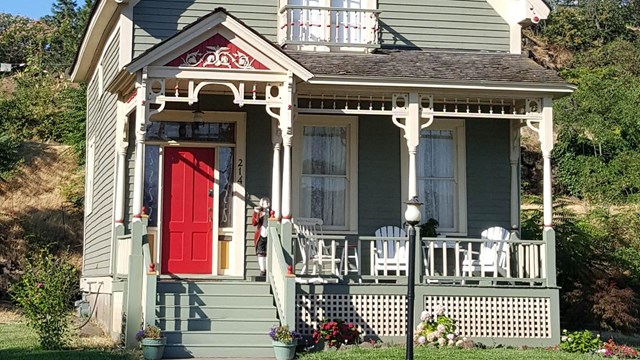
The wooden trim on the eaves and around the
porch gives this building its special historic
character. Loss of the wood trim would destroy
much of the character that is so dependent upon
craftsmanship for the moldings, carvings, and
the see-through jigsaw work. Photo: NPS files.
|
Removing or radically changing wood features which are
important in defining the overall historic character
of the building so that, as a result, the character
is diminished.
Removing a major portion of the historic wood from
a facade instead of repairing or replacing only the
deteriorated wood, then reconstructing the facade with
new material in order to achieve a uniform or "improved"
appearance. Wood features inappropriately stripped of
traditional painted finish.
Radically changing the type of finish or its color
or accent scheme so that the historic character of the
exterior is diminished.
Stripping historically painted surfaces to bare wood,
then applying clear finishes or stains in order to create
a "natural look."
Stripping paint or varnish to bare wood rather than
repairing or reapplying a special finish, i.e., a grain
finish to an exterior wood feature such as a front door.
 |
The distinctive wood features on this historic building have been inappropriately
stripped of their traditional painted
finish. Photo: NPS files.
|

Protect and Maintain

Protecting and maintaining wood features by providing
proper drainage so that water is not allowed to stand
on flat, horizontal surfaces or accumulate in decorative
features.
Applying chemical preservatives to wood features
such as beam ends or outriggers that are exposed to
decay hazards and are traditionally unpainted.
Retaining coatings such as paint that help protect
the wood from moisture and ultraviolet light. Paint
removal should be considered only where there is paint
surface deterioration and as part of an overall maintenance
program which involves repainting or applying other
appropriate protective coatings.
Inspecting painted wood surfaces to determine whether
repainting is necessary or if cleaning is all that is
required. Removing damaged or deteriorated paint to
the next sound layer using the gentlest method possible
(handscraping and handsanding), then repainting.
 |
The nozzle on the electric heat gun permits
hot air to be aimed into cavities on solid decorative
surfaces, such as this carriage house door. After
the paint has been sufficiently softened, it can
be carefully removed with a scraper. Photo: NPS
files.
|
Using with care electric hot-air guns on decorative
wood features and electric heat plates on flat wood
surfaces when paint is so deteriorated that total removal
is necessary prior to repainting.
Using chemical strippers primarily to supplement
other methods such as handscraping, handsanding and
the above-recommended thermal devices. Detachable wooden
elements such as shutters, doors, and columns may--with
the proper safeguards--be chemically dip-stripped.
Applying compatible paint coating systems following
proper surface preparation. Repainting with colors that
are appropriate to the historic building and district.
Evaluating the overall condition of the wood to
determine whether more than protection and maintenance
are required, that is, if repairs to wood features will
be necessary.

Failing to identify, evaluate, and treat the causes
of wood deterioration, including faulty flashing, leaking
gutters, cracks and holes in siding, deteriorated caulking
in joints and seams, plant material growing too close
to wood surfaces, or insect or fungus infestation.
Using chemical preservatives such as creosote which
can change the appearance of wood features unless they
were used historically.
Stripping paint or other coatings to reveal bare wood,
thus exposing historically coated surfaces to the effects
of accelerated weathering.
Removing paint that is firmly adhering to, and thus,
protecting wood surfaces.
Using destructive paint removal methods such as a propane
or butane torches, sandblasting or waterblasting. These
methods can irreversibly damage historic woodwork. Using
thermal devices improperly so that the historic woodwork
is scorched.
Failing to neutralize the wood thoroughly after using
chemicals so that new paint does not adhere.
Allowing detachable wood features to soak too long
in a caustic solution so that the wood grain is raised
and the surface roughened.
Failing to follow manufacturers' product and application
instructions when repainting exterior woodwork.
Using new colors that are inappropriate to the historic
building or district. Failing to undertake adequate
measures to assure the protection of wood features.

Repair
Repairing wood features by patching, piecing-in,
consolidating, or otherwise reinforcing the wood using
recognized preservation methods. Repair may also include
the limited replacement in kind--or with compatible
substitute material--of those extensively deteriorated
or missing parts of features where there are surviving
prototypes such as brackets, molding, or sections of
siding.
 |
A broken clapboard is easily repaired. This board was replaced with one that matches the size and type of the
neighboring clapboards. With a coat of primer and two topcoats of paint, this repair will last as long as the original clapboards next to it. Photo:
© John Leeke.
|

Replacing an entire wood feature such as a cornice or
wall when repair of the wood and limited replacement
of deteriorated or missing parts are appropriate.
Using substitute material for the replacement part
that does not convey the visual appearance of the surviving
parts of the wood feature or that is physically or chemically
incompatible.

Replace

Replacing in kind an entire wood feature that is
too deteriorated to repair--if the overall form and
detailing are still evident--using the physicalevidence
as a model to reproduce the feature. Examples of wood
features include a cornice, entablature or balustrade.
If using the same kind of material is not technically
or economically feasible, then a compatible substitute
material may be considered.
 |
This rotted wood column base is being replaced
with new wood. Photo: NPS files.
|

Removing an entire wood feature that is unrepairable
and not replacing it; or replacing it with a new feature
that does not convey the same visual appearance.
The following work
is highlighted to indicate that it represents
the particularly complex technical or design aspects
of Rehabilitation projects and should only be
considered after the preservation concerns listed
above have been addressed.
Design for the Replacement of Missing Historic
Features

Designing and installing a new wood feature
such as a cornice or doorway when the historic
feature is completely missing. It may be an accurate
restoration using historical, pictorial, and physical
documentation; or be a new design that is compatible
with the size, scale, material, and color of the
historic building.

Creating a false historical appearance because
the replaced wood feature is based on insufficient
historical, pictorial, and physical documentation.
Introducing a new wood feature that is incompatible
in size, scale, material and color.
|
|