| 6 | |
|
Dangers of Abrasive Cleaning to Historic BuildingsAnne E. Grimmer
»What is Abrasive Cleaning?
"Chemical or physical treatments, such as sandblasting,
that cause damage to historic materials shall not be used. The
surface cleaning of structures, if appropriate, shall be undertaken
using the gentlest means possible." The Secretary of
the Interior's Standards for Rehabilitation.
Abrasive cleaning methods are responsible for causing a great
deal of damage to historic building materials. To prevent indiscriminate
use of these potentially harmful techniques, this brief has been
prepared to explain abrasive cleaning methods, how they can be
physically and aesthetically destructive to historic building
materials, and why they generally are not acceptable preservation
treatments for historic structures. There are alternative, less
harsh means of cleaning and removing paint and stains from historic
buildings. However, careful testing should precede general cleaning
to assure that the method selected will not have an adverse effect
on the building materials. A historic building is irreplaceable,
and should be cleaned using only the "gentlest means possible"
to best preserve it.
Abrasive cleaning methods include all techniques that physically
abrade the building surface to remove soils, discolorations or
coatings. Such techniques involve the use of certain materials
which impact or abrade the surface under pressure, or abrasive
tools and equipment. Sand, because it is readily available, is
probably the most commonly used type of grit material. However,
any of the following materials may be substituted for sand, and
all can be classified as abrasive substances: ground slag or volcanic
ash, crushed (pulverized) walnut or almond shells, rice husks,
ground corncobs, ground coconut shells, crushed eggshells, silica
flour, synthetic particles, glass beads and micro-balloons. Even
water under pressure can be an abrasive substance. Tools and equipment
that are abrasive to historic building materials include wire
brushes, rotary wheels, power sanding disks and belt sanders.
The use of water in combination with grit may also be classified
as an abrasive cleaning method. Depending on the manner in which
it is applied, water may soften the impact of the grit, but water
that is too highly pressurized can be very abrasive. There are
basically two different methods which can be referred to as "wet
grit," and it is important to differentiate between the two.
One technique involves the addition of a stream of water to a
regular sandblasting nozzle. This is done primarily to cut down
dust, and has very little, if any, effect on reducing the aggressiveness,
or cutting action of the grit particles. With the second technique,
a very small amount of grit is added to a pressurized water stream.
This method may be controlled by regulating the amount of grit
fed into the water stream, as well as the pressure of the water.
Usually, an abrasive cleaning method is selected as an expeditious
means of quickly removing years of dirt accumulation, unsightly
stains, or deteriorating building fabric or finishes, such as
stucco or paint.
Many mid-19th century brick buildings were painted immediately
or soon after completion to protect poor quality brick or to imitate
another material, such as stone. Sometimes brick buildings were
painted in an effort to produce what was considered a more harmonious
relationship between a building and its natural surroundings.
By the 1870s, brick buildings were often left unpainted as mechanization
in the brick industry brought a cheaper pressed brick and fashion
decreed a sudden preference for dark colors. However, it was still
customary to paint brick of poorer quality for the additional
protection the paint afforded.
It is a common 20th century misconception that all historic masonry
buildings were initially unpainted. If the intent of a modern
restoration is to return a building to its original appearance,
removal of the paint not only may be historically inaccurate,
but also harmful. Many older buildings were painted or stuccoed
at some point to correct recurring maintenance problems caused
by faulty construction techniques, to hide alterations, or in
an attempt to solve moisture problems. If this is the case, removal
of paint or stucco may cause these problems to reoccur.
Another reason for paint removal, particularly in rehabilitation
projects, is to give the building a "new image" in response
to contemporary design trends and to attract investors or tenants.
Thus, it is necessary to consider the purpose of the intended
cleaning. While it is clearly important to remove unsightly stains,
heavy encrustations of dirt, peeling paint or other surface coatings,
it may not be equally desirable to remove paint from a building
which originally was painted. Many historic buildings which show
only a slight amount of soil or discoloration are much better
left as they are.
The crux of the problem is that abrasive cleaning is just that--abrasive.
An abrasively cleaned historic structure may be physically as
well as aesthetically damaged. Abrasive methods "clean"
by eroding dirt or paint, but at the same time they also tend
to erode the surface of the building material. In this way, abrasive
cleaning is destructive and causes irreversible harm to the historic
building fabric. If the fabric is brick, abrasive methods remove
the hard, outer protective surface, and therefore make the brick
more susceptible to rapid weathering and deterioration.
Abrasive cleaning can destroy, or substantially diminish, decorative
detailing on buildings such as a molded brickwork or architectural
terra-cotta, ornamental carving on wood or stone, and evidence
of historic craft techniques, such as tool marks and other surface
textures.
In addition to causing physical and aesthetic harm to the historic
fabric, there are several adverse environmental effects of dry
abrasive cleaning methods. Because of the friction caused by the
abrasive medium hitting the building fabric, these techniques
usually create a considerable amount of dust, which is unhealthy,
particularly to the operators of the abrasive equipment. It further
pollutes the environment around the job site, and deposits dust
on neighboring buildings, parked vehicles and nearby trees and
shrubbery. Some adjacent materials not intended for abrasive treatment
such as wood or glass, may also be damaged because the equipment
may be difficult to regulate.
Wet grit methods, while eliminating dust, deposit a messy slurry
on the ground or other objects surrounding the base of the building.
In colder climates where there is the threat of frost, any wet
cleaning process applied to historic masonry structures must be
done in warm weather, allowing ample time for the wall to dry
out thoroughly before cold weather sets in. Water which remains
and freezes in cracks and openings of the masonry surface eventually
may lead to spalling. High-pressure wet cleaning may force an inordinate
amount of water into the walls, affecting interior materials such
as plaster or joist ends, as well as metal building components
within the walls.
The greatest problem in developing practical guidelines for cleaning
any historic building is the large number of variable and unpredictable
factors involved. Because these variables make each cleaning project
unique, it is difficult to establish specific standards at this
time. This is particularly true of abrasive cleaning methods because
their inherent potential for causing damage is multiplied by the
following factors:
Despite the apparent care taken by most architects and building
cleaning contractors to prepare specifications for pressure cleaning
which will not cause harm to the delicate fabric of a historic
building, it is very difficult to ensure that the same amount
of pressure is applied to all parts of the building. For example,
if the operator of the pressure equipment stands on the ground
while cleaning a two-story structure, the amount of force reaching
the first story will be greater than that hitting the second story,
even if the operator stands on scaffolding or in a cherry picker,
because of the "line drop" in the distance from the
pressure source to the nozzle. Although technically it may be
possible to prepare cleaning specifications with tight controls
that would eliminate all but a small margin of error, it may not
be easy to find professional cleaning firms willing to work under
such restrictive conditions. The fact is that many professional
building cleaning firms do not really understand the extreme delicacy
of historic building fabric, and how it differs from modern construction
materials. Consequently, they may accept building cleaning projects
for which they have no experience.
The amount of pressure used in any kind of cleaning treatment
which involves pressure, whether it is dry or wet grit, chemicals
or just plain water, is crucial to the outcome of the cleaning
project. Unfortunately, no standards have been established for
determining the correct pressure for cleaning each of the many
historic building materials which would not cause harm. The considerable
discrepancy between the way the building cleaning industry and
architectural conservators define "high" and "low"
pressure cleaning plays a significant role in the difficulty of
creating standards.
Nonhistoric/Industrial: A representative of the building cleaning
industry might consider "high" pressure water cleaning
to be anything over 5,000 psi, or even as high as 10,000 to 15,000
psi! Water under this much pressure may be necessary to clean
industrial structures or machinery, but would destroy most historic
building materials. Industrial chemical cleaning commonly utilizes
pressures between 1,000 and 2,500 psi.
Historic: By contrast, conscientious dry or wet abrasive cleaning
of a historic structure would be conducted within the range of
20 to 100 psi at a range of 3 to 12 inches. Cleaning at this low
pressure requires the use of a very fine 00 or 0 mesh grit forced
through a nozzle with a 1/4-inch opening. A similar, even more
delicate method being adopted by architectural conservators uses
a micro-abrasive grit on small, hard-to-clean areas of carved, cut
or molded ornament on a building facade. Originally developed
by museum conservators for cleaning sculpture, this technique
may employ glass beads, micro-balloons, or another type of micro-abrasive
gently powered at approximately 40 psi by a very small, almost
pencil-like pressure instrument. Although a slightly larger pressure
instrument may be used on historic buildings, this technique still
has limited practical applicability on a large scale building
cleaning project because of the cost and the relatively few technicians
competent to handle the task. In general, architectural conservators
have determined that only through very controlled conditions can
most historic building material be abrasively cleaned of soil
or paint without measurable damage to the surface or profile of
the substrate.
Yet some professional cleaning companies which specialize in cleaning
historic masonry buildings use chemicals and water at a pressure
of approximately 1,500 psi, while other cleaning firms recommend
lower pressures ranging from 200 to 800 psi for a similar project.
An architectural conservator might decide, after testing, that
some historic structures could be cleaned properly using a moderate
pressure (200-600 psi), or even a high pressure (600-1800 psi)
water rinse. However, cleaning historic buildings under such high
pressure should be considered an exception rather than the rule,
and would require very careful testing and supervision to assure
that the historic surface materials could withstand the pressure
without gouging, pitting or loosening.
These differences in the amount of pressure used by commercial
or industrial building cleaners and architectural conservators
point to one of the main problems in using abrasive means to clean
historic buildings: misunderstanding of the potentially fragile
nature of historic building materials. There is no one cleaning
formula or pressure suitable for all situations. Decisions regarding
the proper cleaning process for historic structures can be made
only after careful analysis of the building fabric, and testing.
Brick and Architectural Terra-cotta: Abrasive blasting does not
affect all building materials to the same degree. Such techniques
quite logically cause greater damage to softer and more porous
materials, such as brick or architectural terra-cotta. When these
materials are cleaned abrasively, the hard, outer layer (closest
to the heat of the kiln) is eroded, leaving the soft, inner core
exposed and susceptible to accelerated weathering. Glazed architectural
terra-cotta and ceramic veneer have a baked on glaze which is also
easily damaged by abrasive cleaning. Glazed architectural terra-cotta
was designed for easy maintenance, and generally can be cleaned
using detergent and water; but chemicals or steam may be needed
to remove more persistent stains. Large areas of brick or architectural
terra-cotta which have been painted are best left painted, or repainted
if necessary.
Plaster and Stucco: Plaster and stucco are types of masonry finish
materials that are softer than brick or terra-cotta; if treated
abrasively these materials will simply disintegrate. Indeed, when
plaster or stucco is treated abrasively it is usually with the
intention of removing the plaster or stucco from whatever base
material or substrate it is covering. Obviously, such abrasive
techniques should not be applied to clean sound plaster or stuccoed
walls, or decorative plaster wall surfaces.
Building Stones: Building stones are cut from the three main categories
of natural rock: dense, igneous rock such as granite; sandy, sedimentary
rock such as limestone or sandstone; and crystalline, metamorphic
rock such as marble. As opposed to kiln-dried masonry materials
such as brick and architectural terra-cotta, building stones are
generally homogeneous in character at the time of a building's
construction. However, as the stone is exposed to weathering and
environmental pollutants, the surface may become friable, or may
develop a protective skin or patina. These outer surfaces are
very susceptible to damage by abrasive or improper chemical cleaning.
Building stones are frequently cut into ashlar blocks or "dressed"
with tool marks that give the building surface a specific texture
and contribute to its historic character as much as ornately carved
decorative stonework. Such detailing is easily damaged by abrasive
cleaning techniques; the pattern of tooling or cutting is erased,
and the crisp lines of moldings or carving are worn or pitted.
Occasionally, it may be possible to clean small areas of rough-cut
granite, limestone or sandstone having a heavy dirt encrustation
by using the "wet grit" method, whereby a small amount
of abrasive material is injected into a controlled, pressurized
water stream. However, this technique requires very careful supervision
in order to prevent damage to the stone. Polished or honed marble
or granite should never be treated abrasively, as the abrasion
would remove the finish in much the way glass would be etched
or "frosted" by such a process. It is generally preferable
to underclean, as too strong a cleaning procedure will erode the
stone, exposing a new and increased surface area to collect atmospheric
moisture and dirt. Removing paint, stains or graffiti from most
types of stone may be accomplished by a chemical treatment carefully
selected to best handle the removal of the particular type of
paint or stain without damaging the stone. (See section on the
"Gentlest Means Possible.")
Wood: Most types of wood used for buildings are soft, fibrous
and porous, and are particularly susceptible to damage by abrasive
cleaning. Because the summer wood between the lines of the grain
is softer than the grain itself, it will be worn away by abrasive
blasting or power tools, leaving an uneven surface with the grain
raised and often frayed or "fuzzy." Once this has occurred,
it is almost impossible to achieve a smooth surface again except
by extensive hand sanding, which is expensive and will quickly
negate any costs saved earlier by sandblasting. Such harsh cleaning
treatment also obliterates historic tool marks, fine carving and
detailing, which precludes its use on any interior or exterior
woodwork which has been hand planed, milled or carved.
Metals: Like stone, metals are another group of building materials
which vary considerably in hardness and durability. Softer metals
which are used architecturally, such as tin, zinc, lead, copper
or aluminum, generally should not be cleaned abrasively as the
process deforms and destroys the original surface texture and
appearance, as well as the acquired patina.
In the late 19th and early 20th centuries, these metals were often
cut, pressed or otherwise shaped from sheets of metal into a wide
variety of practical uses such as roofs, gutters and flashing,
and facade ornamentation such as cornices, friezes, dormers, panels,
cupolas, oriel windows, etc. The architecture of the 1920s and
1930s made use of metals such as chrome, nickel alloys, aluminum
and stainless steel in decorative exterior panels, window frames,
and doorways. Harsh abrasive blasting would destroy the original
surface finish of most of these metals, and would increase the
possibility of corrosion.
However, conservation specialists are now employing a sensitive
technique of glass bead peening to clean some of the harder metals,
in particular large bronze outdoor sculpture. Very fine (75125
micron) glass beads are used at a low pressure of 60 to 80 psi.
Because these glass beads are completely spherical, there are
no sharp edges to cut the surface of the metal. After cleaning,
these statues undergo a lengthy process of polishing. Coatings
are applied which protect the surface from corrosion, but they
must be renewed every 3 to 5 years. A similarly delicate cleaning
technique employing glass beads has been used in Europe to clean
historic masonry structures without causing damage. But at this
time the process has not been tested sufficiently in the United
States to recommend it as a building conservation measure.
Sometimes a very fine smooth sand is used at a low pressure to
clean or remove paint and corrosion from copper flashing and other
metal building components. Restoration architects recently found
that a mixture of crushed walnut shells and copper slag at a pressure
of approximately 200 psi was the only way to remove corrosion
successfully from a mid-19th century terne-coated iron roof. Metal
cleaned in this manner must be painted immediately to prevent
rapid recurrence of corrosion. It is thought that these methods
"work harden" the surface by compressing the outer layer,
and actually may be good for the surface of the metal. But the
extremely complex nature and the time required by such processes
make it very expensive and impractical for large-scale use at this
time.
Cast and wrought iron architectural elements may be gently sandblasted
or abrasively cleaned using a wire brush to remove layers of paint,
rust and corrosion. Sandblasting was, in fact, developed originally
as an efficient maintenance procedure for engineering and industrial
structures and heavy machinery--iron and steel bridges, machine
tool frames, engine frames, and railroad rolling stock--in order
to clean and prepare them for repainting. Because iron is hard,
its surface, which is naturally somewhat uneven, will not be noticeably
damaged by controlled abrasion. Such treatment will, however,
result in a small amount of pitting. But this slight abrasion
creates a good surface for paint, since the iron must he repainted
immediately to prevent corrosion. Any abrasive cleaning of metal
building components will also remove the caulking from joints
and around other openings. Such areas must be recaulked quickly
to prevent moisture from entering and rusting the metal, or causing
deterioration of other building fabric inside the structure.
For the most part, abrasive cleaning is destructive to historic
building materials. A limited number of special cases have been
explained when it may be appropriate, if supervised by a skilled
conservator, to use a delicate abrasive technique on some historic
building materials. The type of "wet grit" cleaning
which involves a small amount of grit injected into a stream of
low pressure water may be used on small areas of stone masonry
(i.e., rough cut limestone, sandstone or unpolished granite),
where milder cleaning methods have not been totally successful
in removing harmful deposits of dirt and pollutants. Such areas
may include stone window sills, the tops of cornices or column
capitals, or other detailed areas of the facade.
This is still an abrasive technique, and without proper caution
in handling, it can be just as harmful to the building surface
as any other abrasive cleaning method. Thus, the decision to use
this type of "wet grit" process should be made only
after consultation with an experienced building conservator. Remember
that it is very time consuming and expensive to use any abrasive
technique on a historic building in such a manner that it does
not cause harm to the often fragile and friable building materials.
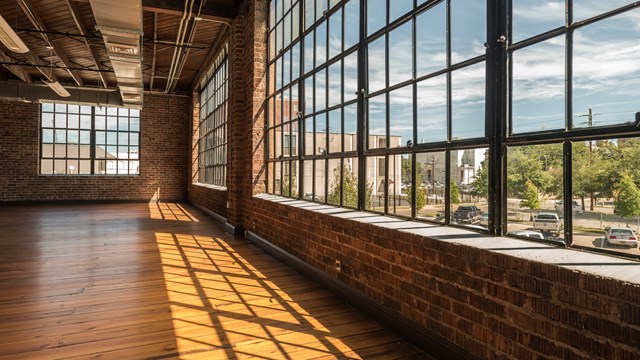
At this time, and only under certain circumstances, abrasive cleaning
methods may he used in the rehabilitation of interior spaces of
warehouse or industrial buildings for contemporary uses.
Interior spaces of factories or warehouse structures in which
the masonry or plaster surfaces do not have significant design,
detailing, tooling or finish, and in which wooden architectural
features are not finished, molded, beaded or worked by hand, may
be cleaned abrasively in order to remove layers of paint and industrial
discolorations such as smoke, soot, etc. It is expected after
such treatment that brick surfaces will be rough and pitted, and
wood will be somewhat frayed or "fuzzy" with raised
wood grain. These nonsignificant surfaces will be damaged and
have a roughened texture, but because they are interior elements,
they will not be subject to further deterioration caused by weathering.
Those instances (generally industrial and some commercial properties),
when it may be acceptable to use an abrasive treatment on the
interior of historic structures have been described. But for the
majority of historic buildings, the Secretary of the Interior's
Guidelines for Rehabilitation do not recommend "changing
the texture of exposed wooden architectural features (including
structural members) and masonry surfaces through sandblasting
or use of other abrasive techniques to remove paint, discolorations
and plaster
Thus, it is not acceptable to clean abrasively interiors of historic
residential and commercial properties which have finished interior
spaces featuring milled woodwork such as doors, window and door
moldings, wainscoting, stair balustrades and mantelpieces. Even
the most modest historic house interior, although it may not feature
elaborate detailing, contains plaster and woodwork that is architecturally
significant to the original design and function of the house.
Abrasive cleaning of such an interior would be destructive to
the historic integrity of the building.
Abrasive cleaning is also impractical. Rough surfaces of abrasively
cleaned wooden elements are hard to keep clean. It is also difficult
to seal, paint or maintain these surfaces which can be splintery
and a problem to the building's occupants. The force of abrasive
blasting may cause grit particles to lodge in cracks of wooden
elements, which will be a nuisance as the grit is loosened by
vibrations and gradually sifts out. Removal of plaster will reduce
the thermal and insulating value of the walls. Interior brick
is usually softer than exterior brick, and generally of a poorer
quality. Removing surface plaster from such brick by abrasive
means often exposes gaping mortar joints and mismatched or repaired
brickwork which was never intended to show. The resulting bare
brick wall may require repointing, often difficult to match. It
also may be necessary to apply a transparent surface coating (or
sealer) in order to prevent the mortar and brick from "dusting."
However. a sealer may not only change the color of the brick,
but may also compound any existing moisture problems by restricting
the normal evaporation of water vapor from the masonry surface.
There are alternative means of removing dirt, stains and paint
from historic building surfaces that can be recommended as more
efficient and less destructive than abrasive techniques. The "gentlest
means possible" of removing dirt from a building surface
can be achieved by using a low-pressure water wash, scrubbing areas
of more persistent grime with a natural bristle (never metal)
brush. Steam cleaning can also be used effectively to clean some
historic building fabric. Low-pressure water or steam will soften
the dirt and cause the deposits to rise to the surface, where
they can be washed away.
A third cleaning technique which may be recommended to remove
dirt, as well as stains, graffiti or paint, involves the use of
commercially available chemical cleaners or paint removers, which,
when applied to masonry, loosen or dissolve the dirt or stains.
These cleaning agents may be used in combination with water or
steam, followed by a clear water wash to remove the residue of
dirt and the chemical cleaners from the masonry. A natural bristle
brush may also facilitate this type of chemically assisted cleaning,
particularly in areas of heavy dirt deposits or stains, and a
wooden scraper can be useful in removing thick encrustations of
soot. A limewash or absorbent talc, whiting or clay poultice with
a solvent can be used effectively to draw out salts or stains
from the surface of the selected areas of a building facade. It
is almost impossible to remove paint from masonry surfaces without
causing some damage to the masonry, and it is best to leave the
surfaces as they are or repaint them if necessary.
Some physicists are experimenting with the use of pulsed laser
beams and xenon flash lamps for cleaning historic masonry surfaces.
At this time it is a slow, expensive cleaning method, but its
initial success indicates that it may have an increasingly important
role in the future.
There are many chemical paint removers which, when applied to
painted wood, soften and dissolve the paint so that it can be
scraped off by hand. Peeling paint can be removed from wood by
hand scraping and sanding. Particularly thick layers of paint
may be softened with a heat gun or heat plate, providing appropriate
precautions are taken, and the paint film scraped off by hand.
Too much heat applied to the same spot can burn the wood, and
the fumes caused by burning paint are dangerous to inhale, and
can he explosive. Furthermore, the hot air from heat guns can
start fires in the building cavity. Thus, adequate ventilation
is important when using a heat gun or heat plate, as well as when
using a chemical stripper. A torch or open flame should never
he used.
Preparations for Cleaning: It cannot be overemphasized that all
of these cleaning methods must be approached with caution. When
using any of these procedures which involve water or other liquid
cleaning agents on masonry, it is imperative that all openings
be tightly covered, and all cracks or joints be well pointed in
order to avoid the danger of water penetrating the building's
facade, a circumstance which might result in serious moisture
related problems such as efflorescence and/or subflorescence.
Any time water is used on masonry as a cleaning agent, either
in its pure state or in combination with chemical cleaners, it
is very important that the work be done in warm weather when there
is no danger of frost for several months. Otherwise water which
has penetrated the masonry may freeze, eventually causing the
surface of the building to crack and spall, which may create another
conservation problem more serious to the health of the building
than dirt.
Each kind of masonry has a unique composition and reacts differently
with various chemical cleaning substances. Water and/or chemicals
may interact with minerals in stone and cause new types of stains
to leach out to the surface immediately, or more gradually in
a delayed reaction. What may be a safe and effective cleaner for
certain stain on one type of stone, may leave unattractive discolorations
on another stone, or totally dissolve a third type.
Testing: Cleaning historic building materials, particularly masonry,
is a technically complex subject, and thus, should never be done
without expert consultation and testing. No cleaning project should
be undertaken without first applying the intended cleaning agent
to a representative test patch area in an inconspicuous location
on the building surface. The test patch or patches should be allowed
to weather for a period of time, preferably through a complete
seasonal cycle, in order to determine that the cleaned area will
not he adversely affected by wet or freezing weather or any by-products
of the cleaning process.
There are certain restoration measures which can be adopted to
help preserve a historic building exterior which has been damaged
by abrasive methods. Wood that has been sandblasted will exhibit
a frayed or "fuzzed" surface, or a harder wood will
have an exaggerated raised grain. The only way to remove this
rough surface or to smooth the grain is by laborious sanding.
Sandblasted wood, unless it has been extensively sanded, serves
as a dustcatcher, will weather faster, and will present a continuing
and ever worsening maintenance problem. Such wood, after sanding,
should be painted or given a clear surface coating to protect
the wood, and allow for somewhat easier maintenance.
There are few successful preservative treatments that may be applied
to grit-blasted exterior masonry. Harder, denser stone may have
suffered only a loss of crisp edges or tool marks, or other indications
of craft technique. If the stone has a compact and uniform composition,
it should continue to weather with little additional deterioration.
But some types of sandstone, marble and limestone will weather
at an accelerated rate once their protective "quarry crust"
or patina has been removed.
Softer types of masonry, particularly brick and architectural
terra-cotta, are the most likely to require some remedial treatment
if they have been abrasively cleaned. Old brick, being essentially
a soft, baked clay product, is greatly susceptible to increased
deterioration when its hard, outer skin is removed through abrasive
techniques. This problem can be minimized by painting the brick.
An alternative is to treat it with a clear sealer or surface coating
but this will give the masonry a glossy, or shiny look. It is
usually preferable to paint the brick rather than to apply a transparent
sealer since sealers reduce the transpiration of moisture, allowing
salts to crystallize as subflorescence that eventually spalls
the brick. If a brick surface has been so extensively damaged
by abrasive cleaning and weathering that spalling has already
begun, it may be necessary to cover the walls with stucco, if
it will adhere.
Of course, the application of paint, a clear surface coating (sealer),
or stucco to deteriorating masonry means that the historical appearance
will be sacrificed in an attempt to conserve the historic building
materials. However, the original color and texture will have been
changed already by the abrasive treatment. At this point it is
more important to try to preserve the brick, and there is little
choice but to protect it from "dusting" or spalling
too rapidly. As a last resort, in the case of severely spalling
brick, there may be no option but to replace the brick--a difficult,
expensive (particularly if custom-made reproduction brick is used),
and lengthy process. As described earlier, sandblasted interior
brick work, while not subject to change of weather, may require
the application of a transparent surface coating or painting as
a maintenance procedure to contain loose mortar and brick dust.
(See Preservation Briefs: No. 1 for a more thorough discussion
of coatings.)
Metals, other than cast or wrought iron, that have been pitted
and dented by harsh abrasive blasting usually cannot be smoothed
out. Although fillers may be satisfactory for smoothing a painted
surface, exposed metal that has been damaged usually will have
to be replaced.
Sandblasting or other abrasive methods of cleaning or paint removal
are by their nature destructive to historic building materials
and should not be used on historic buildings except in a few well-monitored
instances. There are exceptions when certain types of abrasive
cleaning may be permissible, but only if conducted by a trained
conservator, and if cleaning is necessary for the preservation
of the historic structure.
There is no one formula that will be suitable for cleaning all
historic building surfaces. Although there are many commercial
cleaning products and methods available, it is impossible to state
definitively which of these will be the most effective without
causing harm to the building fabric. It is often difficult to
identify ingredients or their proportions contained in cleaning
products; consequently it is hard to predict how a product will
react to the building materials to be cleaned. Similar uncertainties
affect the outcome of other cleaning methods as they are applied
to historic building materials. Further advances in understanding
the complex nature of the many variables of the cleaning techniques
may someday provide a better and simpler solution to the problems.
But until that time, the process of cleaning historic buildings
must be approached with caution through trial and error.
It is important to remember that historic building materials are
neither indestructible, nor are they renewable. They must be treated
in a responsible manner, which may mean little or no cleaning
at all if they are to be preserved for future generations to enjoy.
If it is in the best interest of the building to clean it, then
it should be done "using the gentlest means possible."
Ashurst, John. Cleaning Stone and Brick. Technical Pamphlet 4.
London: Society for the Protection of Ancient Buildings. 1977.
Asmus, John F. "Light Cleaning: Laser Technology for Surface
Preparation in the Arts." Technology and Conservation. 3:3
(Fall 1978), pp. 14-18.
"The Bare-Brick Mistake." The Old House Journal. I:2
(November 1973). p 2.
Brick Institute of America. Colorless Coatings for Brick Masonry.
Technical Notes on Brick Construction. Number 7E ( September/October
1976).
Gilder, Cornelia Brooke. Property Owner's Guide to the Maintenance
and Repair of Stone Buildings. Technical Series/ No. 5. Albany,
New York: The Preservation League of New York State, 1977.
Prudon, Theodore H.M. "The Case Against Removing Paint from
Brick Masonry." The Old House Journal, III:2 (February 1975).
pp. 6-7.
____________. "Removing Stains from Masonry." The Old
House Journal. V:5 (May 1977), pp. 58-59.
Stambolov. T . and J.R.J. Van Asperen de Boer. The Deterioration
and Conservation of Porous Building Material in Monuments: A Review
of the Literature. Second enlarged edition. Rome: International
Centre for Conservation, 1976.
Weiss, Norman R. "Cleaning of Building Exteriors: Problems
and Procedures of Dirt Removal." Technology and Conservation,
2/76 (Fall 1976), pp. 8-13.
___________. Exterior Cleaning of Historic Masonry Buildings. Draft.
Washington, D.C.: Office of Archeology and Historic Preservation,
Heritage Conservation and Recreation Service, U.S. Department
of the Interior, 1976.
The illustrations for this brief not specifically credited are
from the files of the Technical Preservation Services Division.
This publication has been prepared pursuant to the National
Historic Preservation Act of 1966, as amended, which directs the Secretary
of the Interior to develop and make available information concerning historic
properties. Technical Preservation Services (TPS), Heritage Preservation
Services Division, National Park Service prepares standards, guidelines,
and other educational materials on responsible historic preservation treatments
for a broad public.
|