| 13 | |
|
The Repair and Thermal Upgrading of Historic Steel WindowsSharon C. Park, AIA
»Historical Development
The Secretary of the Interior's "Standards for Rehabilitation"
require that where historic windows are individually significant
features, or where they contribute to the character of significant
facades, their distinguishing visual qualities must not be destroyed.
Further, the rehabilitation guidelines recommend against changing
the historic appearance of windows through the use of inappropriate
designs, materials, finishes, or colors which radically change
the sash, depth of reveal, and muntin configuration; the reflectivity
and color of the glazing; or the appearance of the frame.
This Brief identifies various types of historic steel windows
that dominated the metal window market from 1890-1950. It then
gives criteria for evaluating deterioration and for determining
appropriate treatment, ranging from routine maintenance and weatherization
to extensive repairs, so that replacement may be avoided where
possible.(1) This information applies to do-it-yourself jobs and
to large rehabilitations where the volume of work warrants the
removal of all window units for complete overhaul by professional
contractors.
This Brief is not intended to promote the repair of ferrous metal
windows in every case, but rather to insure that preservation
is always the first consideration in a rehabilitation project.
Some windows are not important elements in defining a building's
historic character; others are highly significant, but so deteriorated
that repair is infeasible. In such cases, the Brief offers guidance
in evaluating appropriate replacement windows.
Although metal windows were available as early as 1860 from catalogues
published by architectural supply firms, they did not become popular
until after 1890. Two factors combined to account for the shift
from wooden to metal windows about that time. Technology borrowed
from the rolling industry permitted the mass production of rolled
steel windows. This technology made metal windows cost competitive
with conventional wooden windows. In addition, a series of devastating
urban fires in Boston, Baltimore, Philadelphia, and San Francisco
led to the enactment of strict fire codes for industrial and multi-story
commercial and office buildings.
As in the process of making rails for railroads, rolled steel
windows were made by passing hot bars of steel through progressively
smaller, shaped rollers until the appropriate angled configuration
was achieved. The rolled steel sections, generally
1/8" thick and 1" - 1-1/2" wide, were used for
all the components of the windows: sash, frame, and subframe. With the addition of wire glass, a fire-resistant window
resulted. These rolled steel windows are almost exclusively found
in masonry or concrete buildings.
A by-product of the fire-resistant window was the strong metal frame
that permitted the installation of larger windows and windows
in series. The ability to have expansive amounts of glass and
increased ventilation dramatically changed the designs of late
19th and early 20th century industrial and commercial buildings.
The newly available, reasonably priced steel windows soon became
popular for more than just their fire-resistant qualities. They
were standardized, extremely durable, and easily transported.
These qualities led to the use of steel windows in every type
of construction, from simple industrial and institutional buildings
to luxury commercial and apartment buildings. Casement, double-hung,
pivot, projecting, austral, and continuous windows differed in
operating and ventilating capacities. In addition,
the thin profiles of metal windows contributed to the streamlined
appearance of the Art Deco, Art Moderne, and International Styles,
among others.
The extensive use of rolled steel metal windows continued until
after World War II when cheaper, noncorroding aluminum windows
became increasingly popular. While aluminum windows dominate the
market today, steel windows are still fabricated. Should replacement
of original windows become necessary, replacement windows may
be available from the manufacturers of some of the earliest steel
windows. Before an informed decision can be made whether to repair
or replace metal windows, however, the significance of the windows
must be determined and their physical condition assessed.
An assessment of the significance of the windows should begin
with a consideration of their function in relation to the building's
historic use and its historic character. Windows that help define
the building's historic character should be preserved even if
the building is being converted to a new use. For example, projecting
steel windows used to introduce light and an effect of spaciousness
to a warehouse or industrial plant can be retained in the conversion
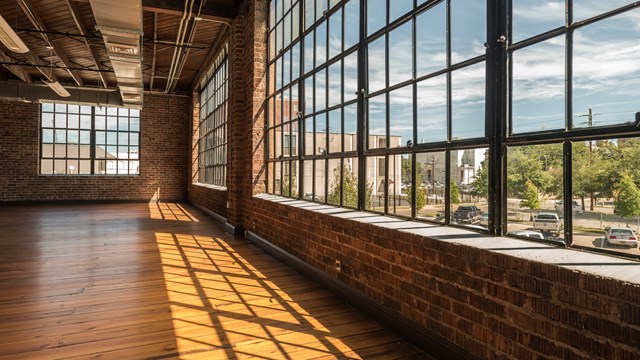
of such a building to offices or residences.
Other elements in assessing the relative importance of the historic
windows include the design of the windows and their relationship
to the scale, proportion, detailing and architectural style of
the building. While it may be easy to determine the aesthetic
value of highly ornamented windows, or to recognize the importance
of streamlined windows as an element of a style, less elaborate
windows can also provide strong visual interest by their small
panes or projecting planes when open, particularly in simple,
unadorned industrial buildings.
One test of the importance of windows to a building is to ask
if the overall appearance of the building would be changed noticeably
if the windows were to be removed or radically altered. If
so,
the windows are important in defining the building's historic
character, and should be repaired if their physical condition
permits.
Steel window repair should begin with a careful evaluation of
the physical condition of each unit. Either drawings or photographs,
liberally annotated, may be used to record the location of each
window, the type of operability, the condition of all three parts--sash,
frame and subframe--and the repairs essential to its continued
use.
Specifically, the evaluation should include: presence and degree
of corrosion; condition of paint; deterioration of the metal sections,
including bowing, misalignment of the sash, or bent sections;
condition of the glass and glazing compound; presence and condition
of all hardware, screws, bolts, and hinges; and condition of the
masonry or concrete surrounds, including need for caulking or
resetting of improperly sloped sills.
Corrosion, principally rusting in the case of steel windows, is
the controlling factor in window repair; therefore, the evaluator
should first test for its presence. Corrosion can be light, medium,
or heavy, depending on how much the rust has penetrated the metal
sections. If the rusting is merely a surface accumulation or flaking,
then the corrosion is light. If the rusting has penetrated the
metal (indicated by a bubbling texture), but has not caused any
structural damage, then the corrosion is medium. If the rust has
penetrated deep into the metal, the corrosion is heavy. Heavy
corrosion generally results in some form of structural damage,
through delamination, to the metal section, which must then be
patched or spliced.
A sharp probe or tool, such as an ice pick, can be used to determine
the extent of corrosion in the metal. If the probe can penetrate
the surface of the metal and brittle strands can be dug out, then
a high degree of corrosive deterioration is present.
In addition to corrosion, the condition of the paint, the presence
of bowing or misalignment of metal sections, the amount of glass
needing replacement, and the condition of the masonry or concrete
surrounds must be assessed in the evaluation process. These are
key factors in determining whether or not the windows can be repaired
in place. The more complete the inventory of existing conditions,
the easier it will be to determine whether repair is feasible
or whether replacement is warranted.
Following inspection and analysis, a plan for the rehabilitation
can be formulated. The actions necessary to return windows to
an efficient and effective working condition will fall into one
or more of the following categories: routine maintenance, repair,
and weatherization. The routine maintenance and weatherization
measures described here are generally within the range of do-it-yourselfers.
Other repairs, both moderate and major, require a professional
contractor. Major repairs normally require the removal of the
window units to a workshop, but even in the case of moderate repairs,
the number of windows involved might warrant the removal of all
the deteriorated units to a workshop in order to realize a more
economical repair price. Replacement of windows should be considered
only as a last resort.
Since moisture is the primary cause of corrosion in steel windows,
it is essential that excess moisture be eliminated and that the
building be made as weathertight as possible before any other
work is undertaken. Moisture can accumulate from cracks in the
masonry, from spalling mortar, from leaking gutters, from air
conditioning condensation runoff, and from poorly ventilated interior
spaces.
Finally, before beginning any work, it is important to be aware
of health and safety risks involved. Steel windows have historically
been coated with lead paint. The removal of such paint by abrasive
methods will produce toxic dust. Therefore, safety goggles, a
toxic dust respirator, and protective clothing should be worn.
Similar protective measures should be taken when acid compounds
are used. Local codes may govern the methods of removing lead
paints and proper disposal of toxic residue.
DOUBLE-HUNG industrial windows duplicated the look of traditional
wooden windows. Metal double-hung windows were early examples of
a building product adapted to meet stringent new fire code requirements
for manufacturing and high-rise buildings in urban areas. Soon
supplanted in industrial buildings by less expensive pivot windows,
double-hung metal windows regained popularity in the 1940s for
use in speculative suburban housing.
PIVOT windows were an early type of industrial window that combined
inexpensive first cost and low maintenance. Pivot windows became
standard for warehouses and power plants where the lack of screens
was not a problem. The window shown here is a horizontal pivot.
Windows that turned about a vertical axis were also manufactured
(often of iron). Such vertical pivots are rare today.
PROJECTING windows, sometimes called awning or hopper windows,
were perfected in the 1920s for industrial and institutional buildings.
They were often used in "combination" windows, in which
upper panels opened out and lower panels opened in. Since each
movable panel projected to one side of the frame only, unlike
pivot windows, for example, screens could be introduced.
AUSTRAL windows were also a product of the 1920s. They combined
the appearance of the double-hung window with the increased ventilation
and ease of operation of the projected window. (When fully opened,
they provided 70% ventilation as compared to 50% ventilation for
double-hung windows.) Austral windows were often used in schools,
libraries and other public buildings.
CASEMENT windows adapted the English tradition of using wrought
iron casements with leaded cames for residential use. Rolled steel
casements (either single, as shown, or paired) were popular in
the 1920s for cottage style residences and Gothic style campus
architecture. More streamlined casements were popular in the 1930s
for institutional and small industrial buildings.
CONTINUOUS windows were almost exclusively used for industrial
buildings requiring high overhead lighting. Long runs of clerestory
windows operated by mechanical tension rod gears were typical.
Long banks of continuous windows were possible because the frames
for such windows were often structural elements of the building.
A preliminary step in the routine maintenance of steel windows
is to remove surface dirt and grease in order to ascertain the
degree of deterioration, if any. Such minor cleaning can be accomplished
using a brush or vacuum followed by wiping with a cloth dampened
with mineral spirits or denatured alcohol.
If it is determined that the windows are in basically sound condition,
the following steps can be taken: 1) removal of light rust, flaking
and excessive paint; 2) priming of exposed metal with a rust-inhibiting
primer; 3) replacement of cracked or broken glass and glazing
compound; 4) replacement of missing screws or fasteners; 5) cleaning
and lubrication of hinges; 6) repainting of all steel sections
with two coats of finish paint compatible with the primer; and
7) caulking the masonry surrounds with a high quality elastomeric
caulk.
Recommended methods for removing light rust include manual and
mechanical abrasion or the application of chemicals. Burning off
rust with an oxyacetylene or propane torch, or an inert gas welding
gun, should never be attempted because the heat can distort the
metal. In addition, such intense heat (often as high as 3800 deg.
F) vaporizes the lead in old paint, resulting in highly toxic
fumes. Furthermore, such heat will likely result in broken glass.
Rust can best be removed using a wire brush, an aluminum oxide
sandpaper, or a variety of power tools adapted for abrasive cleaning
such as an electric drill with a wire brush or a rotary whip attachment.
Adjacent sills and window jambs may need protective shielding.
Rust can also be removed from ferrous metals by using a number
of commercially prepared anticorrosive acid compounds. Effective
on light and medium corrosion, these compounds can be purchased
either as liquids or gels. Several bases are available, including
phosphoric acid, ammonium citrate, oxalic acid and hydrochloric
acid. Hydrochloric acid is generally not recommended; it can leave
chloride deposits, which cause future corrosion. Phosphoric acid-based
compounds do not leave such deposits, and are therefore safer
for steel windows. However, any chemical residue should be wiped
off with damp cloths, then dried immediately. Industrial blow-dryers
work well for thorough drying. The use of running water to remove
chemical residue is never recommended because the water may spread
the chemicals to adjacent surfaces, and drying of these surfaces
may be more difficult. Acid cleaning compounds will stain masonry;
therefore plastic sheets should be taped to the edge of the metal
sections to protect the masonry surrounds. The same measure should
be followed to protect the glazing from etching because of acid
contact.
Measures that remove rust will ordinarily remove flaking paint
as well. Remaining loose or flaking paint can be removed with
a chemical paint remover or with a pneumatic needle scaler or
gun, which comes with a series of chisel blades and has proven
effective in removing flaking paint from metal windows. Well-bonded
paint may serve to protect the metal further from corrosion, and
need not be removed unless paint buildup prevents the window from
closing tightly. The edges should be feathered by sanding to give
a good surface for repainting.
Next, any bare metal should be wiped with a cleaning solvent such
as denatured alcohol, and dried immediately in preparation for
the application of an anticorrosive primer. Since corrosion can
recur very soon after metal has been exposed to the air, the metal
should be primed immediately after cleaning. Spot priming may
be required periodically as other repairs are undertaken. Anticorrosive
primers generally consist of oil-alkyd based paints rich in zinc
or zinc chromate.(2) Red lead is no longer available because of
its toxicity. All metal primers, however, are toxic to some degree
and should be handled carefully. Two coats of primer are recommended.
Manufacturer's recommendations should be followed concerning application
of primers.
The maintenance procedures described above will be insufficient
when corrosion is extensive, or when metal window sections are
misaligned. Medium to heavy corrosion that has not done any structural
damage to the metal sections can be removed either by using the
chemical cleaning process described under "Routine Maintenance"
or by sandblasting. Since sandblasting can damage the masonry
surrounds and crack or cloud the glass, metal or plywood shields
should be used to protect these materials. The sandblasting pressure
should be low, 80-100 pounds per square inch, and the grit size
should be in the range of #10-#45. Glass peening beads (glass pellets)
have also been successfully used in cleaning steel sections. While
sandblasting equipment comes with various nozzle sizes, pencil-point
blasters are most useful because they give the operator more effective
control over the direction of the spray. The small aperture of
the pencil-point blaster is also useful in removing dried putty
from the metal sections that hold the glass. As with any cleaning
technique, once the bare metal is exposed to air, it should be
primed as soon as possible. This includes the inside rabbeted
section of sash where glazing putty has been removed. To reduce
the dust, some local codes allow only wet blasting. In this case,
the metal must be dried immediately, generally with a blowdrier
(a step that the owner should consider when calculating the time
and expense involved). Either form of sandblasting metal covered
with lead paints produces toxic dust. Proper precautionary measures
should be taken against toxic dust and silica particles.
Bent or bowed metal sections may be the result of damage to the
window through an impact or corrosive expansion. If the distortion
is not too great, it is possible to re-align the metal sections
without removing the window to a metal fabricator's shop. The
glazing is generally removed and pressure is applied to the bent
or bowed section. In the case of a muntin, a protective 2 x 4
wooden bracing can be placed behind the bent portion and a wire
cable with a winch can apply progressively more pressure over
several days until the section is realigned. The 2 x 4 bracing
is necessary to distribute the pressure evenly over the damaged
section. Sometimes a section, such as the bottom of the frame,
will bow out as a result of pressure exerted by corrosion and
it is often necessary to cut the metal section to relieve this
pressure prior to pressing the section back into shape and making
a welded repair.
Once the metal sections have been cleaned of all corrosion and
straightened, small holes and uneven areas resulting from rusting
should be filled with a patching material and sanded smooth to
eliminate pockets where water can accumulate. A patching material
of steel fibers and an epoxy binder may be the easiest to apply.
This steel-based epoxy is available for industrial steel repair;
it can also be found in auto body patching compounds or in plumber's
epoxy. As with any product, it is important to follow the manufacturer's
instructions for proper use and best results. The traditional
patching technique--melting steel welding rods to fill holes in
the metal sections--may be difficult to apply in some situations;
moreover, the window glass must be removed during the repair process,
or it will crack from the expansion of the heated metal sections.
After these repairs, glass replacement, hinge lubrication, painting,
and other cosmetic repairs can be undertaken as necessary.
To complete the checklist for routine maintenance, cracked glass,
deteriorated glazing compound, missing screws, and broken fasteners
will have to be replaced; hinges cleaned and lubricated; the metal
windows painted, and the masonry surrounds caulked. If the glazing
must be replaced, all clips, glazing beads, and other fasteners
that hold the glass to the sash should be retained, if possible,
although replacements for these parts are still being fabricated.
When bedding glass, use only glazing compound formulated for metal
windows. To clean the hinges (generally brass or bronze), a cleaning
solvent and fine bronze wool should be used. The hinges should
then be lubricated with a non-greasy lubricant specially formulated
for metals and with an anticorrosive agent. These lubricants are
available in a spray form and should be used periodically on frequently
opened windows.
Final painting of the windows with a paint compatible with the
anticorrosive primer should proceed on a dry day. (Paint and primer
from the same manufacturer should be used.) Two coats of finish
paint are recommended if the sections have been cleaned to bare
metal. The paint should overlap the glass slightly to insure weathertightness
at that connection. Once the paint dries thoroughly, a flexible
exterior caulk can be applied to eliminate air and moisture infiltration
where the window and the surrounding masonry meet.
Caulking is generally undertaken after the windows have received
at least one coat of finish paint. The perimeter of the masonry
surround should be caulked with a flexible elastomeric compound
that will adhere well to both metal and masonry. The caulking
used should be a type intended for exterior application, have
a high tolerance for material movement, be resistant to ultraviolet
light, and have a minimum durability of 10 years. Three effective
compounds (taking price and other factors into consideration)
are polyurethane, vinyl acrylic, and butyl rubber. In selecting
a caulking material for a window retrofit, it is important to
remember that the caulking compound may be covering other materials
in a substrate. In this case, some compounds, such as silicone,
may not adhere well. Almost all modern caulking
compounds can
be painted after curing completely. Many come in a range of colors,
which eliminates the need to paint. If colored caulking is used,
the windows should have been given two coats of finish paint prior
to caulking.
Damage to windows may be so severe that the window sash and sometimes
the frame must be removed for cleaning and extensive rust removal,
straightening of bent sections, welding or splicing in of new
sections, and reglazing. These major and expensive repairs are
reserved for highly significant windows that cannot be replaced;
the procedures involved should be carried out only by skilled
workmen.
As part of the orderly removal of windows, each window should
be numbered and the parts labeled. The operable metal sash should
be dismantled by removing the hinges; the fixed sash and, if necessary,
the frame can then be unbolted or unscrewed. (The subframe is
usually left in place. Built into the masonry surrounds, it can
only be cut out with a torch.) Hardware and hinges should be labeled
and stored together.
The two major choices for removing flaking paint and corrosion
from severely deteriorated windows are dipping in a chemical bath
or sandblasting. Both treatments require removal of the glass.
If the windows are to be dipped, a phosphoric acid solution is
preferred, as mentioned earlier. While the dip tank method is
good for fairly evenly distributed rust, deep set rust may remain
after dipping. For that reason, sandblasting is more effective
for heavy and uneven corrosion. Both methods leave the metal sections
clean of residual paint. As already noted, after cleaning has
exposed the metal to the air, it should be primed immediately
after drying with an anticorrosive primer to prevent rust from
recurring.
Sections that are seriously bent or bowed must be straightened
with heat and applied pressure in a workshop. Structurally weakened
sections must be cut out, generally with an oxyacetylene torch,
and replaced with sections welded in place and the welds ground
smooth. Finding replacement metal sections, however, may be difficult.
While most rolling mills are producing modern sections suitable
for total replacement, it may be difficult to find an exact profile
match for a splicing repair. The best source of rolled metal sections
is from salvaged windows, preferably from the same building. If
no salvaged windows are available, two options remain. Either
an ornamental metal fabricator can weld flat plates into a built-up
section, or a steel plant can mill bar steel into the desired
profile.
While the sash and frame are removed for repair, the subframe
and masonry surrounds should be inspected. This is also the time
to reset sills or to remove corrosion from the subframe, taking
care to protect the masonry surrounds from damage.
Missing or broken hardware and hinges should be replaced on all
windows that will be operable. Salvaged windows, again, are the
best source of replacement parts. If matching parts cannot be
found, it may be possible to adapt ready-made items. Such a substitution
may require filling existing holes with steel epoxy or with plug
welds and tapping in new screw holes. However, if the hardware
is a highly significant element of the historic window, it may
be worth having reproductions made.
Historic metal windows are generally not energy efficient; this
has often led to their wholesale replacement. Metal windows can,
however, be made more energy efficient in several ways, varying
in complexity and cost. Caulking around the masonry openings and
adding weatherstripping, for example, can be do-it-yourself projects
and are important first steps in reducing air infiltration around
the windows. They usually have a rapid payback period. Other treatments
include applying fixed layers of glazing over the historic windows,
adding operable storm windows, or installing thermal glass in
place of the existing glass. In combination with caulking and
weatherstripping, these treatments can produce energy ratings
rivaling those achieved by new units.(3)
The first step in any weatherization program, caulking, has been
discussed above under "Routine Maintenance." The second
step is the installation of weatherstripping where the operable
portion of the sash, often called the ventilator, and the fixed
frame come together to reduce perimeter air infiltration. Four types of weatherstripping appropriate for metal
windows are spring-metal, vinyl strips, compressible foam tapes,
and sealant beads. The spring-metal, with an integral friction
fit mounting clip, is recommended for steel windows in good condition.
The clip eliminates the need for an applied glue; the thinness
of the material insures a tight closure. The weatherstripping
is clipped to the inside channel of the rolled metal section of
the fixed frame. To insure against galvanic corrosion between
the weatherstripping (often bronze or brass), and the steel window,
the window must be painted prior to the installation of the weatherstripping.
This weatherstripping is usually applied to the entire perimeter
of the window opening, but in some cases, such as casement windows,
it may be best to avoid weatherstripping the hinge side. The natural
wedging action of the weatherstripping on the three sides of the
window often creates an adequate seal.
Vinyl weatherstripping can also be applied to metal windows. Folded
into a "V" configuration, the material forms a barrier
against the wind. Vinyl weatherstripping is usually glued to the
frame, although some brands have an adhesive backing. As the vinyl
material and the applied glue are relatively thick, this form
of weatherstripping may not be appropriate for all situations.
Compressible foam tape weatherstripping is often best for large
windows where there is a slight bending or distortion of the sash.
In some very tall windows having closure hardware at the sash
midpoint, the thin sections of the metal window will bow away
from the frame near the top. If the gap is not more than 1/4",
foam weatherstripping can normally fill the space. If the gap
exceeds this, the window may need to be realigned to close more
tightly. The foam weatherstripping comes either with an adhesive
or plain back; the latter variety requires application with glue.
Compressible foam requires more frequent replacement than either
spring-metal or vinyl weatherstripping.
A fourth type of successful weatherstripping involves the use
of a caulking or sealant bead and a polyethylene bond breaker
tape. After the window frame has been thoroughly cleaned with
solvent, permitted to dry, and primed, a neat bead of low modulus
(firm setting) caulk, such as silicone, is applied. A bond breaker
tape is then applied to the operable sash covering the metal section
where contact will occur. The window is then closed until the
sealant has set (27 days, depending on temperature and humidity).
When the window is opened, the bead will have taken the shape
of the air infiltration gap and the bond breaker tape can be removed.
This weatherstripping method appears to be successful for all
types of metal windows with varying degrees of air infiltration.
Since the several types of weatherstripping are appropriate for
different circumstances, it may be necessary to use more than
one type on any given building. Successful weatherstripping depends
upon using the thinnest material adequate to fill the space through
which air enters. Weatherstripping that is too thick can spring
the hinges, thereby resulting in more gaps.
SPRING-METAL comes in bronze, brass or stainless steel with
an integral friction fit clip. The weatherstripping is applied
after the repaired windows are painted to avoid galvanic corrosion.
This type of thin weatherstripping is intended for windows in
good condition.
VINYL STRIPS are scored and fold into a "V" configuration.
Applied adhesive is necessary which will increase the thickness
of the weatherstripping, making it inappropriate for some situations.
The weatherstripping is generally applied to the window after
painting.
Closed cell FOAM TAPE comes either with or without an adhesive
backing. It is effective for windows with a gap of approximately
1/4" and is easy to install. However, this type of weatherstripping
will need frequent replacement on windows in regular use. The
metal section should be cleaned of all dirt and grease prior to
its application.
SEALANT BEAD. This very effective type of weatherstripping
involves the application of a clean bead of firm setting caulk
on the primed frame with a polyethelene bond breaker tape on the
operable sash. The window is then closed until the bead has set
and takes the form of the gap. The sash is then opened and the
tape is removed leaving the set caulk as the weatherstripping.
The third weatherization treatment is to install an additional
layer of glazing to improve the thermal efficiency of the existing
window. The decision to pursue this treatment should proceed from
careful analysis. Each of the most common techniques for adding
a layer of glazing will effect approximately the same energy savings
(approximately double the original insulating value of the windows);
therefore, cost and aesthetic considerations usually determine
the choice of method. Methods of adding a layer of glazing to
improve thermal efficiency include adding a new layer of transparent
material to the window; adding a separate storm window; and replacing
the single layer of glass in the window with thermal glass.
The least expensive of these options is to install a clear material
(usually rigid sheets of acrylic or glass) over the original window.
The choice between acrylic and glass is generally based on cost,
ability of the window to support the material, and long-term maintenance
outlook. If the material is placed over the entire window and
secured to the frame, the sash will be inoperable. If the continued
use of the window is important (for ventilation or for fire exits),
separate panels should be affixed to the sash without obstructing
operability. Glass or acrylic panels set in frames
can be attached using magnetized gaskets, interlocking material
strips, screws or adhesives. Acrylic panels can be screwed directly
to the metal windows, but the holes in the acrylic panels should
allow for the expansion and contraction of this material. A compressible
gasket between the prime sash and the storm panel can be very
effective in establishing a thermal cavity between glazing layers.
To avoid condensation, 1/8" cuts in a top corner and diagonally
opposite bottom corner of the gasket will provide a vapor bleed,
through which moisture can evaporate. (Such cuts, however, reduce
thermal performance slightly.) If condensation does occur, however,
the panels should be easily removable in order to wipe away moisture
before it causes corrosion.
The second method of adding a layer of glazing is to have independent
storm windows fabricated. (Pivot and austral windows, however,
which project on either side of the window frame when open, cannot
easily be fitted with storm windows and remain operational.) The
storm window should be compatible with the original sash configuration.
For example, in paired casement windows, either specially fabricated
storm casement windows or sliding units in which the vertical
meeting rail of the slider reflects the configuration of the original
window should be installed. The decision to place storm windows
on the inside or outside of the window depends on whether the
historic window opens in or out, and on the visual impact the
addition of storm windows will have on the building. Exterior
storm windows, however, can serve another purpose besides saving
energy: they add a layer of protection against air pollutants
and vandals, although they will partially obscure the prime window.
For highly ornamental windows this protection can determine the
choice of exterior rather then interior storm windows.
The third method of installing an added layer of glazing is to
replace the original single glazing with thermal glass. Except
in rare instances in which the original glass is of special interest
(as with stained or figured glass), the glass can be replaced
if the hinges can tolerate the weight of the additional glass.
The rolled metal sections for steel windows are generally from
1" 1-1/2" thick. Sash of this thickness can normally
tolerate thermal glass, which ranges from 3/8" 5/8".
(Metal glazing beads, readily available, are used to reinforce
the muntins, which hold the glass.) This treatment leaves the
window fully operational while preserving the historic appearance.
It is, however, the most expensive of the treatments discussed
here.
Repair of historic windows is always preferred within a rehabilitation
project. Replacement should be considered only as a last resort.
However, when the extent of deterioration or the unavailability
of replacement sections renders repair impossible, replacement
of the entire window may be justified.
A number of metal window manufacturing companies produce rolled
steel windows. While stock modern window designs do not share
the multi-pane configuration of historic windows, most of these
manufacturers can reproduce the historic configuration if requested,
and the cost is not excessive for large orders. Some manufacturers still carry the standard pre-World
War II multi-light windows using the traditional 12" x 18"
or 14" x 20" glass sizes in industrial, commercial,
security, and residential configurations. In addition, many of
the modern steel windows have integral weatherstripping, thermal
break construction, durable vinyl coatings, insulating glass,
and other desirable features.
Windows manufactured from other materials generally cannot match
the thin profiles of the rolled steel sections. Aluminum, for
example, is three times weaker than steel and must be extruded
into a boxlike configuration that does not reflect the thin historic
profiles of most steel windows. Wooden and vinyl replacement windows
generally are not fabricated in the industrial style, nor can
they reproduce the thin profiles of the rolled steel sections,
and consequently are generally not acceptable replacements.
For product information on replacement windows, the owner, architect,
or contractor should consult manufacturers' catalogues, building
trade journals, or the Steel Window Institute, 1230 Keith Building,
Cleveland, Ohio 44115.
The National Park Service recommends the retention of significant
historic metal windows whenever possible. Such windows, which
can be a character-defining feature of a historic building, are
too often replaced with inappropriate units that impair rather
than complement the overall historic appearance. The repair and
thermal upgrading of historic steel windows is more practicable
than most people realize. Repaired and properly maintained metal
windows have greatly extended service lives. They can be made
energy efficient while maintaining their contribution to the historic
character of the building.
(1) The technical information given in this brief is intended
for most ferrous (or magnetic) metals, particularly rolled steel.
While stainless steel is a ferrous metal, the cleaning and repair
techniques outlined here must not be used on it as the finish
will be damaged. For information on cleaning stainless steel and
nonferrous metals, such as bronze, Monel, or aluminum, refer to
Metals in America's Historic Buildings (see bibliography).
(2) Refer to Table IV. Types of Paint Used for Painting Metal
in Metals in America's Historic Buildings, p. 139. (See bibliography).
(3) One measure of energy efficiency is the U-value (the number
of BTUs per hour transferred through a square foot of material).
The lower the U-value, the better the performance. According to
ASHRAE HANDBOOK 1977 Fundamentals, the U-value of historic rolled
steel sash with single glazing is 1.3. Adding storm windows to
the existing units or reglazing with 5/8" insulating glass
produces a U-value of .69. These methods of weatherizing historic
steel windows compare favorably with rolled steel replacement
alternatives: with factory installed 1" insulating glass
(.67 U-value); with added thermal break construction and factory
finish coatings (.62 U-value).
ASHRAE Handbook 1977 Fundamentals. New York: American Society
of Heating, Refrigerating and Air-conditioning Engineers, 1978.
Crittal, W. F. A Metal Window Dictionary. London: Curwen Press,
1926. Reprinted by B.T. Batsford. Ltd., 1953.
Gayle, Margot; David W. Look, AIA; John G. Waite. Metals in America's
Historic Buildings: Uses and Preservation Treatments. Technical
Preservation Services, U.S. Department of the Interior. Washington,D.C.:
U.S. Government Printing Office, 1980.
Gillet, William. "Steel Windows." Windows and Glass
in the Exterior of Buildings. National Academy of Sciences Publication
478. Washington, D.C.: 1957,7578.
Sarton, R. H. "Selecting and Specifying an Appropriate Type
of Steel Window." Metalcraft. Vol. 6, No. 1 (January, 1931):
4348, 6465.
Sweet's Architectural Catalogue. 13th Edition, New York, Sweets
Catalogue Service, Inc., 1918.
The author gratefully acknowledges the invaluable assistance of
co-worker Michael Auer in preparing this brief for publication.
This publication is an extension of research initiated by Frederec
E. Kleyle. Special thanks are given to Hope's Architectural Products,
Inc., Jamestown, NY, for their generous contribution of historic
metal window catalogues which were an invaluable source of information.
The following individuals are also to be thanked for reviewing
the manuscript and making suggestions: Hugh Miller, Chief, Park
Historic Architecture Division, National Park Service; Barclay
L. Rogers, Museum Services, National Park Service; Susan M. Young,
Steel Window Institute, and Danny Schlichenmaier, State Building
Division, Lincoln, Nebraska. Finally, thanks go to Technical Preservation
Services Branch staff and to cultural resources staff of the National
Park Service Regional Offices, whose valuable comments were incorporated
into the final text and who contributed to the publication of
this brief.
Washington, D. C. September, 1984 This publication has been prepared pursuant to the National
Historic Preservation Act of 1966, as amended, which directs the Secretary
of the Interior to develop and make available information concerning historic
properties. Technical Preservation Services (TPS), Heritage Preservation
Services Division, National Park Service prepares standards, guidelines,
and other educational materials on responsible historic preservation treatments
for a broad public.
|