APPENDIX C

 PHYTOLITH ANALYSIS OF FEATURE FILL FROM TWO PREHISTORIC
  HEARTHS AT 48LA277, F. E. WARREN AIR FORCE BASE, WYOMING

 By

Dennis R. Danielson

Introduction

During the 1992 excavations at 48LA277, two hearths (Features 9 and 10) were unearthed in the wall of Trench 1. Analysis of charcoal samples from Feature 10 indicated that Salicaceae (willow and cottonwood) and probably Betula (birch) were utilized as fuel (see Appendix B). The Feature 9 fill material was fine textured, and gross analysis of the sample suggested that it did not contain any charcoal samples large enough to identify to plant species (Melissa Connor, personal communication 1993).

The local contemporary environment is a mixed-grass prairie and does not support an abundant tree stand. Trees, which include species from the Salicaceae and Betula families, are located along Crow Creek and its tributaries. In similar grassland environments, Plains Indians used desiccated buffalo fecal material as fuel (Douglas 1930; Ewers 1955:159; Flynn 1908:245; McHugh 1979:109; Mandlebaum 1979:60; Verbicky-Todd 1984).

Antelope (Antilocapra americana) was the largest mammal represented by skeletal materials recovered during excavations at 48LA277. This suggests that antelope was the primary large mammal utilized during occupation of this site. A major research goal of our phytolith analysis was to determine whether the prehistoric occupants of 48LA277 possibly used antelope dung as an alternative fire fuel in Feature 9.

Accordingly, the analysis included comparison of phytoliths recovered from hearth fill to phytoliths from antelope dung. Also, since the features were identified as roasting basins, it was hoped that an examination of phytoliths would help identify plants that were processed for consumption.

Methods

Five grams of feature fill from each hearth and 1 g of contemporary antelope dung were processed to recover plant phytoliths. Feature fill samples from both hearths were processed according to a soil-processing procedure developed by Rovner (1971) and later modified by Pearsall (1989). I further modified Pearsall's procedure during the heavy-flotation step. Instead of using cadmium iodide and potassium iodide as a heavy-density flotation medium, I used zinc bromide mixed to a specific gravity of 2.3. The procedure is as follows:
 

1. Five grams of feature fill from each hearth were placed in clean separate beakers. To remove organics, approximately 10 ml of 30-percent hydrogen peroxide was added to each sample. When the reaction ceased (24 or more hours), the liquid was decanted.

2. The samples were placed in 600-ml beakers and distilled water was added to a height of 10 cm. One teaspoon of dishwasher detergent (active ingredient, sodium hexametaphosphate) was stirred into the solution to deflocculate the soils. After eight hours the supernatant was siphoned off. This step was repeated until the decanted liquid was clear.

3. Sediments were rinsed into 50-ml centrifuge tubes with distilled water and centrifuged on high for 10 minutes; the liquid was decanted.

4. To eliminate carbonates, 30 ml of 10-percent HCl was added to each sample. The tubes were placed in a hot-water bath for 20 minutes with frequent stirring.

5. After the reaction ceased and the tubes cooled slightly, the samples were centrifuged on high for 10 minutes. The liquid was decanted and 40 ml of distilled water added, centrifuged for 10 minutes and the liquid poured off.

6. Each sample was screened through a 250-micron sieve with distilled water into beakers, and the heavy fraction in the screen was discarded. The collected liquid was centrifuged on high for 10 minutes, and the liquid was decanted.

7. Approximately 10 ml of zinc bromide with a density rating of 2.3 was added to each tube. Each sample was vortexed for a few seconds to ensure mixing and then centrifuged on high for 20 minutes. The supernatant was decanted into clean centrifuge tubes. Step 7 was repeated once.

8. Distilled water (approximately 25 ml) was added to the samples and vortexed for approximately 20 seconds, centrifuged on high for 20 minutes, and the supernatant was discarded. 

9. Distilled water was added to the phytolith precipitate and centrifuged on high for 10 minutes. The water was poured off, and this step was repeated once.

10. Each sample was given one acetone wash, centrifuged for 10 minutes, and the acetone was discarded.

11. Each sample was transferred into storage vials. 

12. One to two drops of phytolith residue was pipetted onto a slide. One drop of glycerin was added and the material mixed. A cover slip was placed over the sample and the edges of the slip were sealed with nail polish.

Chemical digestion of 1 g of antelope dung was achieved with 30-percent hydrogen peroxide and potassium dichromate (Danielson 1993). Phytoliths were mounted on glass slides according to the above mounting procedure.

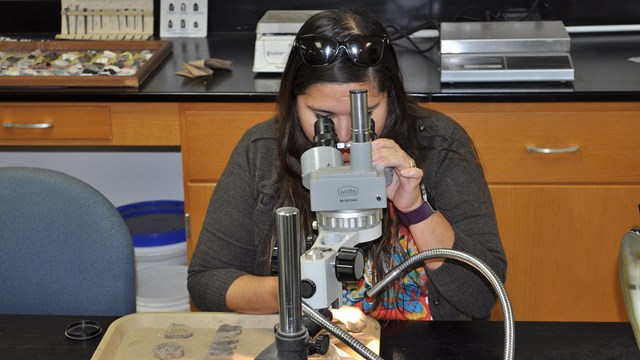
Phytolith counts were attained using a light microscope at 200X and 400X. A total of 200 phytoliths was recorded and identified to the family level and, when possible, to the genus level. 

Discussion

The majority of phytoliths recovered from the antelope dung indicates that they had browsed on plants in the Chenopodiaceae family. The druse-shaped phytoliths produced in this family are distinctive in form and can be an identifying marker to family level. The genus Atriplex (saltbush) is the most prominent plant from this family within the local environment. Therefore, it is probable that the phytoliths recovered from the dung are from this genus. 

Examination of slides from Features 9 and 10 revealed surprising results. Macroanalysis of carbonized wood fragments from Feature 10 indicates that willow and/or cottonwood (Salicaceae) and birch (Betula) were utilized as fire fuel. Microscopic examination of slides from both features revealed copious amounts of carbonized epidermal phytoliths from two different dicot plants. Fragments of both species were distinct in shape. A common form frequently observed in the samples was honeycomb-shaped. The second most common epidermal silicious material were carbonized fragments with evenly spaced rows of holes through the epidermal wall. Also, the sample contained a few unknown opal phytoliths and an abundance of long- and short-cell Gramineae (grass) phytoliths.

Results

A comparison of phytoliths extracted from contemporary antelope dung with phytoliths extracted from two Woodland-period hearths fails to support the hypothesis that the prehistoric inhabitants utilized antelope dung as fuel for fire. And unfortunately, the phytoliths recovered from the feature fill also provide no information on plant-utilization patterns.

Macroanalysis of charcoal recovered from Feature 10 identified cottonwood and/or willow and birch as fire fuel during this occupational episode (Appendix B). Phytolith analysis of a sample from Feature 10 identified copious amounts of two distinct morphological types of carbonized dicot (woody species) epidermal phytolith fragments. A common silicious form observed was honeycomb-shaped. The second most frequently encountered epidermal phytolith form contained evenly spaced holes in the cell walls. Microscopic examination of the Feature 9 sample revealed copious amounts of identical carbonized dicot (wood) epidermal fragments. This suggests that the unidentified fine-textured charcoal in Feature 9 is the consequence of prehistoric utilization of the same plant taxa that were identified in Feature 10.

The most abundant phytolith assemblage observed in both feature samples was composed of long- and short-cell forms that are produced in grass (Gramineae). Some long-cell phytolith shapes are widely produced in the grass family and retain little value for identification below the family level. Short-cell phytoliths are also produced in the epidermis and generally lie across and between leaf veins (Metcalfe 1960). Based on shape, short-cell phytoliths are generally divided into three distinct classes of grass-the panicoid, festucoid, and chloridoid (Twiss et al. 1969).

Each class of grass contains information on vegetative types and basic climatic parameters (Twiss et al. 1969; Pearsall 1989). The panicoid class contains several tribes of tall grasses that grow in warm moist environments. Dumbbell, cross, and crenate-shaped phytoliths are the identifying types for this class. Grass tribes in the chloridoid class contain saddle-shaped phytoliths and are characterized as short grasses that generally grow in warm, dry environments. The festucoid class contains grass tribes that produce circular, rectangular, elliptical, acicular, crescent, crenate, and oblong-shaped phytoliths. These grasses are indicative of a locally cool, moist environment (Twiss et al. 1969). Other grasses that lack the above mentioned morphologically distinct short cells are categorized as other Gramineae. These grasses do not fit into any of the three classifications, but they do contain specific short-cell phytolith types which identify them as Gramineae. These short cells include forms described as horned towers, flat towers, regular spools, irregular spools, half-rotated, and angles (Pearsall 1989).

Expressed quantitatively by percentage of occurrence in a soil sample, a short-cell assemblage can characterize the local environment (Pearsall 1982). Figure C1 illustrates the percentage of short-cell occurrence in the fill from Features 9 and 10. This graph shows that the four classes of grass types are almost equally represented in the fill material. The long- and short-cell phytoliths observed in the feature samples were transparent and not carbonized like the silicious phytoliths from the dicot (wood) species. This suggests that the grass phytoliths were not present during the firing of the woody taxa. The site's post-occupation sequence of plant succession would include the early invasion of the site by grasses and other weedy species. The data shown in Figure C1 indicate that the environment during the Woodland occupation of 48LA277 was quite similar to the contemporary mixed-grass prairie.


REFERENCES CITED

Danielson, Dennis
-1993 The Role of Phytoliths in Prehistoric Diet Reconstruction and Dental Attrition. Master's thesis, Department of Anthropology, University of Nebraska, Lincoln.

Douglas, Frederic H.
-1930 The Buffalo and the Indian. Leaflet No. 17. Department of Indian Art, DenverArt Museum, Denver. 

Ewers, John C.
-1955 The Horse in Blackfoot Indian Culture. Bulletin No. 159. Bureau of AmericanEthnology, Smithsonian Institution, Washington, D.C.

Flynn, A. J.
-1908 The American Indian as a Product of Environment. Little Brown, Boston.

McHugh, Tom
-1979 The Time of the Buffalo. Alfred A. Knopf, New York.

Mandlebaum, David S.
-1979 The Plains Cree. Canadian Plains Study No. 9. Canadian Plains Research Center, 
University of Regina, Regina.

Metcalfe, C. R.
-1960 Anatomy of the Monocotyledons I: Gramineae. Oxford University Press, London.

Pearsall, Deborah M.
-1982 Phytolith Analysis: Applications of a New Paleoethnobotanical Technique in Archaeology. American Anthropologist 84(4):862-871.
-1989 Paleoethnobotany: A Handbook of Procedures. Academic Press, San Diego.

Rovner, Irwin
-1971 Potential of Opal Phytoliths for Use in Paleoecological Reconstruction. Quaternary Research 1(3):343-359.

Twiss, Page C., Erwin Suess, and R. M. Smith
-1969 Morphological Classification of Grass Phytoliths. Proceedings of the Soil Science Society of America 33(1):109-115.

Verbicky-Todd, Eleanor
-1984 Communal Buffalo Hunting Among the Plains Indians: An Ethnographic and Historic Review. Occasional Paper No. 24. Archaeological Survey of Alberta, Edmonton.


Figure C1. Short cell phytolith percentages.


Back to the contents page