CHAPTER 3

 48LA277

Extent of Fieldwork

Approximately 10.79 m³ were excavated in 1992. Most of this was in a block excavation at the north end of the roadcut (Figure 4). Here, eleven contiguous 1-m² units were opened up adjacent to the five units opened in 1991. This covered the isthmus of remaining site between the road and the quarry. Two 1-m² units were opened up 4 m to the south where the site isthmus was only 3 m wide. 

Four backhoe trenches were excavated at this site. At all sites examined, a total of nine trenches was excavated during the 1992 field season. Trench 1 was executed further south on the isthmus between the roadcut and the quarry. Two features, Feature 9 and Feature 10, were observed in Trench 1. The grid was extended over both features prior to their excavation.

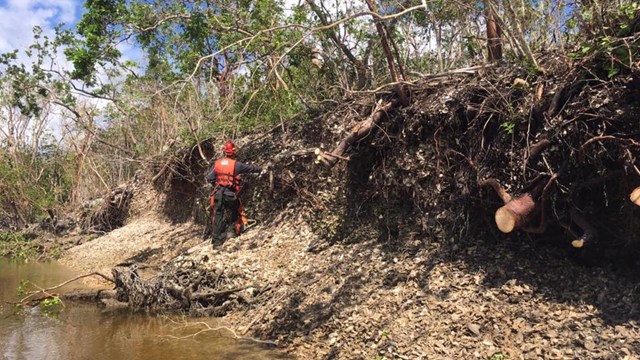
During the field season, it was decided that the east wall of Trench 1 would be used in the interpretation of the site. In order to construct a viewing area, the west side of the trench was lowered. The trench profile was documented. Feature 10 was noted in the north end of the wall and the area excavated. Feature 11 was found while excavating Feature 10, and the excavated area was extended. The remainder of the area was removed by a front-end loader while being monitored by 1-2 archeologists. No cultural material was noted during the mechanical excavation.

Cultural Stratigraphy

During the URS Berger work, it was suggested that there were two cultural layers at the site: surface material was separated from the subsurface material. The testing in 1992 suggested that the surface material occurred where Stratum I had eroded and the subsurface material was exposed (Connor 1993:11). 

Examination of the depth of the 1992 piece-plotted artifacts suggested that there could be two subsurface layers. One would be from 25 to 45 cmbs and the second from 45 to 70 cmbs (Connor 1993:Figure 11). However, statistical tests showed no differentiation in material among the levels. Figure 5 shows that the larger sample collected in 1992 reinforces the suggestion that there were two levels in the block excavation. This is seen most strongly in the depth of the lithic material in the block excavation, where the counts are fairly even from 10 to 50 cm. At 50 cm they drop, but are again fairly even from 60 to 90 cm. In contrast, the highest count of bone is found from 50 to 60 cmbs, which is the depth at which the amount of lithic material drops off.

The depths at which the features were initially detected also cluster into two groups. Features 2 and 3 were both initially detected about 35-45 cmbs. Features 1, 4, 5, 6, and 7 were initially detected between 60 and 75 cmbs. Assuming that the feature surfaces do represent living floors, this is the strongest evidence present for multiple living floors at this site.

The question then becomes whether the difference between the two levels is culturally meaningful. As Figure 5 shows, there is one ceramic sherd from each of the possible levels. As discussed below, the characteristics of these sherds differ enough to suggest that they are from two separate vessels. They are however, both cord-marked Late Plains Woodland sherds, suggesting that much of the deposit represents Late Plains Woodland material.

The projectile points, however, suggest a later occupation as well. FS 282 and FS 210 are both small Late Prehistoric points. FS 282 was found at 10-20 cmbs, making it the projectile point located nearest the surface. FS 210, however, was found in the screen with material between 43 and 62 cmbs. FS 321 is a Late Archaic projectile similar to the Pelican Lake points. It was found 30-40 cm below the surface. Medium-sized corner-notched points were found from 30 to 70 cmbs. It is clear that the stratigraphic sequence of the points is not as it should be, given the known relative sequence of the projectile styles.

The simplest explanation for this is the extensive disturbance of the site area by rodents, particularly in the block excavation area. It was noted by Connor (1993) that faunalturbation was the most detrimental agent in site destruction. As in the previous year, excavators in 1992 found that krotovinae riddled the excavated units. Experimental studies suggest that burrowing rodents and squirrels are estimated to turn over 15-20 percent of the surface soil in a single season (Thorp 1949:190). Other, more deeply burrowing rodents are estimated to bring 7,200-14,000 kg/ha of subsoil to the surface annually (Wood and Johnson 1978:320). These activities have a significant effect on smaller archeological objects, displacing them from their stratigraphic contexts. Interestingly, Bocek (1986:591), in her review of rodent-ecology studies, suggests that objects larger than 5 cm are systematically avoided by rodents, but nonetheless may still be disturbed by rodent burrowing. At 48LA277, there are few artifacts aside from the fired rock larger than 5 cm. Thus, it is quite probable that the vertical distribution of artifacts is partially the result of rodent activity. Unfortunately, because the rodents had access to the site from the side, via the roadcut, and not simply from the surface, it cannot be assumed that there is less disturbance further from the surface.

The site appears to represent multiple occupations, but the distinctions between them are blurred. Plan maps were drawn of the two possible levels of the site to examine differentiation. The upper level of the site (0-50 cm) (Figure 6) was compared to material from the lower level of the site (50-100 cm) (Figure 7). In drawing the maps it became clear that the site differs from the east side to the west. Rather than being a cultural differentiation, however, this was a result of the colluvium feathering out at the edge of the excavations to the west. Thus, the whole cultural occupation is compressed into the top 50 cm in the western edge of the site, while at the eastern edge there was more sedimentation and more differentiation. The greatest differentiation probably occurred where the road is now located.

Another natural process that affected artifact distribution is downslope movement of material during heavy rains that created gullies. On both maps, the predominant distribution of the fired rock not associated with a feature is from the northwest to the southeast, or downslope. Particularly on the map of the lower level (Figure 7), rocks are shown in a linear pattern running northwest-southeast. While some of this distribution may be a result of scattering from the hearths, this pattern may also result from some rocks moving downslope in heavy rains from features that would have been outside of the excavation block. As lighter objects would undoubtedly move farther than heavier objects, it is likely than any flakes associated with the destroyed hearths may have moved closer to the roadcut, if not into the area destroyed by the road.

Features

The seven previously located features are described in Connor (1993). In 1992, Feature 6 was left intact both for lack of time for proper excavation and because of possible use in the interpretive program. This feature was excavated in 1993 and is described here along with six additional features that were located in 1992 (Table 2). 

The previous work found similarities between features which continue to be evident when the additional features are included. The fired rocks in each feature appear to be river cobbles and are composed of the same granites and quartzites found in the bed of Crow Creek. Rocks are frequently stained dark gray on the top and white on the bottom (probably a calcium-carbonate deposit).

Feature 6

As exposed in 1992, Feature 6 was roughly oval, measuring about 60 cm north-south and 70 cm east-west. The feature was basin shaped, extending at its deepest about 15 cm below the top of the feature. The top of the feature consisted of fired rock with a little soil mixed in. The matrix of the feature consisted of a dark, organically stained soil with scattered fired rock. Small amounts of uncharred bone were also located within the feature.

Feature 7

Feature 7 was also a hearth containing large amounts of fired rock. In plan view, the top of the hearth was oval, measuring about 65 cm east-west and 60 cm north-south. The matrix consisted of 27 lbs of fired rock. Dark, organically stained soil was found between the rocks. 

Feature 8

Feature 8 consisted of a small concentration of rocks about 15 cm below the surface. The area was roughly circular, about 45 cm east-west and 34 cm north-south and about 14 cm deep. In total, it contained 0.2 kg of fired rock. No consistent soil differentiation was found around the rocks, but a few small pieces of charred bone were found in this location.

Feature 9

Feature 9, a circular, fired-rock basin, was exposed in the east wall of Backhoe Trench 1 (Figure 8). The top of the feature was exposed, and the profile along the backhoe trench was drawn. However, the feature was not excavated, but rather exposed for interpretation. Only a small amount of the feature was destroyed during excavation of the backhoe trench. The remaining portion of the feature was about 75 cm north-south and 60 cm east-west. The feature extended only about 20 cm below its surface. The units directly adjacent to the feature were excavated, showing a scatter of fired rock.

Soil for a radiocarbon date was taken from the profile and from scrapings between the rocks on the top of the feature. The date on this soil was 1470 ± 60 B.P.; A.D. 547-651 (Beta-56858) (Table 3). The charcoal from the feature was a combination of Salicaceae (willow/cotton-wood, aspen) and cf. Betula (birch) (Appendix B). Analysis of the phytoliths within the feature concur with two species of wood fuel being used (Appendix C). The material dated was from a sample similar to the one identified, and is probably the same species.

Pollen samples were collected from both the feature fill and the matrix outside the feature. The sample from inside the fill contained too much charcoal to allow for analysis of the pollen (Appendix B). The sample from outside the feature contained elevated levels of High-spine Compositae pollen, suggesting that a member of this group of plants may have been processed or utilized near the roasting pit (Appendix B). High-spine composites are a group of plants whose pollen is similar in shape and which includes aster, rabbitbrush, snakeweed, and sunflower.

The macrofloral sample from the feature included one charred Chenopodium seed (Appendix B). While this suggests the presence of goosefoot in the area, it is really too small a sample to determine whether this is an accidental inclusion or if it resulted from seed processing at the site. 

Feature 10

Feature 10 was also a feature spotted in the wall of Trench 1 (Figure 9). The feature was a basin-shaped pit about 60 cm north-south and 45 cm east-west, with the eastern edge of the feature truncated by the backhoe trench (Figure 10). The feature contained much less fired rock than Feature 9 and consisted mainly of a heavily stained, dark, organic matrix. More charcoal was found in this feature than in any of the other features excavated in either 1991 or 1992. However, no flakes or charred bone were found in the matrix.

Charcoal from the feature was radiocarbon dated at 1160 ± 90 B.P.; A.D. 670-1089 (Beta-56859). Charcoal identified from the feature contained the same mix of Salicaceae and cf. Betula charcoal as Feature 9 (Appendixes B and C).

Charred macrofloral remains from the feature fill included an Atriplex fruit fragment and an Atriplex seed (Appendix B). The greens of saltbush were frequently eaten, and the seeds could be processed as well (Kindscher 1987:65-67). The seeds and fruit are produced by the plant in the fall.

Feature 11

Feature 11 was located slightly to the southwest of Feature 10 (Figure 10). It extended roughly 40 cm east-west and 55 cm north-south. The south end was disturbed by the backhoe work when clearing the area for the interpretive center. The feature consisted of fired rock with little or no stained matrix. This feature probably represents a stone-boiling activity area associated with Feature 10. Feature 10 can be interpreted as the hearth where the stones were heated and Feature 11 as the dumping pile where the stones were dumped.

Feature 12

Feature 12 was located only as a pit apparent in the north wall profile of 1485N/1496.5E (Figure 9). The top of Feature 12 would have been located about 35 cm above Feature 10. The fill was a dark, loamy material only slightly different from the surrounding soil. On the west side the pit was apparently truncated by a krotovina. The excavator thought that the dark soil was associated with the krotovina, and it is mapped that way on the plan maps of the levels. However, the outline showed up quite well in profile. A macrofloral sample from the feature included Salicaceae charcoal and a single charred Chenopodium seed (Appendix B).

Lithics

Two hundred and eleven lithic artifacts were collected in 1992, bringing the total count of lithic artifacts for 48LA277 to 438.

Raw Material and Technology

The lithic raw materials collected in 1992 were consistent with the materials already described (Connor 1993; Tetra Tech 1987). No new types of materials were recovered, nor did the proportions of materials change the interpretations previously put forth. These interpretations suggested that the lithic assemblage at the site, and in the general area of the present Air Force base, was organized around the use of locally available lithic material. Raw-material sources were not identified, but were determined to be local based on the characteristics of the cortex and manner of reduction of the artifacts. In the following discussions, the numbers used represent the total assemblage from 48LA277, rather than just the 1992 field season, as the author felt that the use of only the 1992 field season was an arbitrary and misleading division of the material (Table 4).

The most common material at the site is a gray chalcedony (n = 147; 33.6 percent). URS Berger suggested this was a local material, and it probably is. This is also the most abundant material in the total F. E. Warren lithic assemblage, comprising 36 percent of the total. It was previously noted that the cortex on most of these pieces is not rounded, suggesting little or no transport between the outcrop and the collection site. In 1992, a few pieces were collected that belie that assertion. FS 651 is a chalcedony cobble banded with a limestone or dolomite material. On one side, one of the bands is exposed, giving the impression of a rough cortex. On the other side a chalcedony band is exposed. This surface is smoothed and gives the impression the piece may have been transported by glacial or stream movement. Two other chalcedony cores (FS 374 and 540) also show smooth surfaces, suggesting that there probably is collection from a secondary source, and this may be in addition to the collection of this material from the primary source.

Other chert cores (e.g., FS 481) closely resemble stream-bed cobbles. FS 481 is a chert core that contains a wide band of a mustard-colored chert and bands of a green-gray chert. The nodule appears to have been an oval, flat nodule, consistent with many stream cobbles. The cortex remaining on the piece is smooth. One additional nodule was found in 1992, FS 325. This is a small chert river cobble. Although only a small portion of the cobble is covered in cortex, almost all of it is extremely waterworn. 

The material from 1992 reinforced the previous conclusions that the technology is a combination of amorphous cores and bifacial technology (Connor 1993). The technological stages present at the site are described in Table 5

Eight additional cores were located in 1992 (Table 6). Four of these are the gray chalcedony that predominates on the site (FS 239, -374, -382, -651). FS 651 is a nodule worked on two sides. The outside is worn, as if it is from a secondary deposit. There are layers of limestone in the chalcedony, and the piece may have been discarded due to the difficulty in working around the inclusions. FS 239 and -382 are both very small pieces of cores that were probably discarded because of exhaustion. FS 374 is a core fragment, with the distal end of several flake scars. The cortex that remains on the piece is very smooth, suggestive of a secondary deposit.

FS 496 is a chert core that grades into chalcedony on one end. This is the end that was most intensely worked, and it appears that the core was discarded when there was too little chalcedony to utilize. FS 481 is a chert river cobble that had flakes removed from different angles on at least three striking platforms. FS 368 is a chert core fragment that appears to have portions of flakes removed from at least two directions. There is a white coating over part of core. This appears to be a calcium-carbonate precipitate such as that occurring on the fired rocks and ceramics found at the site. It occurs over the flake scars and is thus unlikely to be a part of cortex. FS 611 is a red chert core or core fragment that also appears to have been a part of a river cobble. The red color is very probably a result of heating. Only a few of the very small flake scars exhibit luster, so it is likely that the heating was done after discard and that the lustrous flakes were removed postdepositionally.

Twenty bifaces were recovered from the site, eight in 1991 and 12 in 1992. Of the 12 bifaces found in 1992, four are finished tools (three projectile points and a hafted scraper) and will be described further when discussing the tools. Three of the remaining 1992 bifaces (FS 279, -283, -317) are broken bifacial tips from projectile points or knifes. FS 407 is also a biface fragment, a midsection from a small bifacial tool. It has been heated and is very badly potlidded on one side. Snap fractures occur on both ends. FS 426 is a small, complete biface that may be a preform for a projectile point. FS 421 is a fragment of a late-stage biface. The bifacially worked edges are almost totally straight with little or no sinuosity. The biface has been snapped in two spots to create a point that would be excellent for a graver. 

Only two of the 12 bifaces recovered in 1992 are early-stage bifaces that are still a part of the manufacturing sequence. As described above, the remainder are portions of finished, or almost finished, tools. FS 601 is an early stage biface made from the proximal end of a large flake. The bulb of percussion is partially removed, but still discernable. FS 315 is a portion of a chert biface which is bifacially worked on three sides and has a large snap fracture on the fourth. There is a great deal of cortex on the broken-off piece, and the snap may have been intentional, in order to remove the cortex easily.

The predominant technology is a flake technology, using amorphous cores. A bifacial technology is used for specific, finished tools, such as projectile points. Many of the less formal tools are made on flakes. Kelly (1988) and Parry and Kelly (1987) began a discussion suggesting that the method of lithic technology people use is related to their mobility and the subsistence-settlement pattern they employ. They suggest that bifacial technology is related to a more mobile lifestyle. However, it quickly became obvious that other factors in addition to mobility are important in determining technological attributes. These include raw-material accessibility, patterns of site use, and tool function (Bamforth 1986; Kuhn 1990). The reliance on flake technology at 48LA277 does not appear to relate to mobility as much as to size of available raw material. 

Raw material appears to be local, available in nearby outcrops or from streambeds. The nodules found are not large and neither are the cores. Many pieces also have a number of inclusions that would have impeded the knapper's progress. In these pieces, an amorphous striking pattern, striking where the best material is located until an inclusion is reached and then turning the piece and working another area, will get more flakes from a nodule than a patterned reduction sequence. In a patterned reduction sequence, the knapper may be forced to work through an inclusion, rather than to have the freedom to work around it. That this material was being used, despite its high proportion of waste to usable material, may reflect its local availability. If it were to be transported any distance, it would make more sense to only transport material with few or no inclusions. 

An examination of the cortex present on the raw materials suggests an emphasis on tertiary production. In all material types, at least half of the material recovered has less than 20 percent cortex on the dorsal surface. The fine-grained quartzite has the greatest amount of primary flake debitage (33 percent), which is interesting because none of the cores or bifaces recovered are of this material type. It implies that at least one core of this material was on site, and either was not recovered during our archeological investigations or was curated and removed as the people moved.

Tools

Three projectile points were found on the site in 1992 (Tables 7 and 8, Figure 11a, b, e), in addition to the four projectile points found previously on the site. Measurements on all the points are presented in Table 8. Interestingly, all three of the 1992 points were found in the same unit, 1499N/1499E. The gray chalcedony point found closest to the surface, FS 282, does appear to be the most recent point on the basis of its morphology. It is broken at the midsection in a series of hinge fractures, and there is much crushing around the breaks, suggesting an impact fracture.

FS 321 is a fine-grained reddish quartzite projectile from Level 4 (Figure 11e). It is a large corner-notched point, similar in shape to Pelican Lake points. One tang and part of the base is broken, as is a small portion of the tip of the point. The base is straight. FS 318, a white to gray chalcedony point, was found in Level 5 (Figure 11b). The base is missing, but it appears to have been corner notched. The edges were reworked, and they are serrated. This is a Late Prehistoric point and therefore should not be deeper than the Late Archaic Pelican Lake projectile point. This probably reflects the mixing of materials due to the large amount of bioturbation in the excavated area.

Of the projectile points located in 1992, only FS 211 shows any indication of being serrated. This point is broken midblade; therefore, much of the blade is missing. However, the remaining portion shows about half a centimeter of area that appears to be serrated, although the remainder of the extant blade edges appear smooth. Both serrated and unserrated corner-notched points were also found at the Wilber Thomas Shelter near Carr, Colorado, about 20 miles south of Cheyenne (Zimmerman 1971:80). The points overlap in depth and are associated with Woodland pottery (Gillio 1971:84).

Chronologically, these points suggest the site was occupied in Late Archaic as well as in Woodland/Late Prehistoric times. A possible way to become more specific about the date represented by the projectiles is to examine neck width. Fawcett and Kornfeld (1980) developed a regression formula (Y = 1.893X - 7.943), where X = neck width in mm and Y = age B.P., which appeared to be useful to date points from 2000 to 300 B.P. This was applied to the neck-width measurements of the points from 48LA277. Fawcett and Kornfeld (1980) suggest the formula not be used on assemblages with fewer than 10 projectile points, so that while this is an interesting application, it is not really valid in this instance.

Most interesting is FS 211, a projectile point from Feature 3 (radiocarbon dated to 1390 ± 150 B.P.). The neck width of FS 211 is 10.51 mm, which yields a date based on Fawcett and Kornfeld's regression equation of 1051 B.P. When the radiocarbon date is calibrated with the CALIB computer program (Stuiver and Reimer 1993), it falls within one standard deviation, suggesting that the regression method can be used for producing approximate dates and may be useful in constructing a relative chronology.

Only four Late Prehistoric projectile points from the site were intact enough to measure neck width (Table 8). The neck width measured from 2.41 to 10.51 mm, suggesting dates from 250 B.P. to 1050 B.P. The 250 B.P. date is probably too recent, as there is no other indication of a protohistoric occupation. This, combined with the results of the formula on the neck width of FS 211, suggests that where the formula errs, it errs in estimating the age as too recent.

Seven additional gravers were recovered from the site in 1992 (Table 9). These were defined on the basis of a projecting tip with microflake scars on at least one side of the tip. None of the extremely small gravers (weight less than 0.3 g), such as were recovered in 1991, were found during the 1992 season. Two larger gravers, weighing 4.6 g or more, were recovered. FS 421 is a biface fragment that has been snapped twice to create a point in the middle of the piece (Figure 11c). FS 333, which weighs 4.6 g, is slightly smaller than the 5-g cutoff proposed in 1991 for this class (Connor 1993). But there is a large gap in weight between the heavy-duty gravers and the lighter-duty gravers and this piece is clearly closer to the more heavy-duty pieces. It is a secondary flake with cortex on roughly 30 percent of its ventral side. The distal end of the flake was broken with a snap fracture. The projection used as a graver appears on the side of the flake and was created by two snap fractures. The ventral side of the flake, near the projection, was heated and shows potlidding. The fracture on the distal side shows some post-heating retouch that may be postdepositional in nature.

Five smaller gravers were recovered, in the weight class between 1.3 and 4.6 g. One is a mustard-colored chert, the others are the gray chalcedony that dominates the site assemblage. FS 309 is one of the gray chalcedony flakes. It is shaped rather like a double-sided mason's pick with projections on either side. The projections extend from an arris caused by a hinge fracture on the piece from which this flake was detached. Both of these projections may have been used. On the other pieces, the projection was created by a snap fracture on the side or distal end of the flake. Use of either one or two snap fractures, usually on a flake, to create the graver tip seems to be the most common form of manufacture of this tool type.

Four additional scrapers were recovered in 1992 (Table 10). Scrapers are defined based on unifacial retouch and microflaking along one or more edges of the piece. FS 292 was probably a hafted scraper, made from a milky white chert with dark gray ooliths (Figure 11d). The hafting element is corner notched, and if this is a reworked projectile point, it is from a Late Archaic corner-notched point. The other pieces are unifacially retouched flakes. FS 513 is retouched along the distal end of the flake. It has a projection flaked into the piece on one side of the distal end, so that it could be used as either a graver or a scraper.

The small size of the tools, as was previously noted (Connor 1993:21), probably at least partially reflects the small size of the raw material utilized. It may also partially reflect the activities at the site. In the initial inventory of the site and throughout two seasons of excavation no knives or heavy-duty scrapers were recovered. This may suggest either that these tools were curated or that initial processing of large ungulates was carried out elsewhere.


Chapter 3 (Part 2)

Back to the contents page