|
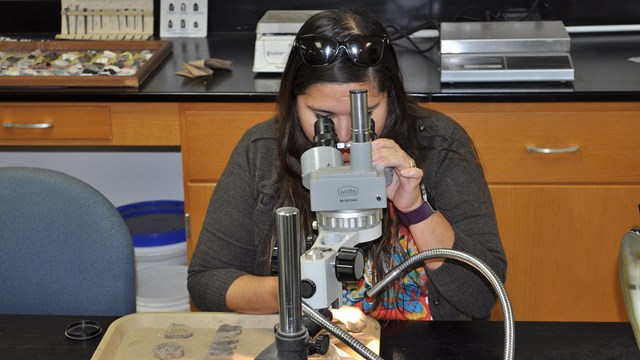
The faunal assemblage at the site was cleaned and rebagged in the laboratory in clear, inert plastic bags. The data were recorded using dBASE III+ in a format that recorded provenience, species, element, side, weight, and notes. Fractured specimens were recorded as one, but were not glued together unless it would aid identification. No other stabilization measures were undertaken. All bones were examined to determine element, side, and portion. If these characteristics could be determined, the specimen was then compared to the MWAC faunal collection in order to assign the piece to a taxonomic grouping at the family level or below, if possible. In all, 730 faunal pieces (816.2 g), mostly fragments, were recovered from the site, 128 in 1991 and the remainder in 1992. Most of the material consists of small, unidentifiable bone fragments. The average weight of a piece of bone is 1.12 g, emphasizing the fragmentary condition of the assemblage. Only four pieces (2.22 g) were burned or charred. No marks attributable to canine gnawing or punctures were observed on the assemblage. A number of pieces, however, do show rodent gnawing. This probably again reflects the intense postdepositional rodent activity in the site area. A number of pieces also show plant etching, demonstrating their nearness to the active root layer. Bone was recovered in 20 of the 24 units excavated at the site, plus a small sample of bone was collected from the surface. The bone was concentrated in the units that included the features (Figure 12), although much less bone was recovered in the units to the south than in the units in the block excavation. This distribution also suggests that more of the site might be present to the north of the block excavation, as some of the highest densities of bone are located there. Vertically, bone was distributed from the surface to 90 cmbs (Figure 5). The densest concentrations were from 30 to 60 cmbs. Not surprisingly, the vertical bone density correlated with the depth of the features in each unit. Almost five percent of the assemblage (n = 34; 4.5 percent) are small mammal or rodent bones (Table 11). Five fragments were identified as rodent on the basis of the teeth. Another mandible fragment (FS 428) was that of a small mammal and was consistent with a prairie dog mandible. Most of these bones are in excellent condition and appear to be recent deposits. It is unlikely that these are related to the archeological component of the site given their association with an area heavily disturbed by rodent runs. Fifteen elements were of the size to suggest they belonged to a medium-sized mammal (e.g., rabbit, opossum). These included five long-bone fragments, eight rib fragments, and a phalanx. It was not possible to identify the elements to species. Forty-two fragments were identified as belonging to either a medium- or large-sized mammal (including 16 long-bone fragments, 5 rib fragments, and four tooth fragments). These were not identifiable to species. Forty elements were identified to large mammal. All of the excavated materials were in the size range consistent with the antelope or deer families. The only Bos specimen at 48LA277 was a fragment of a radius that came from the surface of the site. Fifteen elements were identifiable to either antelope or deer, but to which of the two species could not be determined. Seven elements were identifiable to Antilocapra americana. Specimens were distinguished from deer on the basis of the criteria of Lawrence (1951) and Gilbert (1990), and by using the MWAC comparative faunal collection. In 1991, a group of articulated antelope bone was found as part of Feature 3 (Connor 1993:18). The concentration consisted of the distal end of the tibia articulated with the tarsals and metatarsal. The tibia was broken off about 13 cm from the epiphysis, with the metatarsal almost immediately at the epiphyses. The break at the distal end of the tibia has a very oblique angle and may have been smoothed. Bison bones were frequently cut in this manner for use as hide fleshers (Frison 1991:135; Gilbert 1990:38; Wedel 1961:Plate XII). Serrated versions of these bone fleshers are well known from late in the culture-historic sequence in the Northwestern and Central Plains. There is no indication of serration on the edge of the tibia. It is possible that in butchering the antelope for bone-grease processing, this portion of the long bones was laid aside to make the flesher at a later date. No butchering marks were observed on the elements during analysis. Many of the long bones, however, had beveled and spiral fracture breakage patterns. Epiphyses were separated from diaphyses. Bone breakage may have occurred through blunt instrument trauma from a heavy implement. The fragmentary condition of much of the bone of medium or larger mammals probably resulted from bone-grease processing. In 1991, two ceramic sherds (FS 169, -233) were found on the site (Connor 1993:23). Both were cord-marked body sherds consistent with the designation of the site as Late Plains Woodland. In 1992, three additional cord-marked body sherds were recovered (FS 248, -262, and -287) (Figure 13). All were located in 1498N/1499E. The following description was compiled with the aid of a hand lens (5X, 10X, and 15X) and was done in a combination of natural and artificial light. The ceramics were dry when the colors were compared to the Munsell chart. All the sherds found in 1992 appear mass molded, probably using a paddle-and-anvil technique. They were cord impressed or cord roughened on the outside, suggesting that the paddle was cord wrapped. The sherds found in 1992 were too eroded to be able to determine the twist and ply of the cordage. They all have a hardness of about three on Mohs' scale. They are generally too small to provide information on vessel shape. There are enough differences, however, to suggest that at least two vessels are represented on the site. FS 240 represents one of these vessels. The piece is about 46 x 72 x 6 mm in size. The interior shows finger-sized indentations, suggesting the piece was mass molded into shape using a paddle-and-anvil technique with the hand used as the anvil. The interior was not subsequently smoothed with a tool. The temper consists of large pieces of grit. The largest of these seen in the wall is over 3 x 5 mm in area, and most pieces are in the granule size on the Wentworth scale (Shepard 1971:118). The interior is gray (10YR5/1), and most of the exterior is a very dark gray (7.5YR3/0). The exterior also exhibits some white staining. This is probably a calcium-carbonate precipitate, similar to that seen on the rocks found in the hearth features. The other two pieces are more similar to each other than to FS 240. FS 262 is a very small piece (5.5 x 11 x 13 mm). The inside is smooth, but shows no striations or other indications of a smoothing tool. The sand temper includes both medium- and fine-grained particles. FS 287 is a larger piece (6.5 x 40 x 45 mm). It, too, has sand temper, which includes a number of pieces of angular quartz and mica. The interior is a dark gray (10YR4/1), and the exterior is mainly brown (7.5YR5/2). The exterior also shows some white staining, probably a calcium-carbonate precipitate from the soil. The interior also shows numerous small, parallel striations from using a tool to smooth the moist clay. These sherds conform to the description of Woodland pottery as described by Kivett (1952). Similar ceramics have been found in Woodland contexts in the Pine Bluffs area (Reher 1973) and at Signal Butte (Forbis et al. n.d.). Similar types of pottery would include Ash Hollow Cord-Roughened (Champe 1946) and Agate Cord-Marked (Irwin and Irwin 1957). Butler and Hoffman (1992) have subsumed these two types under the nomen Colorado Plains Woodland Ware, as proposed by Johnson et al. (1991:24). In the course of investigations, 12 field-specimen numbers were assigned to historic-period materials collected on 48LA277. The majority of this material was in the first level of the block excavations, although three items were collected in the second level and two in the third level. This undoubtedly is a reflection of the high degree of rodent disturbance in this area. FS 558 is a small fragment of a red brick, consistent with much of the brick found throughout the base. FS 280 is a small whiteware sherd. FS 525 is a metal bucket bail, found in Level 2 of the block excavation. Three cartridges were recovered (FS 430, -432, -585) FS 432 is a .22 short cartridge, headstamped "H." The "H" (for Henry) is impressed rather than raised. Winchester has used the impressed "H" on cartridges since 1890, and they are still a popular cartridge today (Barber 1987). FS 430 is a .22 long cartridge, headstamped "SUPER." This cartridge is also of recent manufacture. FS 585 is a military .30/06 cartridge with a headstamp indicating that it was made at the Frankfort Arsenal in December 1908. The .30/06 was first introduced in 1903, with refinements in 1906 (Barnes 1989:54). It is still a popular cartridge today. The remainder of the historic-period material consists of glass sherds. FS 330 is a small piece of curved, clear glass from a hurricane lamp. FS 425 is a small sherd of brown bottle glass. The remainder are clear glass bottle sherds. Except for FS 383, which is thinner and more weathered than the other sherds, they are all consistent with a single clear glass bottle. The presence of historic-period artifacts reflects the use of the site area by the personnel at the base. Their subsurface position substantiates the hypothesis that the site has been disturbed by rodents. Site 48LA277 shows the exploitation of the riparian habitat near Crow Creek. Geomorphological analysis suggests, and the pollen data reinforce the idea, that the creek was on the north side of the valley during the prehistoric occupation of the area. The macrofloral record suggests that Chenopodium and Atriplex were processed at the site (Appendix B). Riparian species were used for firewood. Antelope and small game were also processed at the site. The focus of the site was the extraction of a number of species either associated with the riparian habitat or, like the antelope, attracted to the riparian area because of this same biodiversity. The site is consistent with a late summer to fall occupation. Charred Chenopodium seeds are present in small, but consistent quantities throughout the features. These seeds are usually harvested in the late summer or fall. A charred Atriplex fruit fragment and seed were found in Feature 10. These are also produced by the plant in the fall. While it is possible that these seeds and the fruit fragment are accidental inclusions from a previous season, their consistent presence makes it more likely they were included in the features when produced by the plant. This makes it likely that 48LA277 was occupied in the late summer or fall of the year. Activities suggested by the artifacts at the site are consistent with those suggested by the 1991 testing (Connor 1993). Antelope, smaller mammals, goosefoot, and pigweed were processed at the site. The gravers and the bones set aside for a flesher suggest that some hide working occurred at the site. Bone grease was made from the animal bones, and it is probable that the grease and berries were combined to make pemmican. Local riparian species of plants were used for firewood, including willow and birch. Raw materials for the tools were gathered from small cobble outcrops in the immediate area. Larger cobbles were bifacially reduced and curated. Smaller cobbles were reduced using a flake technology and quickly exhausted and discarded. Several other sites in the western Central Plains also exhibit the combination of Plains Woodland ceramics and corner-notched points that occurred at 48LA277 and may help us interpret the site. The Seven Mile Point site (48LA304) is near the Pine Bluffs escarpment (Reher 1973:83-96). Excavations and surface collection uncovered both an Upper Republican and a Woodland occupation. Woodland material included both large and small corner-notched points and cord-marked pottery. Three Late Plains Woodland radiocarbon dates are available for this site: 1100 ± 50, 1250 ± 80, and 1300 ± 60 B.P. (Frison 1991:36), suggesting that the occupation of this site is roughly contemporary with 48LA277. The site is located on the exposed top of a butte, and nearby Muddy Creek may have been an intermittent stream at the time of occupation (Reher 1973:84). Vegetation is similar to that at Warren AFB and includes scattered yucca, prickly pear, and rabbit brush. Reher (1973:83) feels that the site would not have been inhabited in cool weather due to its exposed location. The Petsch Springs site (48LA303), another site in the Pine Bluffs Archeological Project area, also produced Late Plains Woodland/Avonlea dates. These dates are 1510 ± 150, 1510 ± 160, and 1540 ± 70 B.P. (Frison 1991:36), suggesting an occupation earlier than 48LA277. When first reported, the site included one corner-notched point, but exhibited little other evidence of a Late Plains Woodland/Avonlea occupation (Reher 1973:56-73). Undoubtedly, the final report on this work will add to our knowledge of this period. The Pine Bluffs site (48LA312) also included Woodland ceramics and small corner-notched points (Reher 1973:104-106). Late Plains Woodland/Avonlea radiocarbon dates from this site include the following: 1540 ± 70, 1520 ± 70, 1140 ± 80, 1080 ± 70, and 1068 ± 90 B.P. (Frison 1991:36). This is roughly contemporary with 48LA277. Finally, the Sorenson site (48LA1033) also has radiocarbon dates associated with Late Plains Woodland/Avonlea; 1430 ± 70 and 1120 ± 80 B.P. (Frison 1991:36), but to date no further data on the site have been published. This listing suggests that sites with radiocarbon dates contemporaneous with 48LA277 are fairly common in the Pine Bluffs region. The density of Late Woodland sites in the Pine Bluffs region suggests that a similar density may be present in the Crow Creek area. However, additional excavations may be necessary to recover the ceramic material to correctly assign the sites to the Woodland culture, however. Other nearby, contemporary sites include both side- and corner-notched projectiles. Happy Hollow Rock Shelter is only about 12 miles south of Cheyenne (Steege 1967). Hearth 5 at this site produced material radiocarbon dated to 1270 ± 80 and included the base of a small, side-notched projectile point. This hearth was a basin-shaped depression about 6 inches deep, containing about three rocks. Ceramics included four straight-rim sherds of a cord-marked pottery with no smoothing. There was also an Upper Republican component at the site. The faunal assemblage was not separated by component, but species included elk, bison, antelope, deer, prairie dog, rabbit, packrat, and domestic dog. The Wilber Thomas shelter is near Carr, Colorado, about 20 miles south of Cheyenne. It also has a Woodland component identified from two ceramic sherds and 20 corner-notched projectile points. The site contains a number of other components including Cody-, Mountain-, and McKean-complex material, as well as historic-period artifacts (Breternitz 1971). The Plains Woodland tradition represents ceramic-using hunter-gatherers (Wedel 1959). This is not a well-understood tradition, and since 1954 six taxonomic systems have been proposed encompassing the Plains Woodland tradition (Breternitz 1969; Butler 1988; Eddy and Windmiller 1977; Mulloy 1958; Withers 1954; Wood 1967), reflecting the evolution of our knowledge of the tradition. Radiocarbon dates associated with the Plains Woodland tradition occupations, as shown by the sites above, generally fall between around 1800 and 850 B.P. (Butler 1988:460). The use of pottery spread to the Western Plains, through interaction with groups from the east. This does not appear to mark a significant change in the economy, although there is some indication of experimentation with agriculture late in the Plains Woodland in the foothills of northeastern Colorado (Irwin and Irwin 1959), in eastern Wyoming (Tibesar 1980), and in eastern Nebraska (Kivett 1952:57-58). For the most part, however, Plains Woodland ceramics are used by people making a living through hunting and gathering. Wood (1967) suggested that Plains Woodland occupations were extensive, rather than intensive, emphasizing seasonal movement, and that the basic pattern of life was similar to that of earlier periods, despite the adoption of ceramics. Archeologists have defined six Woodland variants, or phases, that appear in or near the Cheyenne, Wyoming, area. The earlier phases are the Keith and Valley phases. They are associated more strongly with areas further to the east in Nebraska (Hill and Kivett 1940; Kivett 1949, 1952), Kansas (Wedel 1959, 1961), and Oklahoma, than with the study area. The ceramic traditions in these phases, however, may be ancestral to the ceramic traditions seen in the foothills area in southeastern Wyoming. In the Valley phase, structures are irregular and temporary. Ground stone is infrequent or lacking, suggesting little emphasis on plant processing (Wood 1967). In the Keith phase, housing may be represented by shallow, circular basins and scattered post molds (Kivett 1949:242). The subsistence base appears to include mussels, birds, deer, and pronghorn (Wood 1967). Ceramics from both phases have been identified from surface sites in southeastern Wyoming (Reher 1971). A third Woodland variant, the Ash Hollow phase, was defined at the Ash Hollow site in west-central Nebraska (Champe 1946). This is a Woodland phase with an emphasis on hunting, including deer, pronghorn, and bison. Wood (1967) identified this phase at several sites in northeastern Colorado. This phase may well be a regional variant of the Valley phase (Kivett 1952). The Parker phase (Withers 1954), the Franktown focus (Withers 1954), and the Hog Back phase (Nelson 1971) all appear to be Woodland variants oriented to the mountain-Plains transition zone. Butler (1986, 1988) points out that it is difficult to separate these phases from each other and suggested replacing them with the term "South Platte" phase. This phase consists of ceramic-using hunter-gatherers who may have incidentally experimented with maize horticulture. Geographically, the phase encompasses an area transitional between the mountains and the Plains. Many of the streams that drain into the South Platte originate in the Laramie Mountains of Wyoming and the Front Range of Colorado. The people using these streams as corridors move from the Central Plains into high-altitude areas, utilizing the mountain areas on a seasonal basis. The effective use of this transitional zone provides access to a broader range of resources than the use of only a single environmental zone. Traits that Butler (1988:459) proposes to identify the South Platte phase include: (1) cord-marked pottery; (2) small-to-medium-sized, diagonally corner-notched projectile points; and (3) expanding-base drills. Also diagnostic of the Woodland complexes is a general reduction in tool-kit complexity between the Archaic and the Woodland, although the reason for the change is unknown. Site location is usually away from the major drainages, with a preference for southern exposures (Kvamme 1979; Scott 1973). Within the South Platte phase are regional and temporal variations,
possibly represented by the sites included in the Parker and Hog Back phases
and the Franktown focus. However, given our present knowledge about the
Woodland in the mountain-Plains area of northeastern Colorado and southeastern
Wyoming, it is difficult to separate the variations with any regularity.
Although 48LA277 is outside the geographic limits set by Butler
(1988:459)
for the South Platte phase (the Colorado state line), 48LA277 would belong
to a Wyoming variant of the South Platte phase. Crow Creek flows into the
South Platte and undoubtedly served as a travel corridor. The use of drainages
as travel corridors is consistent with Reher
and Harrell's (1983) observations that the assemblages within drainages
are more consistent than the assemblages between drainages. Before examining
the implications of this, however, the fieldwork conducted at other sites
in the Crow Creek drainage will be discussed.
|