|
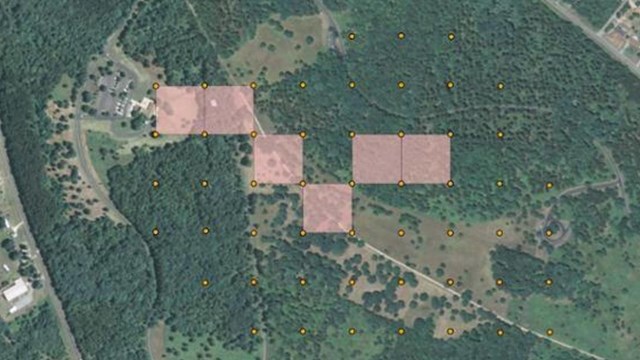
INTRODUCTION In 1992, the second year of archeological fieldwork in support of an interpretive center at site 48LA277 was completed at Warren Air Force Base in Cheyenne, Wyoming. Work was completed at seven locations (five sites and two trenches) on the north side of Crow Creek (Table 1, Figure 1). The interpretive center is being funded through the Legacy Resource Management Program of the Defense Department. Plans for the interpretive center began in 1990. Bill Metz, then Chief of the Environmental Division at the base, requested assistance from the Interagency Archeological Services Division of the National Park Service in completing the interpretive center. The Interagency Archeological Services Division in turn requested the assistance of the Midwest Archeological Center (MWAC) in completing the fieldwork to provide background information on the site for interpretive purposes. Site 48LA277 was chosen for the interpretive center both because of its proximity to the Family Camping area on base and because previous work had shown the site to be eligible for inclusion in the National Register of Historic Places due to a buried subsurface component. The site was badly disturbed, however, as part was used as a gravel quarry, and a fire road ran through another portion. Although two prehistoric hearths were visible in the roadcut, investigators were initially unsure how much of the site remained. In 1991, a total of 3.5 m3 of site 48LA277 was excavated within five excavation units (Connor 1993). Within these units, six features were found and four totally excavated. The features yielded radiocarbon dates, pollen, and macrobotanical specimens, as well as lithic and faunal materials. The excavations outside the features also yielded cultural remains, resulting in a total of 108 lots of faunal material, 227 pieces of lithic material, and two ceramic sherds. This testing suggested that much more cultural material was present than was originally thought. The goal of the 1992 fieldwork, then, was to: (1) determine the extent of the buried portion of the site to the south; (2) expand samples of diagnostics, tools, and subsistence remains; and (3) examine geomorphologically similar locales to the west to determine whether 48LA277 is a unique site or whether similar areas along the Crow Creek drainage were used in similar manners. The resulting information will be used both in the interpretive center and to enhance the existing knowledge of the prehistory of the area. The artifacts and records will be curated at F. E. Warren Air Force Base. People have made their living through hunting and gathering for almost 99 percent of the human past. Yet our knowledge of this lifestyle, its variations, and the processes that cause innovation and change is minimal. Only since the 1960s have anthropologists even realized that the hunter-gatherer economy can allow for leisure time, and that hunter-gatherers can develop a rich and diverse culture. The 1992 investigations along Crow Creek contribute to our knowledge of the time period during which the area was utilized. URS Berger found artifacts diagnostic of cultures from the Middle Plains Archaic through the Late Prehistoric on these sites, which helps us to examine when the land-use patterns seen at 48LA277 began and how they varied over time. Variations in land-use patterns can be expected with innovations in technology, such as the adoption of the bow and arrow around A.D. 500. Variations can also be expected as a result of interactions that occurred between people in the Crow Creek drainage and horticultural or agricultural groups to the east. The investigations at 48LA277 continue to add to our knowledge of the Plains Woodland archeological culture. Detailed excavation and geomorphological investigations help us to understand how prehistoric peoples utilized the landscape and the available resources. This contribution to our understanding of the prehistoric human ecology of the region is of great importance in understanding the relationship between people and their environment today. As noted previously (Connor 1993), the detailed inquiry at 48LA277 also has the potential to contribute to issues in the study of hunter-gatherers such as mobility, food storage, and intrasite patterning. These relate to some of the fundamental tenets that anthropologists have begun to realize about hunter-gatherer societies (Binford 1978, 1980, 1983). For instance, the importance of meat versus the importance of plant foods and fish is strongly correlated with the environment exploited (Binford 1990; Lee 1968). This has implications for the amount of stored food required to support a group of people through the winter months. Mobility of the group will decrease as more stored food is carried. The degree of mobility of a group helps to determine the way available resources are used and dictates the patterning of the archeological sites left behind. Understanding the balance between the need to be mobile to gather resources and the need to store food for the winter, which limits mobility, requires detailed knowledge of the resources utilized. To that end, portions of the environment relevant to the prehistoric inhabitants of sites and regions must be reconstructed. At 48LA277, both geomorphological and palynological analyses were undertaken to reconstruct the prehistoric environment. Analyses of the lithic material, faunal material, and features at the site were conducted to help examine the mobility and food-storage strategies of the site occupants. In many cases, these kinds of analyses are completed as ends in themselves. They become more meaningful, however, when placed in the context of anthropological hunter-gatherer studies. The first systematic archeological work in this portion of the western Central Plains was Strong's (1935) survey and excavations throughout Nebraska. This work laid the basis for the culture history of the area, which was expanded by Champe's (1946) excavations of the stratified Ash Hollow site. After World War II, the archeological database was further expanded by the River Basin Surveys, a large federal program administered by the Smithsonian Institution that salvaged sites threatened by water-control programs. For many years, the western Central Plains was not considered to be an inviting habitat for the prehistoric inhabitants, who were without horses. As Wedel (1961:101) observes:
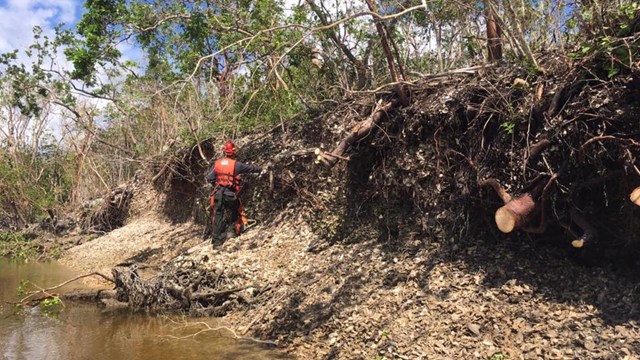
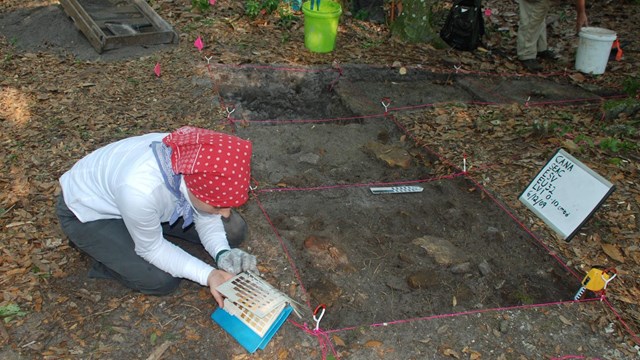
The University of Wyoming's High Plains Project, directed by Charles Reher, was the largest project in southeastern Wyoming at the time it was in progress. Most of the information from the project remains unpublished, but when available, the data will be crucial for defining regional culture history and settlement and subsistence patterns. Radiocarbon dates from the project are available and span the time from 9880 to 380 B.P. (Frison 1991:36). Also available is the inventory of the ceramic sites in southeastern Wyoming, which shows that Woodland, Upper Republican, Dismal River, and Shoshone sites are all present in the region (Reher 1973:118). In 1984 and 1985, URS Berger conducted an archeological inventory of F. E. Warren AFB in conjunction with the Peacekeeper Missile Program. Some site testing was conducted in order to determine the National Register eligibility of selected sites. The data were turned over to Tetra Tech, Inc., who wrote a report summarizing the inventory work (Tetra Tech 1987). All sites examined during the 1992 fieldwork were located during this inventory. The testing and collection crews for URS Berger constructed permanent site datums of rebar set in concrete. These markers were found at most sites and proved to be extremely useful in correlating the mapping from the earlier testing with the 1992 mapping. The collections from the URS Berger testing were stored at the University of Wyoming and were borrowed from the university by MWAC in order to reexamine them as part of the present project. In 1991, a crew of 3-4 MWAC archeologists spent nine days on-site (September 30- October 10) mapping the site area, conducting test excavations, and shovel testing adjacent areas. John Albanese, a geomorphologist, was consulted in 1992 on the age and formation of site landscapes (Appendix A). In 1991, a datum in the form of a wooden stake was set on the top of the roadcut to the east of the site. This location was chosen as it was out of the way of construction for the interpretive kiosk. In 1992, the URS Berger rebar datum was located and utilized. Mapping was completed with a Leitz-Sokkia total station with a theodolite and electronic distance meter (SDM 3D 10). The test excavation and stake remaining from the URS Berger testing were mapped and used to help overlay the 1991 material over the previous material mapped in on the site. A point at the top of the hill was arbitrarily designated 1500N/1500E. From here, a grid was laid out with the 1500E line running north-south along the top of the roadcut. Excavated units were named after the grid coordinates of the southwest corner. Along the bank, units were 1 m north-south. East to west, they were the distance from the 1500E line to the roadcut, varying from about 40 cm to 130 cm. The east boundary of the unit changed with the depth, as the roadcut slumped; this is shown on the level forms for the unit. Backhoe trenches were cut by military personnel (Figure 2). Trenches were about a meter wide and were cut into the bedrock. Trenches were examined by Albanese (Appendix A) for their geomorphological content and by the archeological crew for their archeological content. Units were excavated with the natural slope of the hillside, following stratigraphic units to the extent possible. The first unit was troweled throughout the excavation. However, it showed the URS Berger conclusions to be correct, in that cultural material was mainly located in the dark organic layer (Stratum IV). For the sake of expediency, the remaining units were shoveled to this stratum, screening the soil through quarter-inch-mesh screens. At this point a new level was begun, the unit was excavated by trowel, and all material encountered was piece plotted. When cultural features were encountered, the surface was exposed, mapped, and photographed. Half of the feature was then excavated to expose the profile. Bulk soil samples were taken from the feature fill. A pollen sample was taken from within the center of the feature. Large pieces of charred wood were placed in tinfoil envelopes for possible use as radiocarbon samples. Fired rocks and other material found within the feature were piece plotted. Fired rocks were not collected, but bagged separately and left on-site for possible use in the interpretive display. Faunal material found during the excavation appeared in stable condition and in no need of chemical treatment to halt deterioration. When the profile was exposed, it was mapped and photographed. In most cases, the other half of the feature was then excavated. Soil descriptions were completed on the roadcut and the walls of the excavated units. Stratum differentiations were based on color and texture differences. Samples for particle-size analysis were taken from the soil column on the west wall of 1497N/1500E. Analysis of the particle-size distribution and organic content of the soils was completed by the University of Nebraska's Soil Testing Laboratory. A pollen column, with samples taken every 5 cm, was also obtained from this wall. Locations of both sets of samples were indicated on the unit profile. Shovel tests were completed on the alluvial terrace at 48LA265 and 48LA450. These had diameters of approximately 40 cm and were excavated to a sandy soil stratum that varied from 50 to 100 cm in depth. Shovel test soil was screened through quarter-inch mesh. The tests were arranged in approximately a 5-m grid. In the field, each bag was assigned a Field Specimen (FS) number to catalog the collected material. These numbers were also used throughout the laboratory processing of material. Faunal material was dry brushed. As mentioned above, chemical methods of stabilization were not necessary. Lithic materials were minimally cleaned, to facilitate observation of technological attributes. Materials were dry brushed and rebagged in clear, inert plastic, self-sealing bags. Approximately 2 liters of soil from several features were sent to PaleoResearch Laboratories in Golden, Colorado, for macrobotanical analysis (Appendix B). The remaining material was floated at MWAC. The volume of the material was measured, the soil was placed in water, and the material that floated to the top was screened through a series of U.S. Geological Survey (USGS) soil sieves. The smallest screen size used was 0.15 mm. The heavy fraction was sorted for lithic and faunal material. Lithic analysis consisted of determination of raw-material types and
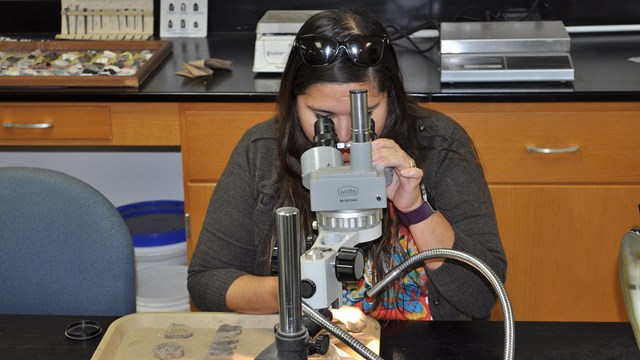
technological stages. For the sake of consistency, raw-material categories
followed those used by Tetra Tech in
their analyses. Technological stage was defined on the basis of morphology
as follows: shatter (no flake characteristics), flake (shows striking platform,
bulb of percussion, or rings of percussion), core (two or more negative
flake scars), uniface, biface, or ground stone. Functional determinations
were based on general morphology and the location of retouch and microflake
scars. Definitions of specific tool types are presented with the discussions
of those tool types. Microflakes were examined using a 5X, 10X, and 15X
hand lens. This information was coded into a dBASE III+ database for statistical
manipulation. Faunal material was identified, when possible, to species
and element using the comparative collection at MWAC. The material was
examined for cut marks, rodent and carnivore gnawing, and breakage patterns.
The results of these analyses are included in this report.
|