Purpose
| References | Information
| Links | Related
Publications
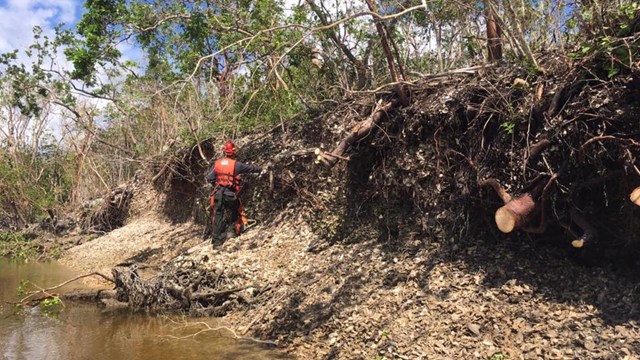
Shoreline stabilization test area in 1990, Cumberland Island National Seashore. Placing shell rake, Cumberland Island, Georgia (Photo courtesy Robert M. Thorne). "After" photo of area taken in 1999. |
Placing filter cloth on Hurricane Mound in preparation for placing riprap, Sardis Lake, Mississippi (Photo courtesy Robert M. Thorne). |
Statement of Purpose The National Clearinghouse for Archaeological Site Stabilization was originally formed through a tripartite cooperative agreement between the National Park Service (NPS) office of the Departmental Consulting Archaeologist, the Cultural Resources Program at the Tennessee Valley Authority (TVA), and the University of Mississippi. The Clearinghouse was headquartered at the University of Mississippi, and its primary functions were to develop and maintain a site stabilization bibliography, to help develop and present workshops on site stabilization, and to provide expertise in the development of archaeological site stabilization projects. Through time, Federal involvement changed, with the DCA no longer actively participating and NPS involvement replaced with cooperative agreements between TVA, the NPS's Southeast Archaeological Center (SEAC), and the University. Ultimately, TVA's role would be diminished and the Clearinghouse now stands alone as a unit of the Center for Archaeological Research at the University of Mississippi. Close consultation ties are still maintained with the TVA archaeological staff and through an MOU with SEAC. The Clearinghouse has evolved and has become a primary source of expertise in the development of archaeological site stabilization projects, but its original purposes have not been forgotten. A partially annotated bibliography containing entries directly applicable to the solution of site stabilization and protection problems is still maintained and is provided at no cost on request. The bibliography is divided into four sections: (1) Philosophy; (2) Technical Support; (3) Management Recommendations; and (4) Practical Applications. Entries in the Bibliography have been drawn from a variety of sources. Contributed references from colleagues that address site preservation and conservation issues are of primary importance in maintaining up-to-date examples of national and international level projects. In-place site conservation projects must , by their very nature, be systemic, and a variety of aspects of the immediate natural and cultural environment must be considered as a plan is developed. These issues are also addressed in the bibliography. Users are cautioned that no single entry in the bibliography is likely to provide sufficient background data to serve as the sole support for the design of a particular stabilization/protection scheme. Rather, data from several sources will need to be combined, and in many instances re-interpreted, to properly support project design. The Clearinghouse conducts a variety of technical assistance activities related to development of archeological site stabilization programs. These have included systematic analyses of the current status of stabilization methodology, analyses of statutory and regulatory bases for stabilization as a preservation alternative, evaluations of preservation technology transfer, initiatives for training development, and design and testing in experimental stabilization projects. Many of these activities, especially training, have been completed in cooperation with governmental agencies, private utilities, and other organizations. The operational problems in conducting stabilization projects, especially as they relate to mid-level administrative structures of organizations, have been analyzed also. The principal result of this work has been an improved understanding of cost-benefit data. These data are critical not only to establish an informed basis for selecting appropriate stabilization technologies for projects, but just as important, to specify cost efficient post-installation evaluation and maintenance procedures compatible with the ways agencies conduct their daily business. Selected Clearinghouse References Thorne, Robert
M. 1988 Filter Fabric: A Technique for Short-term Site Stabilization. Archaeological Assistance Program, Technical Brief No. 1, U.S. Department of the Interior, National Park Service, Washington, D.C. 1988 Guidelines for the Organization of Archaeological Site Stabilization Projects: A Modeled Approach. Technical Report EL-88-8, U.S. Army Engineer Waterways Experiment Station, Vicksburg, MS. 1989 Intentional Site Burial: A Technique to Protect Against Natural or Mechanical Loss. Archaeological Assistance Program, Technical Brief No. 5, Department of the Interior, National Park Service, Washington, D.C. 1990 Revegetation: The Soft Approach to Archaeological Site Stabilization. Archaeological Assistance Program, Technical Brief No. 8, Department of the Interior, National Park Service, Washington, D.C. 1991 Stabilization, Protection Lessen Resource Damage. Federal Archaeology Report, Vol. 4, No. 1, USDI, National Park Service, Archaeological Assistance Division, Washington, D.C. 1992 Archaeological Site Stabilization: The American Experience. Paper presented at the Stabilization Seminar, Birmingham, England, September, 1992. 1993 Pre-stabilization Assessment of Archaeological Sites on Vandenberg Air Force Base, Santa Barbara County, California. National Park Service, Southeast Regional Office, Atlanta, GA.
1994 Recommendations for the Conservation of the Skitchewaug Site
(VT-MN-41), Vermont. Report on file at the National
Clearinghouse for Archaeological Site Stabilization, Center for Archaeological
Research Thorne, Robert
M. and John E. Ehrenhard 1993 Archaeological Site Stabilization Recommendations for Resources Located at Canaveral National Seashore, Florida. National Park Service, Interagency Archaeological Services Division, Atlanta, GA. 1993 Archaeological Site Stabilization Recommendations for Resources Located at Hurlburt Field, Fort Walton, Florida. National Park Service, Interagency Archaeological Services Division, Atlanta, GA. 1994 Archaeological Site Stabilization Study Eglin Air Force Base, Fort Walton, Florida. National Park Service, Interagency Archaeological Services Division, Atlanta, GA. 1997 Archaeological Site Conservation Recommendations for the Cove House Site, Gateway National Recreation Area, Sandy Hook Unit. National Park Service, Southeast Archaeological Center. Tallahassee, FL. Ehrenhard,
John and Robert M. Thorne Thorne, Robert
M., P.M. Fay and James J. Hester Pace, Judith
L. and Robert M. Thorne For more information or to receive a copy of the complete site stabilization bibliography, contact: Robert M. Thorne
National Clearinghouse for
Archaeological Site Stabilization
Florida Department
of State Southeast Archeological
Center
|