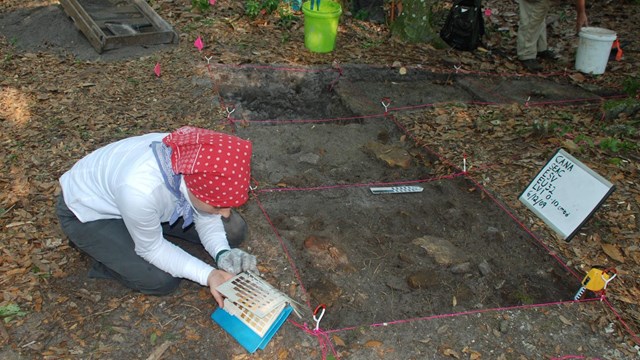
CONSTITUENTS OF SOIL

Soil material has four basic constituents: mineral or inorganic matter, organic substances, water, and air.

MINERAL MATTER

Mineral or inorganic matter can be crystalline or amorphous. A crystal is a chemical compound with a definite chemical formula and a distinct molecular structure. For example, the mineral gibbsite has the chemical formula Al(OH)3. The small Al3+ ion is in the center, surrounded by three hydroxyls (OH) that are equidistant apart. Hydrogen ions can be removed, opening bonds. This allows the crystal to grow laterally and vertically forming sheets that stack up like a deck of cards.

Amorphous minerals lack a repeating long-range structure, but often atoms appear in a definite ratio. A charge may be associated with the surface of mineral matter. Predominantly negative, the charge can also be positive. The type and amount of charge give minerals certain characteristic properties, such as shrink/swell potential and nutrient retention. 

ORGANIC SUBSTANCES

Organic substances are molecules with carbon-to-carbon bonds. In soils, these molecules are formed by biochemical activity. Animals, insects, and soil microorganisms act together to decompose dead plant leaves, root tissue, and animal remains in the soil. Organic matter in soils ranges from leaf litter, where decomposition is minimal and plant species are still recognizable, to a highly decomposed substance called humus, which gives soils a dark brown color.

Organic matter tends to accumulate near the surface where high biological activity, such as leaf litter, roots, and insect life, occurs. As a result, soils near the surface are normally darker in color than the soil horizons a few centimeters below. Organic matter provides a reserve source of plant nutrients and buffers soil against pH changes. It forms a very weak cement that, when acting alone, binds soil particles together in a crumb-like structure.

Living organisms residing within the matrix are considered part of the soil. Different fungi, bacteria, protozoa, algae, and actinomycetes play a vital role in converting parent material into soil. Plant roots, rodents, worms, insects, and other burrowing creatures help redistribute matter within a soil profile. 

WATER

Soil pores provide an important reservoir for water and atmospheric gases. Soil water is the medium through which nutrients are transferred to plants. Since water has a great capacity to adsorb heat, it can insulate soil from rapid temperature changes. A moist soil is slower to heat in the spring and slower to freeze as the temperature drops. 

Hydrogen ions from both organic and inorganic matter dissociate in water, resulting in the soil's pH. A soil's pH affects the solubility of minerals. Soil water may be lost in several ways:

  • as transpiration from plant leaves;
  • through evaporation from the soil surface;
  • by draining through soil pores to groundwater reservoirs;
  • through lateral flow; and
  • by being held in relatively small pores.
The maximum amount of water a soil holds against gravity is its field capacity. A soil's field capacity is a function of the volume of pores small enough to hold water against gravity. The process is similar to that of a sponge holding water.

AIR

Pore space not filled with water contains gases in concentrations comparable to those in the atmosphere. The soil air is the source of oxygen for root and microbial respiration. A high respiration rate, coupled with the twisting path that a gas must follow in order to diffuse out of soil pores, results in a carbon dioxide concentration about one hundred times greater than that in the atmosphere. Individual gasses move into and out of soil pores primarily by diffusion. After a heavy rain, soil pores fill with water displacing the air.

Oxygen diffuses very slowly through water. Therefore, once a soil becomes saturated with water, respiration quickly removes oxygen from the pores. If the soil layer remains wet for significant periods during the year, the low oxygen content will result in a change in the oxidation/reduction state. Soils so affected become increasingly reduced. Iron oxide minerals in this environment of reduction will change color from red/yellow to a light gray. This change in color can be indicative of a seasonal high-water table.


SOIL FORMATION


The five soil forming factors are: parent material, topography, climate, biological activity, and time.

Soil formation begins with a parent material derived from weathering of either the native rock or material transported to the site. The concerted effect of climate and biological activity then transforms parent material by producing the physical and chemical energy to alter minerals and vertically redistribute material through the soil profile. The effect of climate and biological activity is modified by topography. For example, slope affects the amount of water flowing down through the profile as opposed to running off the surface. Finally, soil forming processes work slowly over time. The intensity and direction of these processes can also change over time. During any given period, one process may dominate; but, with time, another process can become dominant.

PARENT MATERIAL

Parent material is the initial mineral substance that forms a soil. It may reside at the site of its origin or be transported from somewhere else to its current location. A soil formed from parent material found at the site of its origin is called a residual or sedentary soil. Bedrock weathering in place produces a stony, massive material called saprolite. As physical and some chemical weathering occur, the saprolite becomes more dense than the underlying bedrock. The texture and original rock structure remain, but the material is soft enough to dig with a hand shovel. As chemical weathering converts primary minerals to secondary minerals, particles are redistributed vertically. As material is both added and removed, a soil develops. A residual soil will retain many of its characteristics from underlying bedrock. Soil texture, mineralogy, pH, and other characteristics may be a direct result of the saprolite below.

Material can be eroded from one place and transported to another where it becomes parent material for a soil at the new site. Often weathering occurs before the material is transported to the new site. In this case, the soil may have few features in common with the underlying rock. Transported material can bury an existing soil at the new site. Once a depositional episode is completed, time zero for the new soil's formation begins. Several forces can supply energy for the transportation of parent material: ice, wind, water, and gravity.

Ice

Glacial deposits occur at the front and sides of advancing ice. Normally this material is poorly sorted with respect to particle size. Because ice melts from the bottom, this is also true of material deposited under a glacier. Also, material can be deposited as outwash in the glacier's meltwater.

Soils formed from glacial deposits vary in composition depending on the rock type over which the glacier traveled. Since glaciers advance and retreat with time, the composition and depositional environment of the parent material can be quite complex. Overall, the texture of soil produced in glacial deposits reflects the mode and distance of transport and the type of rock scoured. Shale and limestone scouring tends to produce a soil with relatively more clay and silt-sized material. Igneous and metamorphic rocks produce mostly sandy soils. Deposits beneath the ice usually result in finer textured, denser materials, whereas outwash and front and side deposits are generally coarser.

Wind

Wind deposits two major types of material: eolian sands and loess. Clay-sized material (< 0.002 mm) tends to bind together in aggregates too large to erode by wind.

Eolian sands are windblown deposits of material predominantly greater than 0.05 mm (0.05 to 2 mm) in diameter. Most of this material moves in a series of short-distance jumps called saltation. Eolian deposits may move several kilometers from the source. Material adhering to saltating sand particles and material deposited as an aerosol are the sources of clay in eolian sand. Normally this material has a narrow textural range and is deposited on the leeward side of valleys or bodies of water.

Loess, which is windblown silt-sized material (0.002 to 0.05 mm), once airborne, can travel several hundred kilometers before deposition. The texture of loess usually does not vary in a vertical direction, but tends to thin with horizontal distance from the source.

Windblown material tends to have sharp edges, a conchoidal shape, and surface etching. In contrast, material deposited by water tends to have rounded edges and a polished surface. Careful observation under a hand lens can shed light on the environment present at deposition.

Water

An alluvial or stream-borne deposit occurs in floodplains, fans, and deltas. Because fast-moving water picks up debris, a river meandering downstream will undercut the outer bank of each bend. Water moves slower around the inner bank than the outer bank and therefore loses energy. Thus, coarse material settles out, forming a bar over the inner bank. As water levels rise during floods, the stream overflows its channel and spills over onto the floodplain.

Typically, alluvial deposits are characteristic of the decrease in energy during deposition. Where the stream overflows its bank, the energy is still relatively high; only deposits of coarse material occur, forming a levee. On the far side of a levee, moderate energy is available, and silty material settles.

On the floodplain, water velocity and its corresponding energy is low, and clay settles. Because bars form under moderate energy, this type of sorting does not occur on the plain. However, a floodplain may surround a bar. As the distance from the channel increases, the material's texture becomes finer, and the thickness of the deposit decreases.

Alluvial fans form where water in a channel, carrying sediments downhill, experiences an abrupt reduction in slope. The stream energy is reduced quickly, and material settles. This also occurs where a narrow valley opens onto a wide flat. Fans have a cone shape, widening in the downslope direction. Channels shift easily in fan deposits, and sediments are reworked over time. The texture of a fan becomes finer with distance from its apex. Normally fans in humid areas are not as steep and cover a much larger area than those in arid regions.

Marine and lacustrine deposits form in low-energy environments under inland seas and lakes. These sediments are typically coarse near the shore and finer toward the middle of the lake or sea.

Several shoreline features can be associated with inland water bodies, including deltas, sand dunes, and beaches. Deltas are essentially alluvial fans with their sediments deposited underwater. As lakes dry, evaporite minerals form. Under other conditions, eolian sediments can fill in the lakebed. Such soils have a finer texture and occupy lower sections on the landscape. Soils formed in shoreline deposits have a coarser texture and occupy higher landscape positions. In lakebeds with a very low influx of sediments, organic substances dominate the sediments, and peats form.

Gravity

Colluvium or hillslope sediments result from the force of gravity and runoff moving downslope. This material may be deposited in catastrophic events, such as mudslides, or by very slow but persistent processes, such as slope wash or surface creep. As viewed from the crest of a hilltop, sediments thicken, and the clay content increases on the downslope.

TOPOGRAPHY (RELIEF)

Topographic relief, or the slope and aspect of the land, has a strong influence on the distribution of soils on a landscape. Position on a slope influences the soil depth through differences in accumulation of erosional debris. Slope affects the amount of precipitation that infiltrates into soil versus that which runs off the surface. Aspect, or the direction a slope is facing, affects soil temperature. In northern hemisphere sites, south-facing slopes are warmer than those facing north. Differences in moisture and temperature regimes create microclimates that result in vegetational differences with aspect. Differences in weathering, erosion, leaching, and secondary mineral formation also can be associated with relief.

CLIMATE

Climate arguably has the greatest effect on soil formation. It not only directly affects material translocation (leaching or erosion, for example) and transformation (weathering), but also indirectly influences the type and amount of vegetation supported by a soil. Precipitation is the main force in moving clay and organic matter from the surface to a depth within the profile. When a soil is at field capacity, the addition of more water will result in drainage either downward or laterally. Drainage water carries with it dissolved and suspended clay particles that collect at a new location within the soil profile. As a result, soils often show an increase in clay with depth as wind erosion selectively removes clay (and organic matter) from surface horizons.

Temperature and moisture affect physical and chemical weathering. Diurnal and seasonal changes in temperature cause particles to expand and contract unevenly, breaking them apart. Heat and moisture are active agents of chemical weathering, the conversion of one mineral into another.

Climate affects the type and amount of vegetation in a region. A warm, humid climate produces the most vegetative growth; however, microbial decomposition is also rapid. The net effect is that tropical and subtropical soils are generally low in organic content. In contrast, organic matter tends to be highest in a cool damp environment where decomposition is slow.

Temperature and the amount of water moving through a profile affects all of the following:

  • the amount and characteristics of organic matter;
  • the depth at which clay accumulates;
  • the type of minerals present;
  • soil pH (humid climates tend to produce more acidic soil than do arid climates); 
  • soil color;
  • iron, aluminum, and phosphorus distributions within a soil profile; and
  • the depth to calcium carbonate and/or salt accumulation.


BIOLOGICAL ACTIVITY

Biological activity and climate are active forces in soil formation. Soil pedogenesis involves a variety of animals, plants, and microorganisms. Ants, earthworms, and burrowing animals, for example, mix more soil than do humans through plowing and construction. Plant roots remove mineral nutrients from subsoil and redeposit them at the surface in leaf litter. Growing roots open channels through soil where rainwater can wash clay and organic matter down along these channels. Soil microbes decompose plant and animal debris, releasing organic acids. This biochemical activity is the catalyst for a great deal of the oxidation/reduction and other chemical reactions in soil.

The distribution of organic matter in a forest soil is different from that in a grassland. The surface soils of forests tend to have concentrated organic matter, which quickly decreases with depth. Grassland soils tend to accumulate organic matter to a greater depth than do forest soils. It is important for archeologists to note that the dark staining from the humic fraction of organic matter can persist in a buried soil. Thus, ancient buried surface soils may be recognized in the field by color alone.

The distribution of iron and aluminum throughout a profile also differs between forest and grassland soils. In forests, due to the greater rainfall, clays and organics drain downward, leaving behind resistant minerals. As a result, iron and aluminum in B horizons in forest soils are found in higher concentrations than in grassland soils.

TIME

Soils develop over time. Soil formation is a dynamic process, where a steady state is slowly approached but only rarely reached. The rate at which a soil forms is related more to the intensity of other soil forming factors than to chronological age.

Soil development begins with a parent material that has a surface layer altered by vegetation and weathering. For example, a young Coastal Plain soil has relatively uniform material throughout, and is altered only by a dark-stained surface layer that has been formed by vegetation. A more mature soil, on the other hand, shows evidence of the removal and transport of surface-layer clay to a subsurface layer called the B horizon. In an even older soil, chemical weathering and leaching have removed silicon, causing a change in the suite of clay minerals. A senile soil is excessively weathered and dominated by very resistant iron and aluminum oxide minerals. The rate that a young Coastal Plain soil becomes a senile soil depends not on its chronological age but on how rapidly minerals are transported and transformed within the profile.

Human activity frequently alters the process of pedogenesis. Once human activity ends, soil formation can continue as before-if no radical change in the soil-forming factors occurred in the interim. Because fine material leaches selectively faster than coarse material, differences between human-altered and undisturbed soils in the ratio of fine to coarse clay may be apparent in a relatively short span of time (one hundred years in a humid environment).


WEATHERING


Weathering is the physical and chemical processes by which rocks and minerals are disintegrated, decomposed, and resynthesized into new compounds. (Here rocks refer to unconsolidated material and soil at the surface [regolith], while minerals are inorganic substances with a definite chemical structure and formula.)

Weathering encompasses both physical and biogeochemical processes, which generally occur simultaneously. At different times, however, one process may dominate. In a soil forming from saprolite, for example, physical weathering dominates initially. As more surface area is exposed with smaller particles, and as biological activity increases, chemical weathering takes over.

PHYSICAL WEATHERING

Physical weathering is the mechanical disintegration of rocks and minerals into smaller sizes. Some of the several mechanisms that work to break apart rocks include: temperature, water, ice, glaciers, erosion, wind, and plants and animals.

Temperature

Seasonal and even day-to-night temperature changes can cause rocks to heat and cool unevenly. As rocks heat up, they expand; as they cool down, they contract. The outer surface expands and contracts faster than the interior, causing the outer surface to separate and peel off.

Water

The force of raindrops beating down on soft rocks, and the scouring effect of suspended material in water flowing over rocks can wear the rocks away with time.

Ice

Water can infiltrate the cracks and pores of rocks and freeze. As the ice expands and thaws, the rocks break up. 

Glaciers

Glaciers weather rocks in several ways. The weight of a glacier can crush rocks. As it moves over an area, a glacier can grind and pulverize rocks. As it recedes, the pressure release can cause rocks to expand and crack.

Erosion

Erosion causes pressure-release related weathering.

Wind

Wind suspends fine particles. As the particles are pushed and bounced over one another, they abrade the rock surfaces over which they pass, slowly wearing the rocks down. Over time, the material removed results in pressure-release weathering similar to that of retreating glaciers.

Plants and Animals

The expansion and decomposition of roots growing in soil can alter the density and coherence of particles. The digging and burrowing of animals can have the same effect.

CHEMICAL WEATHERING

The process of chemical weathering changes the atomic makeup of a mineral. Near the surface, water and biological activity play important roles in chemical weathering. Given time and enough water moving through a profile, even seemingly insoluble minerals will slowly dissolve. These minerals loose a portion of their atomic makeup and reprecipitate as new minerals in a leachate.

Water hydrates minerals, weakening them as it expands the size of their crystals. Hydrolysis removes atoms (ions) from certain minerals and, in the process, splits water molecules affecting the soil pH. Carbon dioxide mixed with water causes a form of acid hydrolysis called carbonation.

Another mechanism of chemical weathering is oxidation/reduction, or the transfer of electrons from one substance to another. Oxidation/reduction affects both the solubility and stability of minerals. Some mechanisms of chemical weathering include:

Solution.....CaCl2 + H2O -> Ca2+ + 2Cl- + H2O

Hydration.....2Fe2O3 + 3H2O -> 2Fe2O3·H2O

Hydrolysis.....KAlSi3O8 + H2O -> HAlSi3O8 + KOH

Carbonation.....CaCO3 + H2O <=> HCO3- + Ca2+ + H+

                                   oxidation  <=> reduction
Oxidation/reduction.....4FeO + O2 <=> 2Fe2O3


Back to Last Section / Next Section

Contents