|
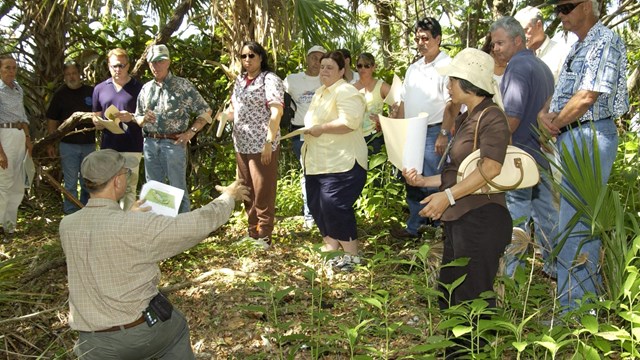
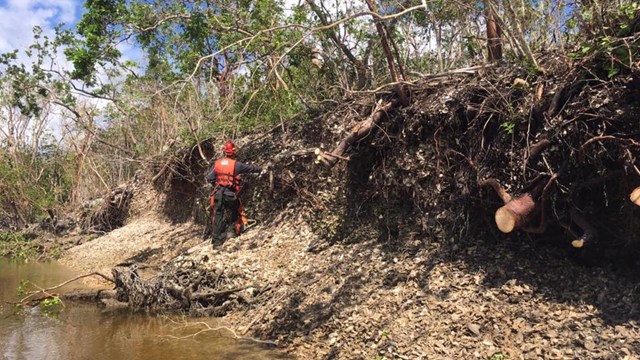
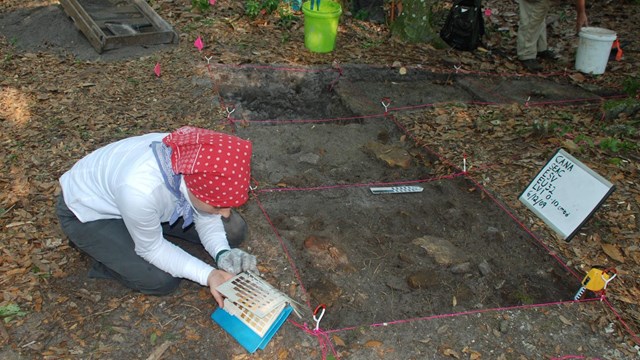
In December 1999, the Southeast Archeological Center (SEAC) of the National Park Service and the Agricultural Department of Florida Agricultural and Mechanical University (FAMU) in Tallahassee entered into an agreement to develop a workshop to train archeologists in soil classification. The goal was to acquaint the archeologists with soils typically found at archeological sites in the region. FAMU agronomist, Dr. Stewart Reed, conducted the two-day class. Two sites were visited: the Spanish Mission San Luis located on the red clay hills of Tallahassee, and a small, multicomponent prehistoric shell midden (8Wa29) on the sandy Gulf of Mexico shoreline south of Tallahassee. Open archeological units were examined at both sites. Methods for determining horizonization, particle size, compaction, moisture content, clay content, texture, and color were described and practiced by the participants. The class will be offered annually to students and archeologists. This
manual was written for the participants and will be updated periodically.
It is the first of two volumes, the second of which is forthcoming and
will feature case studies from class projects. For more information, please
contact Mike Russo at SEAC: 850-580-3011, ext. 238, or mike_russo@nps.gov.
Soil, in terms of its morphological characteristics, is defined as unconsolidated surface material forming "natural bodies" made up of mineral and organic materials and the living matter within them. Soil is a dynamic entity with material continually and simultaneously added, removed, and transformed. Its formation begins with a parent material derived from either the underlying rock or material transported from somewhere else to its present site. It is mainly the combined effects of climate and living matter that convert a material to a soil. For example, in temperate rainy environments, moisture and dense vegetation may lead to deep, richly organic soils. In deserts, with the lack of moisture and subsequent vegetation, soils may be thin and remain highly mineral. Human disturbances, such as dwellings, agricultural practices, grave sites, and garbage dumps, may also affect soils, giving them other unique characteristics. This manual reviews the basic genesis, morphology, and physical, chemical,
and mineralogical properties of soil. With careful observation of these
properties, archeologists can often identify previous human impacts on
sites and gain additional data to help determine the activities that led
to the present soil characteristics.
|