Archaeological Site File Management volume
Archaeological Site File Management: A Southeastern Perspective. In Readings in Archeological Resource Protection Series, No. 3. David G. Anderson and Virginia Horak, Editors, 1995. 140 pps.
The articles in this volume derive from a workshop of southeastern site file managers that took place March 22-23, 1995, at the GIS laboratory in the Department of Anthropology at the University of Georgia, Athens. The workshop was jointly sponsored by the National Park Service's Technical Assistance and Partnerships Division, Southeast Archeological Center, the Lamar Institute, and the Department of Anthropology at the University of Georgia.
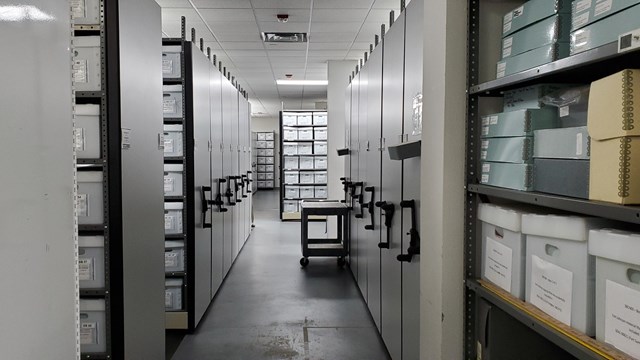
As of early 1995, over 180,000 historic and prehistoric archaeological sites had been recorded in the Southeast, a figure that is growing at a rate of almost 10,000 sites a year. Site files are a critical aspect of our nation's cultural heritage, the primary and, in many cases, only records documenting the location, content, and condition of cultural resources in an area. The ability to access and use this information efficiently is critical to the effective management of cultural resources in the region. Furthermore, when subject to technical analysis, these site file records are capable of providing important insights about where past human populations lived and where significant, yet currently unrecorded, cultural resources may be found.
The workshop was held in a GIS lab permitted several on-line demonstrations of the Georgia Site Files/GIS mapping system; examples of multimedia records management by the University of Alabama; the National Archeological Database (NADB); and various World Wide Web (WWW) home-page sites, such as the one posted by the Center for Advanced Spatial Technologies (CAST), University of Arkansas, where NADB and many other cultural resources data reside. The entire meeting was video filmed, and the tapes are curated at SEAC.
The March 1995 workshop and this subsequent publication are intended to foster communication between southeastern site file managers and their data providers. The ultimate goal is to help improve the regional database.
Introduction
David G. Anderson and Virginia Horak
The Site File as a Research Database: The Alabama Experience
Eugene M. Futato
Computerized Site Files in Arkansas: Utilizing New Technologies
Lela Donat
Site File in the Sunshine: The Florida Master Site File
Marion F. Smith, Jr.
The Georgia Archaeological Site Files and GIS: A Useful Beginning
Mark Williams
Archaeological Site File Users of All Kinds: A Viewpoint from Kentucky
R. Berle Clay
A Brief History of the Archaeological Site Survey in Louisiana
Philip G. Rivet
The Utility and Potential of the Mississippi Archaeological Site File
Keith A. Baca and Joseph A. Giliberti
The Management of Archaeological Site Files in North Carolina
Almeta Rowland and Dolores A. Hall
Site File Management in Puerto Rico
Miguel A. Bonini
Information Management within SCIAA: A South Carolina Perspective
Keith Derting and Jonathan Leader
Improving Site Recording Accuracy in a GIS: A South Carolina Example
James D. Scurry and Ruth E. Carlson
Site File Management in the Electronic Age: Future Directions in Tennessee
Suzanne D. Hoyal and Kevin E. Smith
Excerpts from Workshop Discussions
Site File Information Management: Myths, Illusions, and Realities
Lee Tippett
Managing and Exchanging Information about Archeological Sites
in the Electronic Age
S. Terry Childs
Site Records in the Southeast: An Overview of Preservation Efforts and Challenges
Michael Trinkley
Site File Management in the Southeast
David G. Anderson
A text version of this volume is available at URL http://anthro.org/sfm01.htm.