| Today's
Accomplishments: |
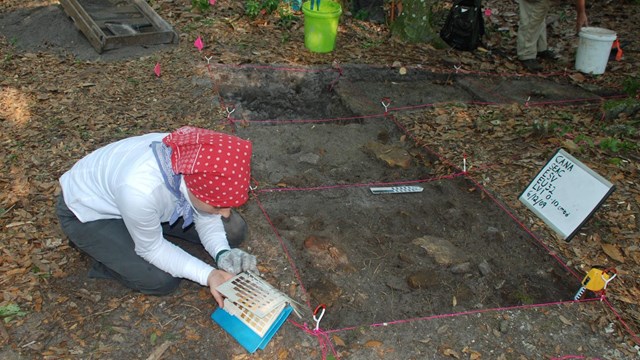
Cleaned and photographed the summit area,
profiled the south trench area, and closed down and covered the north side
for the season. Josh Wells, Addison Carter, and Emily Yates, project
stalwarts from the start, left today, as did volunteer Steve Robbins, who
was with us for a week. |
 |
The top of mound A at the close of the 2002
excavations. The entire area atop the mound that will be lost to erosion was
opened to depths of between 70 and 160 cm below the ground surface this
season. View to the south, from the north end of the summit. |
 |
The top of mound A at the close of the 2002
excavations. The entire area atop the mound that will be lost to erosion was
opened to depths of between 70 and 160 cm below the ground surface this
season. View to the southeast, from the north end of the summit. The
Tennessee River is in the background. |
 |
SEAC archaeologists Steven Kidd, Jessica McNeil,
Jill Halchin, and Heather Mustonen drawing wall profiles in the south
excavation trench. Walls are carefully cleaned with trowels, then
photographed, and then drawn to scale. |
 |
N39E79 west wall profile, showing a number of
filling episodes. At the base and near the top of the profile reddish orange
bands are present that appear to have been caps for mound stages or unusual
filling episodes. Every wall was photographed and drawn as part of the
scientific documentation; some 3100 high resolution digital pictures have
been taken this season alone, as well as about 2000 color slides. |
 |
Shiloh National Military Park Superintendent
Woody Harrell making one of his daily visits to the site to examine the
work, examining profiling in the south trench by Steven Kidd and Jessica
McNeil. Superintendent Harrell and Chief Ranger Stacy Allen visited the site
almost every day we were in the field. |
 |
N37 E180 north profile, showing the red silt
clay underlying mound stage three on the south side of the mound. This fill,
which also contained beige/white pebbles, was overlain by a mottled clay,
which would have capped it and prevented it from washing away. |
 |
Project Co-PI David G. Anderson in a fairly
typical position, taking pictures. Most of the shots of the fieldwork this
(and past) seasons were taken by him, which is why he is in comparatively
few pictures. |
|
|
|
|
|
|
|
|
|
|
|
|
|
|
|
|
|
|
|
|
|
|
|
|
|
|
|
|
|
|
|
|
|
|
|
|
|
|
|
|
|
|
|
|
|
|
|
|
|
|
|
|
|
|
|
|
|
|
|
|
|
|
|
|