August 22, 2002

Today's Accomplishments:

Finished cleaning and photographing the south trench area, and excavations on the top of the mound. Close down work is continuing. Volunteers Susan Holiday and Nancy Olsen left today.

The south trench, showing the third (second interior) mound stage after cleaning, and prior to profile drawing. The south trench, showing the third (second interior) mound stage after cleaning, and prior to profile drawing. This stage extends upward to where it levels off, close to two meters below the present mound summit. View to north.
The south trench, showing the third (second interior) mound stage after cleaning, and prior to profile drawing. View to northwest. The south trench, showing the third (second interior) mound stage after cleaning, and prior to profile drawing. View to northwest. On the west (left) side of the interior mound stage, from the bottom of the slope are a white wash layer, a reddish brown covering, a gray clay cap extending up about a meter, above which was a yellowish-orange cap, after which the stage slope leveled off to a bright red fired clay floor.
The south trench, showing the third (second interior) mound stage after cleaning, and prior to profile drawing. View to south from the top of the mound. The south trench, showing the third (second interior) mound stage after cleaning, and prior to profile drawing. View to south from the top of the mound.
N53 E181 west wall profile, showing probable basket loading of the gray silt/clay fill used for a platform atop the mound summit, that appears associated with stage three on the south side. N53 E181 west wall profile, showing probable basket loading of the gray silt/clay fill used for a platform atop the mound summit, that appears associated with stage three (second interior stage) on the south side.
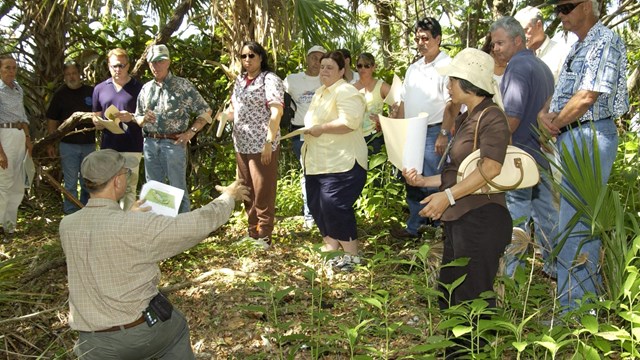
Members of the Hardin County Historical Society visited the site for about 45 minutes today, and are shown here on the west steps of Mound A. Members of the Hardin County Historical Society visited the site for about 45 minutes today, and are shown here on the west steps of Mound A.
Project co-director David G. Anderson talking about the work to date at the mounds to members of the Hardin County Historical Society. Project co-director David G. Anderson talking about the work to date at the mounds to members of the Hardin County Historical Society.
Breaking down the water screening area on the north side of Mound A. Breaking down the water screening area on the north side of Mound A. The last barrels were sent down the roller chute today, and consisted of fill from broken sandbags used to line the excavation block. This fill had been piled on the mound summit and had to be removed as part of the clean up.
SEAC archaeologists Charles Lawson and Robert Moses removing the tarps from atop the mound, as part of the close down effort. SEAC archaeologists Charles Lawson and Robert Moses removing the tarps from atop the mound, as part of the close down effort. These tarps provided shade for units atop the mound for much of the project.
The cover over the trench on the north side of Mound A. The cover over the trench on the north side of Mound A. Sandbags are placed around the excavation trench, which is then lined with thick black plastic, which in turn is covered by another layer of sandbags. The trench itself is covered with reinforced plywood, and will be covered with another layer of plastic, itself held down by a layer of sandbags. The multiple layers of sandbags and plastic are designed to keep the trench dry until excavations start again sometime next year. The procedure worked remarkably well in 2001..

Return to Calendar