July 31, 2002

Today's Accomplishments:

Continued work on Mound A on the top and south slope. David G. Anderson was 53 today, and received a number of Harry Potter (who shares the same birthday) type presents from the crew, including some chocolate frogs at lunch baked by Donna Rausch and Emily Yates.

  Post intruding through a hearth in N47 E181.

 Post intruding through a hearth in N47 E181. The fired outer margin of the hearth is identified by the thin red line of fired earth. The post has been removed, and was a later feature as it passed through the hearth basin.

Fired structure surface at the north end of the mound summit, view to east after initial cleaning effort.

Fired structure surface at the north end of the mound summit, view to east after initial cleaning effort. More detailed photographs will be taken in the days to come, as the floor is extended to the south.

Fired structure surface at the north end of the mound summit, view to north after initial cleaning effort. Fired structure surface at the north end of the mound summit, view to north after initial cleaning effort.

SEAC archaeologist Robert Moses cleaning the fired surface at the north end of the mound summit, in the area around the stump where extensive firing and one and possibly several hearths appear to be present.

SEAC archaeologist Robert Moses cleaning the fired surface at the north end of the mound summit, in the area around the stump where extensive firing and one and possibly several hearths appear to be present. At both ends of the mound summit, hearths were found close to the large tree stumps. (Hearths were also found near the center of the summit on floors as well.)

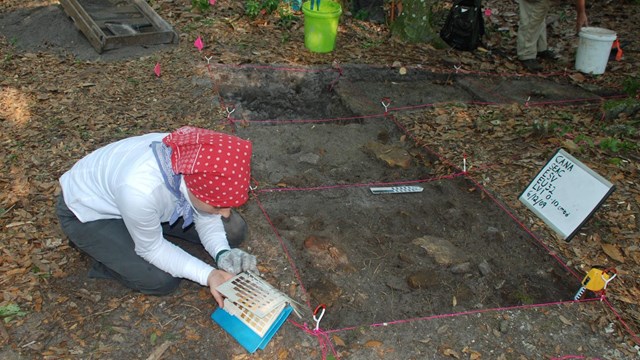
Archaeologist Sudha Shaw taking elevation measurements in the unit (N37 E180) she is excavating in the control trench on the south side of Mound A. Archaeologist Sudha Shaw, an anthropology graduate student from the University of Michigan, taking elevation measurements in the unit (N37 E180) she is excavating in the control trench on the south side of Mound A. The unit was characterized by a distinctive bright red silty mound fill with white/beige pebbles.
N37 E180, view to north, showing the floor upon cleaning, with the bright red silty strata. N37 E180, view to north, showing the floor upon cleaning, with the bright red silty strata. The layer was covered with a thick clay filled strata, which kept it from washing away quickly, which would have happened had it been exposed for very long. The fill of this layer had no artifacts whatsoever present in this unit, although beige/white pebbles were found throughout. We are trying to determine if they were added intentionally, or are present in this soil layer. Similar colored soils have been found lower in the bluff face by the project geoarchaeologist Sarah Sherwood, who is examining this question.
N33-34 E179, Features 81, 82, and 84, a possible wall trench and two posts at the base of the mound on the south side. N33-34 E179, Features 81, 82, and 84, a possible wall trench and two posts (which are faint, and are located just south of the photo board) at the base of the mound on the south side.
SEAC archaeologists Heather Mustonen, Jessica McNeil, Robert Moses, and volunteer Addison Carter cleaning the fired surface at the northern end of the mound summit. SEAC archaeologists Heather Mustonen, Jessica McNeil, Robert Moses, and volunteer Addison Carter from Antioch College cleaning the fired surface at the northern end of the mound summit.
Hearth (Feature 59) in N41 E180-181 upon sectioning and removal of half the fill. Hearth (Feature 59) in N41 E180-181 upon sectioning and removal of half the fill. The fired base of the hearth is about 2 cm thick and is clearly visible in the profile.
Volunteer Addison Carter cleaning the fired surface at the northern end of the mound summit. Volunteer Addison Carter from Antioch College cleaning the fired surface at the northern end of the mound summit.

Return to Calendar