Shiloh 2001 Trip Report
MEMORANDUMOctober 3, 2001 To: Director, SEAC From: Archeologists David G. Anderson and John E. Cornelison, Jr. Subject: Excavations at Mound A, Shiloh: The 2001 Season IntroductionFrom late June through early September 2001, a team of archaeologists from the Southeast Archeological Center, National Park Service (SEAC), conducted remote sensing, coring, precision mapping, dispersed test pitting, and the excavation of a 1 m wide step trench into two sides and across the top of Mound A at the Shiloh Indian Mounds National Historic Landmark. The work produced a number of findings that dramatically alter our understanding of how the mound was built and what it looked like when it was in use some 900 years ago. The 2001 fieldwork also demonstrated that there is appreciable important information remaining to be obtained from the portions of the site and mound that will be lost to erosion in the near future, and that archaeological research is the only way this information can be recovered. The project research design was approved by the Chickasaw Nation, who commented on various drafts, and subsequently entered into an Memorandum of Understanding (MOU) between themselves, SEAC, and the Shiloh National Military Park. The excavations proceeded in accordance with the provisions of this MOU and research design. No human remains were found during the project, and indeed, bone preservation of any kind was extremely poor. A physical anthropologist, Dr. Elizabeth Monahan Driscoll, was in the field for much of the project, and available to identify any bone encountered, but none of the little that was found proved to be human. Perhaps the most important finding from the 2001 fieldwork was that Mound A had a complex construction history, probably over many generations, and was dramatically different in appearance when it was in use than at present. During the Mississippian era, a series of large buildings were located at the base of the mound, that probably represent associated ceremonial structures, storage areas, temples, and possibly the residences of lesser elites. The mound itself had brightly colored sides with red and gray prepared clay surfaces, and an elaborate structure on top, built on or over a bright red colored platform. The mound would have been a dramatic feature when viewed from a distance. Structures atop it were likely elaborately decorated, based on descriptions of what these structures looked like from early historic accounts (e.g., Garcilaso de la Vega, in Clayton et al. 1993:298304). These buildings probably served as the primary temple, and residence of the principal chief, for the society centered on this site. The traditional picture of the way this mound, and indeed perhaps most Mississippian mounds are interpreted in parks, as green, grass covered earthen masses, with simple thatched buildings on top, and few if any structures near the base, is almost certainly wrong. The way these mounds are maintained and interpreted, it appears, are in need of appreciable revision. Prior to the 2001 fieldwork, limited archaeological testing conducted in the 1970s had concluded that Mound A was built in a single stage, and that no additional fieldwork was necessary to mitigate the eventual loss to erosion of appreciable portions of the mound that was known would eventually occur (Beditz 1980, Beditz and Bellomo 1980). This interpretation was questioned by SEAC archaeologists beginning in the early 1990s, when planning began for additional investigations at the site. This planning resulted in a contract issued by SEAC for a synthesis of previous work at the site (Welch 2001), and limited field investigations at Mound A in 1999 (Anderson and Cornelison 2000; Anderson et al. 1999a, 1999b). A workshop of professional archaeologists, NPS personnel, and a representative of the Chickasaw Nation convened at Shiloh 16-18 June, 2000 to discuss what had been done in the past, and what more should be done, in the vicinity of Mound A. The workshop participants recommended further investigations be undertaken to determine whether significant information was present in and near Mound A, in the area to be lost to erosion. The 2001 field program was designed and conducted to address these recommendations. A detailed project research design describing the goals of the project, research questions to be explored, and field procedures that would be employed, was prepared over the winter and spring of 2001, and finalized in June 2001 (Anderson and Cornelison 2001). The 2001 fieldwork demonstrated that Mound A was built in a series of successive stages, and that great ceremony may have accompanied the construction of each stage. The latter point is indicated by the discovery that brightly colored soils, some of colors such as red and white that are known to have been highly symbolic to many southeastern Indian groups (Hudson 1976: 126-127, 132), were used to cover portions of the sides and top of most mound stages. Red and gray soils were found on the sloping south side of the mound, near a ramp leading to the summit, and evidence for red caps was also found on the top and north side of the mound. The fill under these brightly colored caps was typically midden or soil scraped from nearby areas, but sometimes included masses of white, red, and gray colored materials, typically clay or sandy silt. Among many southeastern Indian groups, the color red was associated with "conflict, war, fear, disunity, and danger" while white was "the color of that which is old, established, pure, peaceable, holy, united, and so forth" (Hudson 1976: 235). These colors were also associated with kinship groupings such as clans and even whole towns, reflecting social divisions within the societies. What this color symbolism means at Shiloh is unknown, but it is quite clear that use of color, and red color in particular, played a major role in the construction of portions of Mound A. Large posts and wall trenches were found on the south side of the mound, indicating large buildings once stood in this area, and remote sensing, and the discovery of one such post, indicated comparable structures were present on the north side of the mound. A raised platform of gray clay with a red cap was found atop the mound that also appears to be the foundation for, or part of, an elaborate structure, or perhaps multiple structures. Only small portions of these colored mound surfaces and buildings were exposed and examined, however, indicating there is much remaining to be learned about the portion of the site on and near Mound A that will be lost to erosion. We do not know, for example, the size, shape, or function of the buildings atop and around the base of the mound, nor the extent to which the mound sides were colored, nor whether these colors form designs or patterns of some kind. In addition, because the trenches opened in 2001 were only able to go just over two meters in depth, and the mound itself is some seven meters high, there are undoubtedly many more mound stages and buildings as of yet undiscovered deeper in the mound. That is, smaller mounds are likely present in the interior, whose tops or sides did not extend far enough out to be intersected by the trenches opened in 2001. On the tops of each of these interior mounds, furthermore, there are likely to be buildings. Only the two highest and most recent stages were examined on top of the mound in any detail. An elaborate red and gray clay platform from a building or buildings was found on the second most recent stage, beginning about 60 cm below the surface. We still have almost six meters to go, and it is likely several such buildings will be found. The remains associated with each stage can tell us much about the changing history of the center. Archaeological research is the only way information about these successive occupations can be recovered. Remote Sensing ProceduresIn June and July 2001, a series of remote sensing procedures were used on and near Mound A at Shiloh, to develop a record of potential subsurface remains occurring in this part of the site, to guide the archaeological excavations (Clay 2001; Jones 2001; Nickels 2001). These investigations complemented an earlier program of ground penetrating radar work and associated test excavation conducted in 1999 (Anderson and Cornelison 2000, 2001; Anderson et al. 1999a, 1999b). During the 2001 remote sensing work a series of 20x20 m squares were examined, encompassing the top, north, west, and south sides of Mound A, and adjoining areas of the plaza between Mounds A and B. These survey areas were laid out using a total station by SEAC personnel, and tied in to the site grid system.
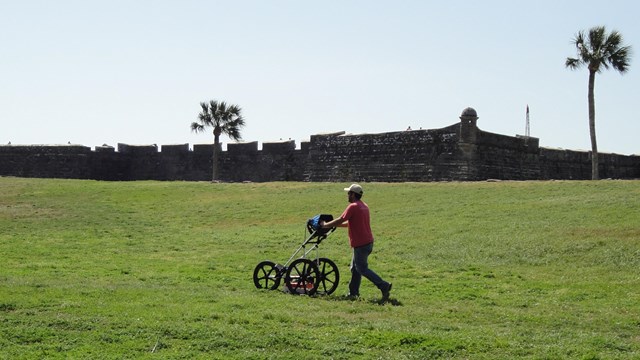
An FM36 fluxgate gradiometer and an EM38 earth conductivity meter (Figure 1) were used on and near Mound A on 28-29 June 2001 by Dr. Berle Clay (2001). A number of probable prehistoric features, probably the remains of hearths or burned areas, were found in the plaza, including the remains of a structure associated with Mound J. The resistance/conductivity survey located the outlines of two trenches that were almost certainly excavated by Frank Roberts in the 1930s. These trenches were found on the apron immediately west of Mound A. Survey of the Mound A summit was attempted with the fluxgate gradiometer, but the area was too disturbed by recent historic metal from historic construction and visitation to yield useful results. The floors of two possible burned structures were also found to the north of Mound A. The fluxgate gradiometer was also used to examine the top of Mound G, where Union soldiers were buried after the battle of Shiloh in 1862, and then removed to the National Cemetery in 1866. A large rectangular feature of probable metallic origin was found, but whether it was a Civil War era interment could not be determined. A ground penetrating radar survey was conducted on and near Mound A on 28-29 June 2001 by Mr. Bob Nickels (2001). The top of Mound A was found to be extremely disturbed, but a pronounced linear feature extending for several meters was found on the east side of the mound near the river. This may be associated with the gray clay platform found during the subsequent excavations, but this is uncertain. A number of other reflections were found that appear to reflect shallow historic disturbances. In the plaza south and west of Mound A, a number of circular features were found that appear to be of cultural origin, possibly pits or disturbances of some kind. Electrical resistance and magnetic field gradient surveys were conducted near Mound A by Mr. Geoffrey Jones (2001), on July 25-27, 2001. Nine 20x20 m grids south and west Mound A, and a 20x20 and a 20x15 m grid to the north of the mound were examined using resistance survey. The two grids to the north of Mound A were also examined using magnetic field gradient survey. The top of Mound A was largely covered by boardwalks and the screening platform by this time, and was no longer accessible for remote sensing work. Numerous features from possible house floors and wall lines were found in the plaza and apron areas to the south and west of Mound A. In addition, at least three possible linear rectangular anomalies were found that appear to be remains of excavation trenches opened by Frank Roberts in the 1930s. The investigations north of Mound A detected evidence for at least two, and possibly several structures, in rough agreement with the findings by Clay (2001). Precision Mapping Activity
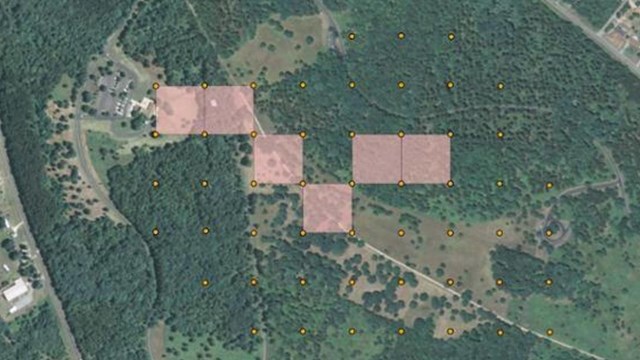
Starting in late June, and continuing over the course of the fieldwork, precision mapping of the Mound A area was conducted using a total station, under the overall direction of John Cornelison and Tammy Cooper (Figure 2). The site grid initially established by Paul Welch in 1997 was re-established, and temporary datums were placed at 20 m intervals over a large area of the plaza and around Mound A. A number of these datums were later replaced with permanent concrete benchmarks, and the locations of all these benchmarks, and at least one corner of every excavation unit, were determined to submeter accuracy using a GPS. The mapping effort ensures that future generations will be able to relocate the SEAC investigations undertaken at the site. Several thousand elevation points were obtained from the vicinity of Mound A in 2001, using a one meter grid, as part of an ongoing effort to produce a highly accurate site map, work that will continue over subsequent field seasons. Areas north, west and south of the mound were mapped. The fine grained mapping permitted the resolution of subtle microtopographic variation that points to the existence of a variety of cultural and natural features, such as house mounds, old back dirt piles, paths and roadways and, of course, general site features like gullies, mounds, and plaza areas. Coring Activity
On July 18th and 19th 2001, a series of sixteen 2-inch cores were taken by Dr. Glen Doran of Florida State University at various locations around the site with a Geoprobe vibracore. The core samples were sealed in clear plastic tubes with flexible airtight plastic caps, and the location and depth of each hole and the length of each core was measured; both measurements were essential since some compaction occurred. Dr. Sarah Sherwood, the project geoarchaeologist, will be examining and describing the soils in each core (Figure 3).
Several cores were taken near Mound A, to determine what the fill of the apron was like, with several others taken in outlying plaza and presumed borrow pit areas. One core each was taken from within and immediately adjacent to one of Frank Roberts known 1933/1934 excavation trenches in the apron west of Mound A. Three cores were taken north and two cores to the south of Mound A, within a few meters of the base of the mound. Five cores were also taken from the plaza area between Mounds A and B, to determine the depth of cultural deposits, and get a sense of how much cutting and filling may have occurred, to level the area. One core each was taken at the bottom of, and immediately adjacent to a dry presumed borrow pit near House Mound N. Another core was taken from a mounded feature in the center of a much larger borrow area nearby, and the loose nature of the fill suggested it was an old back dirt pile, probably from the 1933 excavations, that had been dumped into the borrow pit. One core from a pond south of Mound G contained gray clay throughout most of its two meter length, and was water saturated (Figure 4). The pond itself may be a Mississippian borrow pit, but it differs from several other possible borrow pits nearby in having standing water and masses of duckweed. This core may provide pollen and plant macrofossil data useful for paleoenvironmental reconstruction. Its potential for that is currently being assessed by Hazel and Paul Delcourt. A radiocarbon sample selected by the Delcourts from the base of the core is also currently being run, to determine the age of the sediments in the pond. Excavation ActivityExcavation began in the vicinity of Mound A on 10 July 2001, and continued until 4 September 2001. A total of 77 1x1 m units encompassing some 50 cubic meters of were opened in four areas, on the south, west, and north sides of the mound, and on top of the mound (Figure 5). All of the units on the north and south sides and atop the mound were opened in the direct impact area, within roughly 10 meters of the bluff edge, since these portions of the site will be lost to erosion in the near future. Some shallow units were opened to the west of the mound, in disturbed areas, to relocate excavation units opened in this area in the 1930s. No extensive work was undertaken in portions of the site that are currently undisturbed.
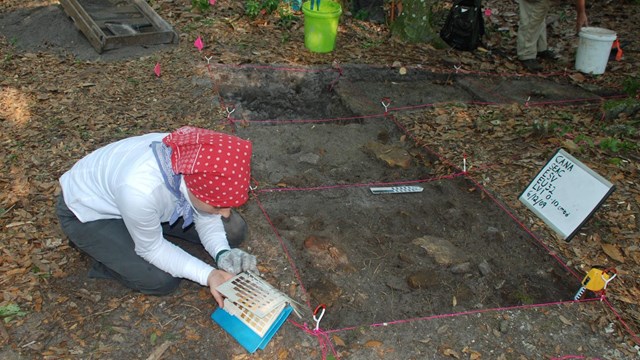
The park maintenance staff constructed solid wooden stairways approximately 1.5 m west of the north and south step trenches while the fieldwork was underway. A safety barrier was also constructed on the top of the mound, on the east side by the eroding edge. A boardwalk and large screening area were also built atop the mound. The boardwalk ran across the top of the mound about 5 m from the eroding edge, and was tied in to the stairways on the north and south sides. The stairs facilitated the safe and efficient movement of personnel and fill up and down the sides of the mound, while the boardwalk and screening area reduced damage to the top of the mound. The 2001 excavation units were opened in arbitrary 10cm levels, with one exception. The initial level in each unit opened in the trenches on the sloping north and south sides of the mound were taken to level at the lowest surface point. This first "level" was thus a triangular solid in shape, and encompassed a fairly appreciable volume, the extent of which has been calculated. These trenches, accordingly, had a step like appearance, which facilitated access as well as safety. These trenches came to be known as the north and south step trenches. No unit was taken below a depth of about two meters, for safety reasons. Depth control in each unit was maintained using a transit or level, with elevation readings taken from four fixed datums. These were established on the south, west, and north sides of the mound, and atop the mound, and tied in to one another. Three stakes made of 2x4s a foot long were driven into the ground, with small holes drilled in the top, to ensure the transit tripod legs were set up over the same point each day. Nails were driven into trees at between 90 and 180 degree angles from one another and used as a level check, to ensure readings were consistent. Wall profiles were maintained using washers attached to strings, and great care was taken to ensure consistent unit size and clean straight wall profiles. Based on the remote sensing results, as well as ideas about where subsurface features might be expected given the presence of topographic or cultural features (i.e., the mound ramp, suspicious rises or depressions), eighteen 1x1 m units were dispersed over the direct impact areas to the north and south of Mound A. These units were excavated using 1x1 m squares and 10 cm levels, and many were taken to culturally sterile deposits. Two of the units opened at the base of the mound on each side were later incorporated into the step trenches, which were extended out to them to examine the mound/apron or mound/nonmound contacts, on the south and north sides of the mound, respectively. The primary excavation work consisted of a near contiguous one meter wide trench opened up the south side of the mound, across the top, and down the north side. Trench placement was dictated by safety considerations, vegetation (i.e., the presence of large trees), recent cultural features (i.e., an existing stone stairway), and the need to work within the direct impact area, as close to the edge of the mound as possible, since this would be the first material to be lost to erosion. The north step trench (n=15 units) and the trench atop the mound (n=13 units) were located on the same north south grid line, while the south step trench (n=10 units) was offset one meter to the west to avoid stone stairs constructed in this area during the New Deal era. The trenches were placed within 3 to 5 meters of the eroding mound edge, in areas certain to be lost to erosion in the near future. The goal of the step trenching was to quickly determine mound stratigraphy, while obtaining well controlled samples of the mound fill. Profiling the exposed and eroding eastern face of the mound was not feasible, for safety reasons. This face was undercut, and characterized by a ca. 50 foot shear drop to large boulders placed below the mound as part of an attempt to stabilize the bluff edge. While rappelling over the edge and cleaning the face was considered, the possibility of a collapse was considered too great. A number of units (n=21) were opened in the apron area to the west of the mound, to relocate Roberts old excavation units, as well as better delimit the apron in this area. One of Roberts trenches, oriented north-south, had been found in this area in 1999. This trench was relocated, along with two others. During the 2001 fieldwork, fill from every unit excavated was dry screened through ¼ inch mesh, with special soil samples taken as necessary from features and strata. The screened fill was placed on tarps and covered with black plastic to prevent erosion. A special fine screen/flotation sample was taken from every level in every unit, save for those units opened to the west of the mound to delimit Roberts trenches. This sample was typically taken from the northeast corner of each unit, and comprised a minimum of 5 liters. Each sample was processed using a Flot-Tech Model A flotation machine in the field and in the lab after returning to SEAC. When features were encountered, they were mapped, drawn, and photographed, with all fill retained for flotation/fine screening. If suspected features were later found to be modern disturbances, the fill was ¼ inch screened, and kept as a separate provenience apart from the general level contents. Geoarchaeological research was a major part of the project, to document mound and apron construction history, appearance, and contents. Soil column samples intersecting a number of stage surfaces or other features were collected by Dr. Sarah Sherwood on 4 September 2001. The goals of the geoarchaeological research, currently underway, included determining how long individual mound stages may have been in use and hence exposed to erosion, what these mound stages and particularly the stage sides may have looked like when in use, sources for the colored soils and other materials used in their fill, and what preservation to expect throughout the mound and in adjoining site areas. Zooarchaeological (i.e., typically vertebrate fauna) and malacological (i.e., shell and snail) investigations were proposed, to determine what the site inhabitants ate, whether specialized feasting behavior took place on or near Mound A, and what the site environment was like when the mound was in use. Shellfish and particularly snail remains are an excellent indicator of fine grained environmental conditions, and it was initially hoped that they could be obtained from stage surfaces, feature fill, and from general midden areas. These investigations had to be abandoned due to the minimal preservation. Dr. Evan Peacock, the projects proposed specialist for shell remains, visited the site on 20 July 2001, and readily agreed the preservation conditions for shell and other faunal remains were very poor. Some snail and shell was found deep within the mound during the 1979 test pitting, however, suggesting better preservation of these remains may occur deeper within the mound. If so, this would be an important source of information. Extensive high resolution digital as well as conventional color slide and black and white photography was conducted during the fieldwork. Several thousand images were taken and processed. The digital still images, of which over 1600 were taken, were also used to prepare a project web site, with new shots posted each day the fieldwork was underway. Several hours of digital video film was also taken of various excavation activity. Every wall profile was drawn and photographed in the trenches opened into the sides and atop the mound, and at least one wall profile was drawn and photographed in the units opened into the apron. Excavations on the South Side of Mound AExcavations were initiated first on the south side of Mound A, because the mound slope in this area was comparatively gentle compared to the north side of the mound, and because the presence of a ramp on this side suggested it may have been an entrance area of some kind. A total of ten 1x1 m units were opened in a contiguous linear trench oriented north/south and located immediately west of the New Deal era stone stairway. The trench ran from the top of the mound to the base, a distance of between 6 and 7 meters, and out into the level apron area for another ca. 3 meters. An additional ten 1x1 m units were opened in the adjoining apron area.
A number of features were located in the apron area, both at the base of the mound and in some of the outlying units (Figure 6). These consisted of post pits, wall trench lines and, at the south end of the main trench, a raised clay surface that may be part of a house platform. These features were found at varying depths, typically beginning upwards of 60 cm below the surface (where red washing episodes off the mound are also present), and indicate that a series of large buildings were apparently built, and rebuilt, in this area. Patches of red sandy silt soil were also found in the apron area near the south end of the step trench that appear to be associated with these structures. Appreciably more area needs to be opened, however, to determine the size, shape, and function of these structures. Several units opened in the apron around a low rise thought to be a house mound instead quickly reached subsoil; the elevated area instead appears to be an eroded back dirt pile from Roberts excavations. Features in the apron area were discovered either immediately below the humus layer, or at appreciable depth, where they are apparently associated with earlier mound stages. The upper part of the apron, at least the upper 60cm or so, may have been laid down in one filling episode, given the general absence of features in this part of the fill. In the northern part of the step trench, based on the area opened to date, evidence for at least five, and possibly six successive mound construction episodes was found, as well as evidence to indicate that much of the fill in the apron area was added late in the site history, after several mound stages had been erected. Stage surfaces were thin at the base of the mound, where they had feathered out, and thickened appreciably higher up in the mound to the north. Remarkably, a series of four successive bright red sandy/silt/clay layers were found at the base of the mound, separated by a series of thin light and dark bands from probable washing episodes (Figure 7).
One of the bands had appreciable quantities of small white pebbles, an admixture that may have been chosen for its symbolic associations. As noted previously, the colors red and white have great symbolic importance to many southeastern Indian groups, and in this stage it appears a conscious attempt was made to blend these colors together. These caps appear to cover mound stages, indicating that when the mound was in use, the south face was likely red colored. Thin red bands were also observed extending out into the apron area, that appear to reflect wash off these caps. Due to the volume of fill excavated, it has been possible to link strata from the bottom to the top of the south step trench, at least for the upper two mound stages. One of these stages has a mottled gray clay cap about 2-3 cm thick over it in places, overlying a mottled fill with red, gray, orange and white clays and sandy silts. This fill which is easily identifiable, was followed all the way up the mound. As the top it begins at about 1.6 m below the surface, and at the bottom of the mound it feathers out over successive brown, red, and light brown soil layers/filling episodes, including the multiple red caps. Immediately above the subsoil at the base of the mound in the west wall of unit N35E180, the lowest red mound surface had a distinctive burned lens atop it that should provide a good date for the beginning of mound construction, or at least of this particular stage or construction episode. Two radiocarbon dates are currently being run on material from this burned lens. There may be older stages deeper into the mound, from mounds that are so small that there edges dont extend out this far. The excavations in the south step trench demonstrate conclusively that the mound was built in a number of separate episodes, and that great care apparently went into the selection and mixing of colored soils used in the fill. Excavations on the North Side of Mound AExcavations on the north side of Mound A were initiated last, because the mound slope in this area was extremely steep, presenting safety issues, and because the area to examine was appreciably greater than that on the south side. Work did not begin, in fact, until the stairway was completed on this side of the mound, to lessen the chances of people, equipment, or buckets of fill falling on those working beneath. A total of fifteen 1x1 m units were opened in a contiguous north-south trench that ran from the top of the mound to the base, a distance of between 12 to 13 meters, and out into the level apron area for another ca. 2 meters. An additional eight 1x1 m units were opened in the adjoining apron area; two of these units were later connected to the north end of the step trench. Comparatively few features were found in the apron, even though the remote sensing had suggested one or more houses were present in the area examined. Thin patches of orange silt/clay, possibly daub or fired clay fragments, were found in a few units that may be from these possible structures. No unequivocal posts were found in these apron units, however, unlike the situation on the south side of the mound, where such features were more common. One well defined pit feature containing rock and fired clay was found in the northern most unit of the step trench, however, in the level area at the base of the mound, that may be from a large post. Evidence for internal mound stage clay capping surfaces was found in many of the units in the north trench, particularly in units opened deeper into the mound. Evidence for at least two distinct mound stages was found, with the uppermost followed in several of the units. A mottled clay surface from a presumed mound stage cap exhibiting a burned upper surface was found near the base of the mound in N69&70E181. A sample from this surface was taken by Dr. Sarah Sherwood, the project geoarchaeologist, to examine, among other things, whether the firing might have been part of the process by which the surface was stabilized, or whether it was an accidental feature. Her work can also evaluate whether paleomagnetic dating, which requires samples of fired clay in place since the time of firing, might be an option in future investigations if more such fired clay surfaces can be found. Although the first internal stage exhibited a thin red clay cap in several of the units opened near the top of the mound in the north step trench, no evidence for multiple red caps was found at the base of the mound, at the northern end of the trench. This may be because comparatively few units reached subsoil in this trench, although the two northernmost units appear to have done so. It may also, however, be because these caps are from earlier mound stages that did not extend out this far, or possibly because only certain portions of the mound were covered with brightly colored (i.e., red) material. Excavations on the Top of Mound AA one meter wide trench was opened across the top of Mound A in the direct impact zone approximately one meter west of the safety barrier near the eroding mound edge. This trench, opened soon after the south step trench was started, was designed to determine the condition of the last/final stage of Mississippian period mound use, as well as to assess the extent of subsequent historic use and disturbance. The trench did not extend all the way across the mound, but instead stopped about three meters short of where the north and south step trenches began, because large hickory trees were located in these areas, and the walkway was located immediately to the west. Little evidence for the remains of the final Mississippian temple/chiefly residence were located at and immediately below the surface atop Mound A, and it appears any such features, and associated debris layers, have been largely eroded away, or were located farther to the west, in the center of the mound. A number of root and rodent borrows were encountered immediately below the surface in this trench that may have originally been pit and post-like features, but this cannot be determined. The soil atop the mound was rock hard, from generations of visitors trampling on it, so it is possible that areas of softer fill (i.e., prehistoric features) may have been sought out and followed by small animals and roots. A number of historic artifacts were also found in the upper soil layers, from park visitors, and possibly from activity associated with the cottage known to have been built atop the mound in the early years of the 20th century. A charred beam fragment was found just below the surface in one of the units that may be from this structure. It does not appear to be Mississippian in age, and hence is not being dated. A second, internal stage, in a much better state of preservation, was found at a depth of about 60 cm in several excavation units in the north central part of the trench. This surface was identified by a pronounced red sandy/silt soil layer was found over a raised platform of gray clay (Figure 8). The edge of the platform, with its pronounced red cap, has a sharp contact with the subsequent filing episodes. At the south end of the platform, the surface slopes downward. No base was located, even though the sloping south surface was followed some 40 cm downward. The clay cap and underlying gray clay fill was truncated in unit N55E181 at the northern end of the trench, suggesting an intrusion, or an end to the platform, possibly at a wall line. The presence of a large tree in the next unit precluded resolution of this question at this time. A burned clay and charcoal lens was found in the red cap atop this internal platform in N48E181, and radiocarbon dates from this location may provide an age for the next to final mound stage. Two such assays are currently being run using AMS dating. Excavations West of Mound AA total of 21 1x1 m units were opened into the apron west of Mound A to locate one or more of Frank Robert's New Deal era trenches. The 1999 test excavations by SEAC personnel had shown that Roberts trench fill was distinct from the surrounding apron, being much lighter and more mottled in appearance. The north-south trench immediately west of Mound A that had been originally found in 1999 was quickly relocated, as well as the outlines of several of the 1999 backfilled units themselves. The edges of a second, east-west trench were also located, that ran close to, but did not connect with, the north-south trench. A short portion of another probable north-south trench were also found at the west end of the east-west trench. Time did not permit the backhoe excavation, cleaning, and profiling of these trenches. Prior to backfilling, however, the trench margins were carefully mapped and outlined with numerous large nails driven flush with the edges, and then all the units were lined with black plastic and backfilled. Relocating and excavating these units, and then excavating Roberts trenches to re-examine the apron stratigraphy, should be a comparatively easy process. Stabilizing the Excavations Units
During the last several days of the project, backfilling and stabilizing of the existing excavation units occurred, since further work is planned at the site in 2002. The 1x1 meter units opened in the apron were lined with black plastic sheeting and then completely backfilled, each with an 18 inch piece of iron rebar in the southwest corner, and coins (typically pennies) dated 2001 placed on the bottom of the unit in one or more corners under the black plastic. The trenches atop and on the sides of Mound A were not backfilled, but were instead stabilized, permitting excavations to begin in them almost immediately once fieldwork resumes in 2002 (Figure 9). The floors and walls of these trenches were lined with two layers of thick black plastic, held in place around the margins of the trench by (minimally) a double layer of sandbags. The sandbags, most of white plastic (canvas bags were found to rot quickly, and smell), were filled using screened back dirt from the excavations. The trenches were then covered with plywood sheets that were braced all the way around on their underside using 2x4s nailed into the plywood. Each sheet of plywood so reinforced was itself nailed to the adjoining piece as they were placed across the trench. A third layer of black plastic was then placed over the entire frame, and covered with two more layers of sandbags. The trenches are thus covered with three layers of black plastic sheeting, a plywood cover reinforced by 2x4s, and protected with multiple layers of sandbags. The site area was then carefully cleaned, including removing all of the back dirt from the screening platform and other areas atop the mound. Over 1000 sandbags were filled, most using screened back dirt from atop the mound. This removed only a small fraction of the fill actually present. Remaining fill from atop the mound was carried in wheelbarrows to the massive back dirt piles on the south side of the mound, which were then partially consolidated by hand, and covered over with plastic. Additional cleaning and consolidation of the back dirt piles on the north and south sides of the mound may be done later this fall using a front end loader.
ConclusionsThe 2001 excavations in and near Mound A made a number of important discoveries, perhaps the most important of which was determining, at least in part, what Mound A looked like when it was used by the Mississippian inhabitants of Shiloh. It now appears unlikely that the original mound surfaces were in mowed Bermuda grass, but instead were bare and brightly red colored, at least over some portions of their surfaces, and for at least several of the stages that were documented. Additionally, evidence for numerous large structures at the base of the mound was found, as well as for a structure on or over an elaborate red capped platform atop the mound. The vicinity of Mound A at Shiloh was thus an elaborate ceremonial complex, not the grass and tree covered earthen mass it now appears. Only tiny fractions of this past glorythe colored mound surfaces, and large and presumably quite elaborate structures atop and beside the moundhave been documented, however. Appreciably more fieldwork will be needed to understand what was once present, and to document what will be soon lost. For the near future, a more detailed report on the 2001 findings will be prepared and made available. A paper will be prepared for the Southeastern Archaeological Conference meetings, describing the 2001 work. A revised research design and budget for excavations to be conducted in 2002 will then be prepared and submitted to NPS authorities for their review and consideration in late 2001 or early 2002. It will include specific field procedures to be used, areas to be examined, and research questions to be addressed. On the north side of the mound, for example, we need to dig deeper, and out further, to determine the extent and condition of the many more lower stages likely present in this area. All three trenches, in fact, need to go much deeper to document internal and possibly older mound surfaces. To do this, they will have to be stepped out, that is, opened wider to the east and west, to enable us to safely explore deeper parts of the mound, as well as expose the structures and surfaces found in the trench over a much larger area. If necessary, a workshop between interested parties will be held in February 2002, in conjunction with the Current Research in Tennessee Archaeology meetings, to evaluate the revised research design. This workshop would be much like the planning workshop held in June 2000 at Shiloh, and include many of the same participants, as well as those joining the project since then. If all goes well, fieldwork will begin in early May 2002. References CitedAnderson, David G., and John
E. Cornelison, Jr. Anderson, David G., John Cornelison,
George S. Smith, and Paul D. Welch Anderson, David G., John Cornelison,
David Bean, and Paul Welch Beditz, Lindsay Beditz, Lindsay, and Randy V.
Bellomo Clay, R. Berle Clayton, Lawrence A., Vernon James
Knight, Jr., and Edward C. Moore (editors) Hudson, Charles M. Jones, Geoffrey Nickels, Robert. Vega, Garcilaso De La (The Inca) Welch, Paul D. |