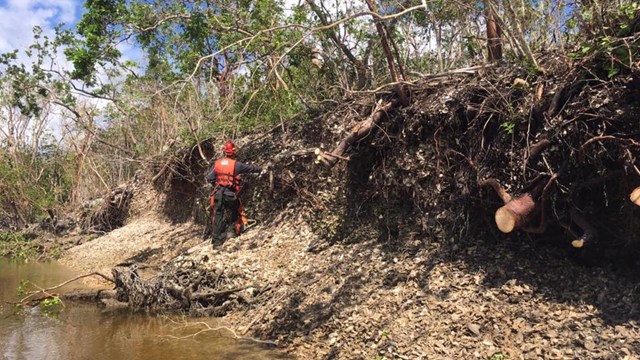
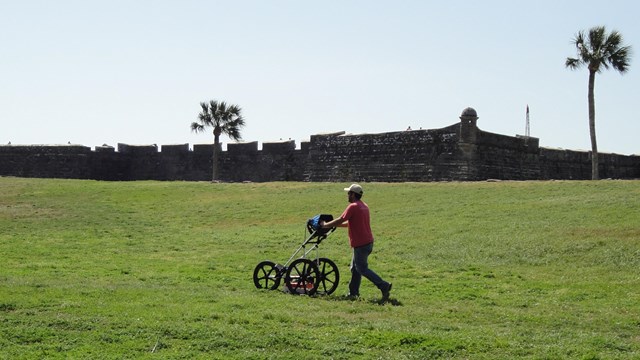
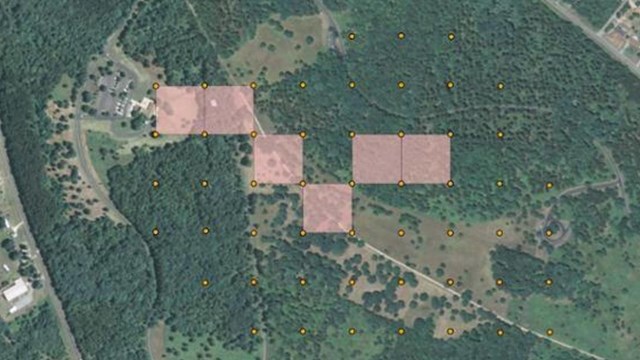
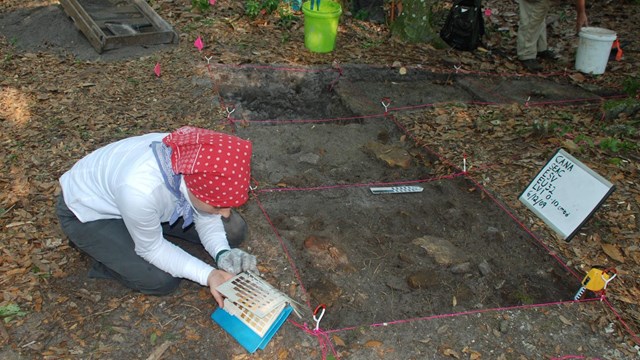
Shiloh 2001 Trip Report SummaryExcavations that occurred at Mound A in Shiloh National Military Park from July 9 to September 6, 2001, proved to be very productive. One of the most important discoveries was the determination of what this particular mound looked like during the height of its use. Archeologists from the Southeast Archeological Center used various methods of scientific investigation, including remote sensing, precision mapping, coring, and extensive excavation to show Mound A's structure and composition 900 years ago. It was shown that the mound's appearance was dramatically different from what can be seen today when visiting this National Park. The initial stages of archeological investigation at Mound A and surrounding areas involved the use of remote sensing equipment. This was done in order to provide the archeologists with a better idea of where to place their excavation units. The remote sensing investigations helped to show the locations of many subsurface features including the remains of possible hearths, earlier excavation trenches, the floors of two possible burned structures, and other possible prehistoric-related features. Remote sensing proved to be a very useful tool by saving the archeological crew both time and money through its rapid identification of the numerous subsurface feature locations. A program of precision mapping of Mound A was conducted following the remote sensing investigations. This was done in order to provide the archeologists with a clear picture of the current structure of the mound and surrounding area, and to provide them with an accurate means of showing the locations of their excavation units. Mapping was completed using a Global Positioning System, which was able to record the user's location with an accuracy of less than one meter. A total station was also used to lay out the grid for mapping and to help determine elevations at the site. In mid June, a vibracore machine was obtained from Florida State University. This device was used to take samples of soil layers, and provided the researchers with a better understanding of how far out the mound apron extended and what areas were used for taking fill for the mound's construction. Excavations occurred both around the mound and on the mound itself throughout the entire length of the project. A one-meter wide trench was dug through the center of Mound A in order to map the various episodes of filling. Excavations to the north, south, and west of the mound were undertaken with the intent of identifying other use areas throughout the site. The units to the north and south of the mound were excavated during this field season since the erosion of the mound into the river threatens these areas. Excavations to the west of the mound were conducted to identify areas that were previously dug during field projects in the 1930s. The work located numerous features throughout the site, and provided the investigators with a much clearer picture of the stages of mound construction. The multi-tiered approach to archeological investigation utilized at Shiloh National Military Park yielded a great deal of information on this site. In addition to helping the archeologists understand Mound A, it will also play an important role in research at other mound sites throughout the Southeast. Future fieldwork building on the findings of the 2001 season at Mound A should prove to be very productive. Read the Complete Trip Report:Web Version | PDF
Version (2.6 Mb)
|